dailynewsnblog
When  Boeing first unveiled the 777X, much of the attention focused on the aircraft’s folding wings, stretched fuselage, and enormous General Electric GE9X engines. Boeing marketed the aircraft as the next major evolution of the long-haul twinjet, promising 20% lower fuel burn per seat, a 40% smaller noise footprint, and lower operating costs than competing aircraft. However, hidden inside those headline claims is one particularly interesting detail that often gets overlooked.
Despite being larger than the aircraft it is effectively replacing, the Boeing 777X actually operates with less certified engine thrust than the Boeing 777-300ER. The older 777-300ER uses General Electric GE90-115B engines rated at 115,000 pounds of thrust, while the GE9X powering the 777X is expected to enter service at around 105,000 to 110,000 pounds.
At first glance, that sounds backward. A bigger aircraft would normally be expected to require more power. However, the explanation lies in how dramatically Boeing improved the aircraft’s overall aerodynamic efficiency and how modern engine technology has evolved beyond relying purely on brute force.
The 777X Is Significantly Larger Than The 777-300ER

Shutterstock | Simple Flying
The reduced thrust figure initially seems strange because the Boeing 777X is larger in nearly every dimension. The 777-9, the main passenger version of the program, is longer than the 777-300ER and can accommodate more passengers depending on airline configuration. Boeing lists the aircraft at up to 426 passengers in a two-class layout, compared to roughly 392 on the older 777-300ER. The wings are also much larger, as the 777X features a wingspan of 238 feet and ten inches when fully extended.
This makes it one of Boeing’s widest commercial aircraft ever built. To avoid airport gate compatibility problems, Boeing introduced folding wingtips for the first time on a commercial aircraft. While the aircraft is on the ground, the outer sections fold upward so the jet can continue using many of the same gates designed for previous 777 models. Normally, a larger aircraft carrying more passengers would require more engine thrust to maintain takeoff and climb performance, and aviation history generally followed that pattern for decades.
The original Boeing 777 itself demonstrated this when the General Electric GE90-115B became the most powerful commercial jet engine ever certified specifically to support the 777-300ER. That is why the 777X appears counterintuitive. It is larger and heavier, yet officially uses less operational thrust. The reason is not reduced capability, but improved efficiency that allows the aircraft to achieve similar or better performance without relying on sheer engine power alone.
How Much Does A Boeing 777X Engine Cost?
The largest and most powerful commercial engine ever built, the GE9X is by no means cheap
The GE9X Prioritizes Efficiency Over Raw Power

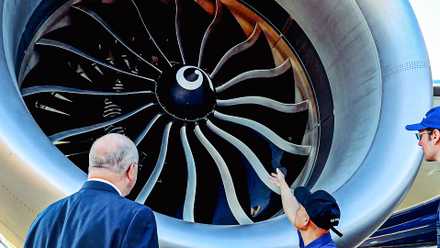
Although the General Electric GE9X operates at a lower thrust rating than the GE90-115B, it remains one of the most advanced commercial engines ever developed. During testing, the engine actually produced more than 134,000 pounds of thrust, exceeding the GE90’s record. However, Boeing and General Electric designed the engine around efficiency rather than maximum operational output. The General Electric GE9X uses a massive 134-inch fan and a bypass ratio of roughly 10:1.
This allows far more air to flow around the engine core instead of through it. Modern turbofan efficiency increasingly depends on moving larger amounts of slower-moving air rather than producing extremely fast exhaust gases. This design approach allows engines to generate enormous amounts of thrust while consuming less fuel and producing lower noise levels. This approach improves fuel efficiency substantially: General Electric states that the GE9X delivers approximately 10% lower specific fuel consumption than the GE90.
The large fan also reduces noise. Unlike the engines found on the Boeing 787 family, which use chevrons on the nacelle to reduce turbulence, the GE9X achieves lower noise levels naturally through slower exhaust velocities. Boeing claims the 777X produces a noise footprint 40% smaller than earlier aircraft in its category, while the engine reportedly operates eight decibels below international noise standards. The result is an engine designed around generating thrust more efficiently and more quietly.
The Wing Plays A Major Role In Reducing Thrust Requirements

While the General Electric GE9X receives most of the attention, the Boeing 777X’s wing may actually be the aircraft’s biggest technological advancement. Boeing designed an entirely new composite wing with a much higher aspect ratio than previous 777 models. Longer, slimmer wings generate less induced drag during cruise flight, improving the aircraft’s lift-to-drag ratio. In simple terms, the airplane wastes less energy fighting aerodynamic resistance, so the engines do not need to work as hard to maintain speed and altitude.
Composite construction also helps reduce weight while allowing the wing to flex more efficiently during flight. The US manufacturer applied many lessons learned from the Boeing 787 program when developing the 777X wing. The composite structure is both lighter and stronger than conventional aluminum designs, helping improve aerodynamic efficiency across multiple phases of flight.
Simple Flying Quiz
Easy (15s)Medium (10s)Hard (5s)
This aerodynamic efficiency explains why the aircraft can maintain strong performance despite lower operational thrust. The wing itself generates lift far more effectively than the older design, reducing the need for sheer engine output. The aircraft is essentially extracting more performance from every pound of thrust produced by the engines.

Why Might This Monster Jet Engine Have Airbus Worried?
The massive powerplant offers some impressive capabilities.
Boeing’s 20% Fuel Efficiency Claim Is Slightly Misleading

Shutterstock, Simple Flying
One of the most important details surrounding the 777X is that Boeing’s widely quoted 20% fuel efficiency improvement combines two separate figures into one headline number. The actual aircraft-level efficiency improvement from the engines and aerodynamics appears closer to roughly 12-13% compared to the 777-300ER. That alone is still extremely impressive for a mature aircraft category. However, Boeing reaches the larger 20% figure by calculating fuel burn per seat rather than fuel burn for the aircraft overall.
Because the Boeing 777-9 carries more passengers, the fuel cost is distributed across additional seats. Airlines care deeply about this metric because profitability depends heavily on reducing the cost per passenger. From a business perspective, carrying more passengers with only a modest increase in overall fuel burn is enormously valuable on long-haul routes.
This distinction matters because the aircraft itself is not burning 20% less fuel overall. Instead, Boeing combines genuine efficiency improvements with increased passenger capacity to achieve that figure. Understanding this split also helps explain why Boeing focused on aerodynamics and efficiency rather than increasing thrust. Airlines are far more interested in lowering operating costs than simply operating more powerful aircraft.
Lower Thrust Does Not Mean Lower Performance

Some observers initially interpreted the lower thrust rating as a weakness compared to the Boeing 777-300ER. In reality, the opposite may be true. The fact that Boeing designed a larger aircraft requiring less operational thrust demonstrates how much modern aerodynamic and propulsion technology has advanced. Aircraft capability is determined by far more than engine thrust alone. Wing efficiency, drag reduction, structural weight, and engine design all contribute to performance.
The Boeing 777X was optimized as a complete system rather than simply pairing a traditional airframe with larger engines. The General Electric GE9X itself illustrates this clearly. Although the engine enters service at a lower thrust rating, it is capable of producing substantially more power if required. The lower rating reflects Boeing’s operational needs rather than the engine’s maximum capability.
For airlines, lower required thrust can also reduce maintenance costs and engine wear over time. Since engine maintenance is one of the largest expenses in long-haul operations, improved efficiency can save airlines enormous amounts of money across an aircraft fleet. Lower fuel burn and lower noise levels also help airlines meet increasingly strict environmental and regulatory requirements around the world.

Here’s How Much More Range The Boeing 777X Has Compared To The 777-300ER
While the 777-300ER has more range than the larger 777-9, the similarly sized 777-8 can fly 1,375 NM further, while carrying a few more passengers.
Certification Delays Have Overshadowed The Aircraft’s Engineering

Unfortunately for Boeing, much of the public discussion surrounding the 777X has centered on certification delays rather than the aircraft’s engineering achievements. The program has faced years of setbacks, pushing its expected entry into service to 2027. Those delays gave competitors like the Airbus A350-1000 a significant advantage in the long-haul market.
Airlines that originally expected the 777X years earlier have already introduced competing aircraft into service while Boeing continued flight testing and certification work. Still, the Boeing 777X flight test program has accumulated extensive testing hours, and Boeing’s efficiency claims are moving closer to real-world validation. If the aircraft performs as expected in service, it may ultimately demonstrate that smarter aerodynamic design can reduce the need for ever-increasing thrust levels in large commercial aircraft.
|
Ranking |
Airline |
Boeing 777-8 |
Boeing 777-9 |
Boeing 777-8F |
Total |
|---|---|---|---|---|---|
|
1 |
Emirates |
35 |
235 |
– |
270 |
|
2 |
Qatar Airways |
– |
90 |
34 |
124 |
|
3 |
Cathay Pacific |
– |
35 |
– |
35 |
|
4 |
Singapore Airlines |
– |
31 |
– |
31 |
|
5 |
Lufthansa |
– |
20 |
7 |
27 |
|
6 |
British Airways |
– |
24 |
– |
24 |
|
7 |
China Airlines |
– |
19 |
4 |
23 |
|
8 |
All Nippon Airways |
– |
18 |
2 |
20 |
|
9 |
Korean Air |
– |
20 |
– |
20 |
|
10 |
Air India |
– |
10 |
– |
10 |
That is the real story behind the 777X’s lower thrust rating. Boeing did not simply reduce engine power. Instead, it designed an aircraft efficient enough that it no longer needed the same level of brute force as the jet it is replacing. The latest data from ch-aviation shows that  Emirates is set to be by far the largest operator of the Boeing 777X. The carrier, based at Dubai International Airport (DXB), has a staggering 270 of the aircraft on order, followed by
  Qatar Airways with 124.