dailynewsnblog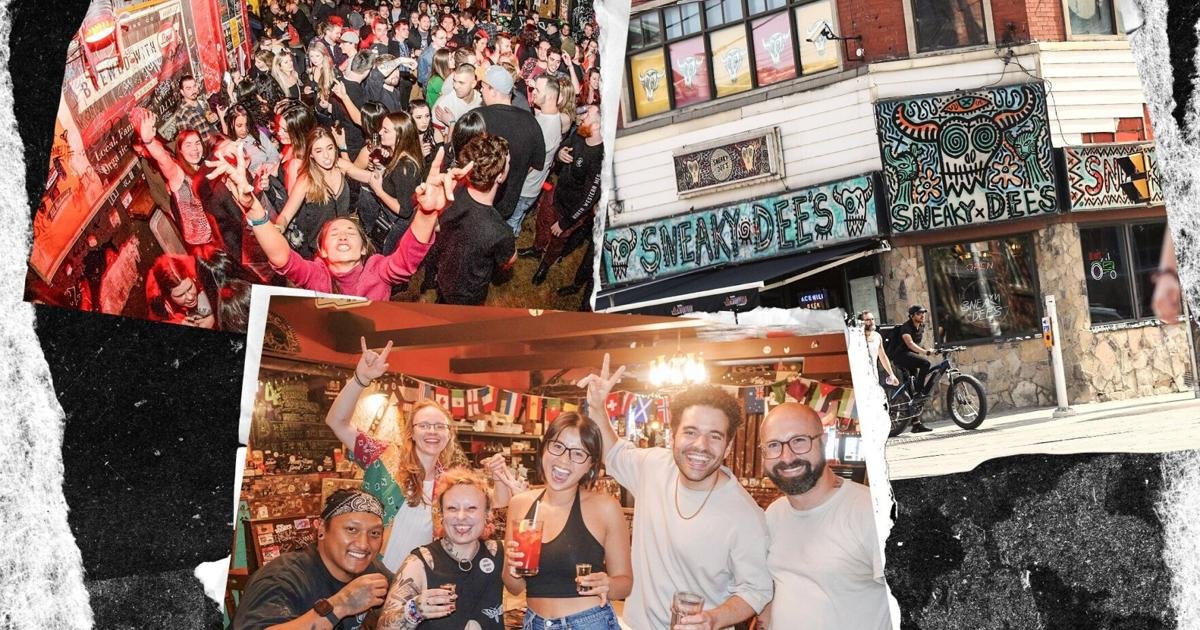
Everyone is just the right cause away from becoming an activist.
For a bunch of self-described “emo and punk kids,” it was the seemingly impending loss of a beloved dive bar, Sneaky Dee’s, that served as their political awakening.
In a city that many argue doesn’t protect its history, the fight between the bar and potential redevelopment has captured the imagination of Torontonians. In the end, furious organizing and a last-minute discovery caused the application to be rescinded, saving one of Toronto’s most cherished drinking holes.
“Everyone has a wholesome story, and a not-so-wholesome story about Sneaky Dee’s,” said Martin Perez, 33, a musician and one of the main people behind the Save Sneaky Dee’s campaign.

The developer withdrew its application from the City of Toronto on Friday.
Perez said after immigrating from Venezuela, he first moved to Mississauga, but it was at Sneaky Dee’s where he found a home. He’s performed in bands there and is a regular patron. And he said he is very concerned about the live music venues that are often being shuttered in this city.
“In my 20s, it was where I found my place and these days, I call it the living room of the city. You go in there any day, and you’ll run into people you know,” he said.
The battle is being celebrated for showing that Toronto can rise up and protect its treasured institutions and demonstrating that fighting for what you love in this city is not always a lost cause.
A cultural touchstone
Since first opening up at Bloor and Bathurst streets in 1987 — where its name was a play on its former neighbour, Honest Ed’s — and moving to its current location at the corner of College and Bathurst streets in 1990, generations of Toronto partiers have entered the graffiti-covered lair that has been colloquially dubbed “Sneaks,” “Dee’s” or “Sneaky Disease.”
It’s a ramshackle joint — its walls covered in graffiti. It is renowned for both its nachos and for being an early stop for some of this country’s best bands.
It looks lived in, because it has been. The downstairs has wooden booths and tables with mismatched chairs. There are bars on both floors, and upstairs is the venue space, a long room with a low ceiling, with a stage abutted by a usually packed dance floor.

Generations of Toronto partiers have entered the graffiti-covered lair that has been colloquially dubbed “Sneaks,” “Dee’s” or “Sneaky Disease.”
Arlyn McAdorey/Toronto Star file photo
It was immortalized in “The Song about Trees and Kites,” by The Lowest of the Low, in 1994: “Well, I don’t mean to be a preacher, and give a sermon from the church of Sneaky Dee’s, but one more jug of beer and that point that I was reaching, will hit me like a vision and make me fall on my knees.”
“(This is) a long way from Sneaky Dee’s, where we played our first show in Toronto,” said Win Butler of Arcade Fire, after winning a Juno in 2011.
It’s also featured in “Scott Pilgrim,” the beloved Toronto graphic novel series that led to a cult classic movie, which was a snapshot of Toronto cool in the early 2000s.
In a city where nightlife is often shiny and showy, Sneaky Dee’s has always been its own thing, serving its clientele hearty grub, foamy beers, bands and DJs who have helped keep the dance floor moshing for decades.
A six-year saga
For such a storied institution, it also makes sense that its potential jeopardy has also been a saga that’s been going on for almost six years. That’s how long the planning application to rezone that block has been on the books.
A few months ago, the Toronto and East York Community Council was on its way to rubber stamping the planning application, which would have rezoned that block to allow for a 16-storey residence, until the word got out and the bar’s most enthusiastic patrons started organizing.
“What was really wonderful about this team is it came together so organically; ‘I know how to do this. Can I help you?’ And suddenly we had this small group of community members who had never spoken before this, really, except for Martin and I knew each other through the scene,” said Mackenzie “Mack” Kundakcioglu, 33.
Kundakcioglu has been going to Sneaky Dee’s since 2016, and started as a regular at the weekly Emo Night North events. They were such a regular, they were asked to help run it, doing everything from working the door to now, when they are one of the night’s regular DJs.
In late May, it was that popular Friday night party that served as the epicentre of the crew that took up this cause, and after they sent out a social media post telling people to show their support of the bar and galvanized many to proclaim their love of the bar at city hall.
Perez said he spoke at a May 28 council meeting about the bar, but the item got deferred until July. That was the moment they kicked into action.

The people behind the Save Sneaky Dee’s campaign, from left to right, Ivan Cabus, Monika Baird, Mackenzie Kundakcioglu, Lily Ruble, Martin Perez and Dan Seljak.
Mackenzie Kundakcioglu
He then bought the SaveSneakyDees website domain, and they started planning. The movement kicked off with a flurry of online content, including countdown videos of how many days left until the next meeting, urging people to contact city hall, hoping the upcoming fall municipal election would lend pressure.
“We didn’t have to convince people to give a crap about Sneaky Dee’s. People already loved Sneaky Dee’s,” explained Perez. “The audience was already there. We just had to activate it.”

Party-goers dance to Emo music during the Homesick event at Sneaky Dee’s on March 2, 2019.
Andrew Lahodynskyj file photo
They began researching solutions. Could they go to the Ontario Land Tribunal? What about a city heritage designation? They pored over the application and looked up the land registry and titles. They also contacted officials they thought could help, including local city councillor Dianne Saxe.
“They were able to generate a degree of public awareness and enthusiasm and engagement that’s unlike anything we’ve seen in a long time,” said Saxe. “I think all my council colleagues were getting an email about Sneaky Dee’s every ten minutes, seven days a week, for the last several weeks.”
A bank steps in
Saxe said that Perez mentioned that they had heard that the Royal Bank of Canada (RBC) branch next door was not owned by the developers. A former lawyer with connections to RBC senior management, Saxe made some calls to confirm the information and convinced them to write a letter stating as much.
“Getting a major bank to do a legally significant letter in a few days on a summer week with a holiday is not non-trivial. But I contacted them every single day, and every day they promised me I’d get the letter in,” said Saxe, adding it actually took three attempts before the bank got it right and sent the missive into the proper community council.
That now famous letter, saying that RBC did own the parcel of land next to Sneaky Dee’s and had no intention of selling, also included a sentiment that hopefully says something about this city: that neighbours, no matter how different they are, can come together to build a vibrant community.
The letter RBC sent to the developer behind the prospective Sneaky Dee’s project.
“It is worth noting that the recent news coverage was focused on the dislocation of our neighbour, Sneaky Dee’s, a popular community music venue. We believe that it is worth pointing out here that our business has coexisted with Sneaky Dee’s for many years and we would be entirely content to see that relationship continue,” read the RBC letter.
Shortly after the letter was public, the rezoning application was withdrawn on July 3, and Sneaky Dee’s seemingly imminent upheaval had been halted.
“The rowdiest punk group of people buddying up with the biggest corporation in the country, basically, to say, eff you to a developer. Let’s keep our s——y dive bar,” marvelled Perez.
Sneaky Dee’s ownership declined a request for an interview. Perez said the owners are walking a fine line as they are tenants and need to maintain a good relationship with their landlord, adding that his group worked independently from the bar.
RBC declined to comment further.
What’s next?
Sean Galbraith is a planner with his own firm, Galbraith and Associates, who was not involved in this project, but the Star reached out for comment on the developer’s application.
He said it is not illegal to try to rezone or develop land that you do not own, and really, all you have to do is notify the landowners that you are putting in a rezoning application. But you should have agreements in place to acquire them, or something like this, an abrupt end to a years-long planning application, can happen.
“Rezoning land you don’t own and also don’t have the permission of the landowner, like that is not common at all,” Galbraith said. “I’ve never heard of that before. I can’t even fathom why you would do it that way. Like the risk is so huge.”
The planning applicant, Goldberg Group, did not respond to requests for comment.
As for what’s next, Kundakcioglu said they have a few plans and strategies, and the first one they are pursuing is attempting to get a heritage designation for the bar, which is possibly another long-shot. Most designations in Toronto hinge on architectural features and Sneaky Dee’s doesn’t really have any bona fides on that front.

Is culture becoming a ‘luxury’ in Toronto?
Kundakcioglu said they are trying to focus on a 1993 brawl between neo-Nazis and anti-racism activists as an important historical event that took place there, along with the bar’s cultural history and significance. The group has also updated the savesneakydees.com site and is asking people to write in with their memories as part of the submission.
Saxe has put forth a motion to city staff to look at a possible heritage designation.
“The fact that we were able to save Sneaky Dee’s after the staff recommended redevelopment was absolutely extraordinary. It almost never happens. That is the most extraordinary thing. But the second thing would be the energy, the initiative, the imagination, the creativity and the reach of these volunteers,” said Saxe.
The heritage designation is probably a Hail Mary. But a few months ago, so was the idea that a bunch of emo kids could help stop a condo development in its tracks.