dailynewsnblog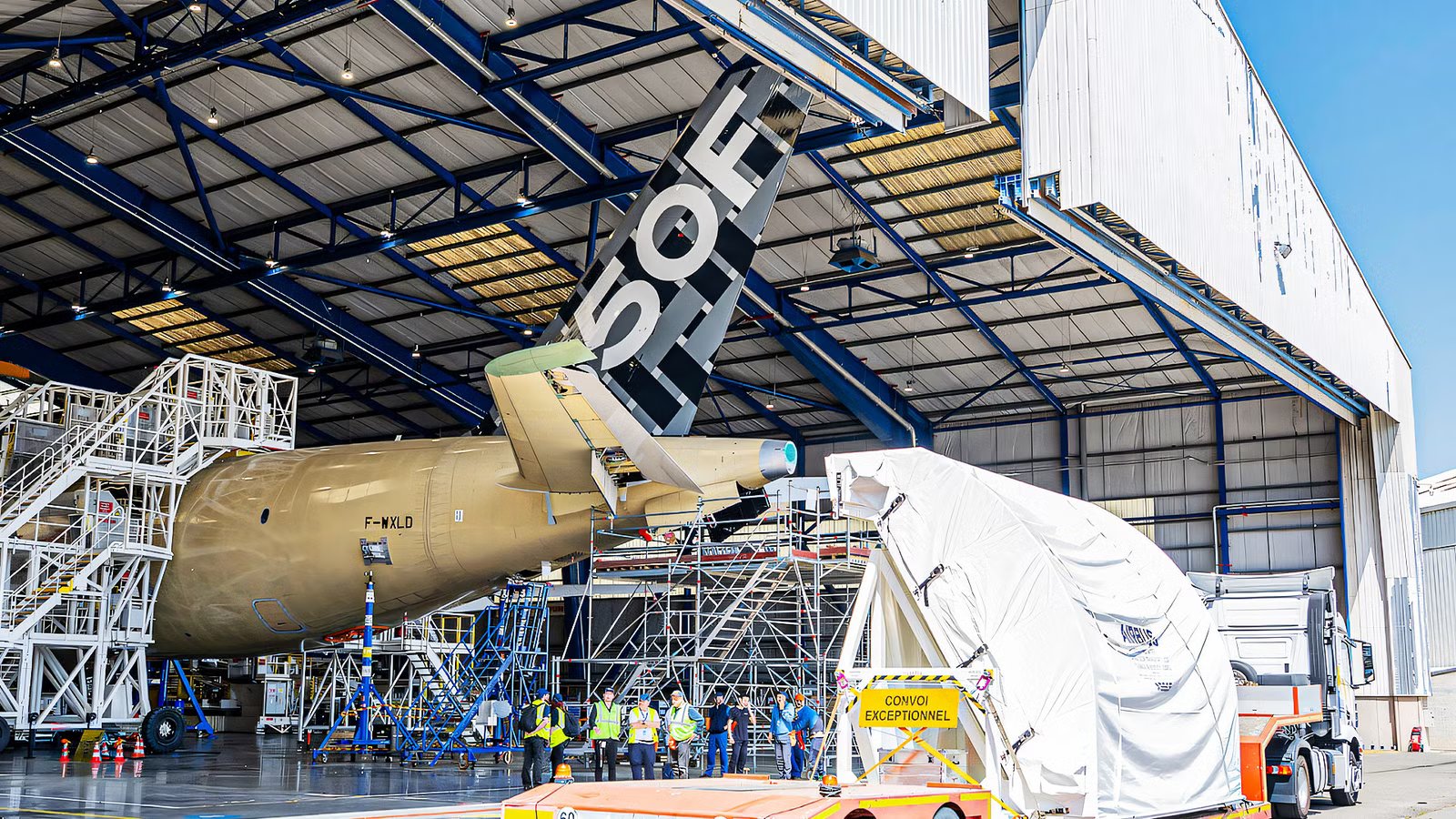
When Airbus completed the first main deck cargo door for its new Airbus A350F, the headline number was impossible to ignore: a door roughly 14.7 feet (4.5 meters) wide and 14.1 feet (4.3 meters) high, large enough to accommodate entire jet engines. However, the real story is not about scale alone. Rather, it is about solving a deeply counterintuitive engineering problem: how to carve a garage-sized opening into a pressurized aircraft fuselage without compromising its structural integrity, safety, or lifespan.
That challenge sits at the heart of Airbus’s attempt to compete with Boeing in the long-haul freighter market. The A350F promises a payload of around 245,000 pounds (111,000 kg), improved efficiency, and lower emissions, but those advantages only matter if the aircraft can reliably perform its core mission, moving large, often oversized cargo quickly and safely. That mission depends heavily on whether this enormous, complex cargo door works exactly as intended over thousands of flights.
The Structural Problem: Cutting A Hole In A Pressurized Tube

Aircraft fuselages are essentially pressurized cylinders. At cruising altitude, the cabin is maintained at a higher pressure than the outside atmosphere, creating outward forces that act across the entire structure. This pressure is normally distributed evenly, allowing the fuselage to carry loads efficiently with minimal excess weight. Structurally, the skin works with frames and stringers to resist both hoop (circumferential) and longitudinal stresses, forming a lightweight but very strong shell.
Introducing a large opening disrupts that balance. A cargo door measuring over 14 feet (4.3 meters) in height removes a significant portion of the load-bearing skin, forcing engineers to rethink how stresses are carried through the surrounding structure. Without careful design, the edges of the opening would experience concentrated stress, leading to fatigue damage over time as the aircraft repeatedly cycles through pressurization and depressurization.
To solve this, Airbus engineers redesigned the load path around the door, so forces are redirected rather than interrupted. Reinforced frames, longitudinal beams, and local strengthening elements carry loads smoothly around the opening, while carefully shaped edges reduce stress concentrations. Using advanced materials like carbon-fiber composites allows strength to be added precisely where needed without excessive weight, helping the fuselage behave as though the opening does not significantly weaken it.

passenger platform, which relies heavily on carbon-fiber-reinforced polymer rather than traditional aluminum. This shift brings major advantages, including lower weight, improved fatigue performance, and strong corrosion resistance, all of which are particularly valuable for a high-cycle aircraft. It also allows engineers to ‘tailor’ the structure more precisely, aligning fibers in specific directions, so the material carries loads more efficiently than a conventional metal design.
This ensures that the structure remains both strong and durable over many pressurization cycles. The manufacturing process also becomes more complex. Composite structures must be produced with tight tolerances to ensure proper alignment and load transfer. Around a large cargo door, even small inconsistencies can affect performance, requiring advanced fabrication techniques and rigorous quality control. In this sense, the door is not just a structural feature: rather, it is a test of how far a composite aircraft design can be pushed.
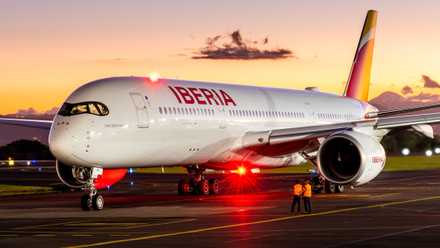
How Composite Materials Make The Airbus A350 A Gamechanger
Using lightweight and robust composites reduces net fuel burn and minimizes maintenance costs.
Reinforcement Without Penalty: Strength Vs Weight

Adding strength to an aircraft structure is straightforward in principle: use more material. The challenge is that every additional pound reduces payload capacity and increases fuel consumption. For a freighter designed to compete on efficiency, excessive reinforcement would undermine its economic advantage.
Airbus addresses this by concentrating reinforcement where it is most needed. Around the cargo door, a network of strengthened frames and load-bearing elements forms a kind of structural bypass, allowing forces to flow around the opening rather than through it. This creates a localized zone of increased strength without significantly increasing the overall weight of the aircraft.
This approach reflects modern aerospace design philosophy, where optimization replaces overengineering. Instead of building uniformly strong structures, engineers tailor reinforcement to specific stress patterns. The result is a fuselage that remains both strong and lightweight, two qualities that are essential for the A350F’s performance targets.
Why Shape Matters: Geometry & Stress Control

The geometry of the cargo door is critical to its performance. Sharp corners are avoided because they act as stress-concentration points, where forces can accumulate and initiate cracks under repeated loading. This lesson was learned the hard way in the early jet age, most notably the de Havilland Comet, whose square window corners led to stress concentrations that contributed to catastrophic structural failures in the 1950s.
As a result, modern aircraft use carefully engineered rounded edges and smooth radii, allowing stresses to flow more evenly around openings and significantly reducing peak stress levels. At the scale of a large cargo door, these geometric decisions become even more critical. A poorly designed corner or abrupt transition could become a focal point for fatigue damage after thousands of pressurization cycles, as the aircraft repeatedly expands and contracts in flight.
|
Category |
Parameter |
Value (Per Airbus) |
|---|---|---|
|
Dimensions |
Length |
232 feet 4 inches (70.80 m) |
|
Wingspan |
212 feet 5 inches (64.75 m) |
|
|
Height |
56 feet (17.08 m) |
|
|
Capacity |
Maximum payload |
244,700 lb (111,000 kg) |
|
Main deck capacity |
30 containers |
|
|
Lower deck capacity |
40 LD3 containers |
|
|
Performance |
Range |
5,410 mi/4,700 nmi (8,700 km) |
|
Efficiency |
Fuel burn / CO₂ |
20–40% lower vs previous freighters |
|
Structure |
Materials |
Advanced composites (carbon fiber, titanium) |
|
Cargo Features |
Main deck cargo door width |
175 inches (14.6 ft) (4.45 m) |
|
Engines |
Engine type |
Rolls-Royce Trent XWB-97 |
|
Operations |
Reliability |
99.5% (A350 family baseline) |
|
Environmental |
SAF capability |
Up to 50% at entry (target 100%) |
Engineers therefore use detailed computational analysis and full-scale fatigue testing to refine the door frame, reinforcements, and transitions so loads are distributed smoothly. Features like gradual thickness changes, reinforced frames, and optimized curvature help prevent crack initiation and slow any potential crack growth, ultimately preserving structural integrity and extending the aircraft’s service life.
Shape also plays an important role in how the door seals against the fuselage. During flight, the aircraft structure flexes slightly due to aerodynamic forces and internal pressure, subtly altering the shape of the opening. The door and its sealing system must accommodate these small but continuous changes while maintaining a reliable airtight barrier. Achieving this requires not only precise manufacturing but also advanced sealing materials that can remain effective despite repeated deformation, temperature changes, and long-term operational conditions.

How Much Do Airlines Make From Cargo?
In the post-pandemic world, there is a lot of money to be made from cargo.
Systems Behind The Door: Actuation & Sealing

Operating a cargo door of this size involves more than structural integrity. The A350F uses an electrically powered actuation system to open and close the door, replacing traditional hydraulic systems with a more modern approach. Electric actuation offers improved control and can reduce maintenance complexity, but it also requires robust redundancy to ensure reliability.
The system must function consistently in a wide range of conditions, from ground operations in extreme climates to repeated cycles over the aircraft’s service life. It must also ensure safe operation even if one component fails, preventing scenarios where the door cannot be secured properly.
Sealing the door is equally critical. The aircraft must maintain cabin pressure at altitude, which means the door’s sealing system must withstand internal pressure forces while adapting to slight structural deformation. Over time, seals must resist wear, environmental exposure, and repeated use, making durability just as important as initial performance.
Why This Door Could Decide The Market

For cargo airlines, the main deck cargo door is not just a feature: rather, it is a core part of the aircraft’s value proposition. A larger door allows operators to carry oversized freight, including industrial equipment and large aircraft engines, without disassembly. This expands the range of cargo missions the aircraft can handle and increases its revenue potential.
The door’s position near the rear fuselage also helps with loading efficiency and weight distribution. Maintaining the correct center of gravity is essential for safe flight, and the placement of the door simplifies the loading process while reducing the need for complex adjustments. Faster, more efficient loading translates directly into shorter turnaround times on the ground.
This is why the cargo door plays such a central role in Airbus’s challenge to  Boeing. While the A350F offers advantages in efficiency and payload, those benefits only matter if the aircraft performs reliably in daily operations. If the door enables faster loading, greater flexibility, and consistent performance, it could help Airbus gain ground in a market long dominated by its American rival.