dailynewsnblog
In August 2026, the next phase of the most ambitious cabin renewal program in commercial aviation history will begin.  Emirates will send 60 Airbus A380s and 51 Boeing 777s through a comprehensive retrofit touching every element of the passenger experience — seats, entertainment screens, connectivity, the overhead lighting, the lounge. What makes the A380 portion of this particularly interesting is not the Safran Business Class seats or the 4K OLED screens, impressive as those are. It is a brand-new connectivity solution. Providing reliable, broadband internet access to up to 615 passengers distributed across two full-length decks inside the world’s largest commercial aircraft requires engineering choices that have never been made before on any other airline in the world.
The program sits within a broader $5 billion commitment from Emirates to refurbish all 219 aircraft in the current fleet — a total that has grown steadily since the airline first announced a 120-aircraft retrofit in 2021, before expanding to 191 aircraft in May 2024, and again to 219 later that year. According to Emirates’ official retrofit program page, 93 aircraft had been refurbished as of April 2026, all now flying with Premium Economy cabins and refreshed interiors. The next batch of 111 aircraft to upgrade represents the program’s largest single phase yet, and the first to combine new seats, new IFE, and Starlink connectivity simultaneously on the A380 as a single integrated upgrade rather than sequential installations.
The Scale Of What Emirates Is Actually Undertaking

The retrofit program’s scope tends to get lost in the product announcements. Emirates is not refreshing cushions or swapping screen bezels. It is pulling seats out of aircraft, installing new structural fittings, running new power and data cabling through fuselages, certifying new antenna configurations with aviation regulators, and returning airframes to revenue service that passengers reasonably expect to find identical to their previous flight. Across 60 A380s, each carrying up to 615 passengers in Emirates’ highest-density configuration or 484 in the standard four-class layout, the whole program is a logistical and engineering exercise on a scale that very few MRO organizations anywhere in the world are equipped to handle.
Emirates Engineering is the primary delivery vehicle for this program, working with a partner list that includes Airbus, Safran, Recaro, Panasonic Avionics, SpaceX’s Starlink division, and UUDS. According to the Emirates official press release issued on November 18, 2025, Sir Tim Clark, President of Emirates Airline, framed the program’s ambition clearly: ”Emirates’ retrofit program is about continuously elevating standards across our entire fleet.”
“Working with our long-standing partners, we’re taking this commitment a step further with the aim of delivering product consistency at scale, in tandem with next-generation innovations in seating, entertainment, and connectivity being brought into service with our newly delivered fleet. Our customers expect an excellent experience every time they fly Emirates, and this investment ensures we deliver on that promise in the years to come, wherever they travel with us.”
As previously examined on Simple Flying, the A380 has proven more durable commercially than almost anyone predicted when Airbus ended production in 2021. Of the 251 A380s ever sold, Emirates holds 123 and operates 116 today, with a target of 110 operationally active by the end of 2026. The retrofits are Emirates’ declaration that the A380 remains a core revenue-generating asset well into the 2030s, worth a multi-billion-dollar investment to keep competitive against newer widebodies entering service at rival carriers.
Why The A380’s Double Deck Required An Industry-First Connectivity Solution

The engineering challenge of connecting a double-deck aircraft like the A380 to satellite internet is fundamentally different from the challenge on any single-deck widebody. A Boeing 777 operates with two Starlink flat-panel antennas (electronically steered arrays, or ESAs) mounted on the fuselage exterior. Those two antennas, together with the cabin access points they feed, can cover a single-deck cabin of approximately 300 to 400 seats adequately. The A380 is a different problem entirely: 238.6 feet (72.7 meters) long, 261.8 feet (79.75 meters) in wingspan, two full passenger decks separated by a structural floor, and potentially more than 600 passengers demanding simultaneous high-bandwidth access. Two antennas would not suffice.
According to the Emirates official announcement of the first A380 Starlink completion, published April 27, 2026, the solution is an industry-first three-antenna configuration, one additional ESA beyond the two-antenna setup used on Emirates’ 777s, supplemented by additional wireless access points specifically designed to support inter-deck integration. The three antennas together deliver a total aircraft bandwidth of more than two Gbps, which dwarfs the one Mbps bandwidth of Emirates’ original in-flight internet system first introduced in the 2000s. As Simple Flying reported at the announcement of the Starlink deal, Emirates is targeting a rate of approximately 14 aircraft per month for the Starlink rollout, with the full A380 fleet expected to be equipped by mid-2027.
The first Emirates A380 to receive Starlink, aircraft registration A6-EEA, a 13-year-old airframe, was ferried to Newquay Airport in Cornwall, United Kingdom, on April 2, 2026, and completed installation and certification before returning to Dubai in late April 2026. According to Runway Girl Network, the service will be complimentary for all passengers across all cabin classes, with one-click sign-up and no pre-booking required. Future enhancements will include Live TV streaming over Starlink, initially on personal devices and later integrated into the seatback screens — which will at that point be running Panasonic’s Astrova system, not the current ICE platform.
Where Does Emirates Fly The Airbus A380? All 48 Routes For July [List & Map]
Compared to June, the airline is scheduled to operate its A380s to four additional destinations during the month of July.
Panasonic Astrova: A Complete Rewrite Of What IFE Can Do At 40,000 Feet

Emirates has operated Panasonic’s ICE (Information, Communications, and Entertainment) system for years, one of the most mature inflight entertainment platforms in the industry. The Astrova platform that will replace it on the retrofitted A380s and 777s is a clean-sheet design built around display technology that was not commercially available when the current ICE platform was specified.
The new feature is 4K OLED HDR10+ screens at every seat, a display standard that delivers true blacks, infinite contrast ratio, and peak brightness performance that standard LCD screens mounted in aircraft cabins cannot match. At cruising altitude, where windows are typically darkened and ambient light is low, OLED’s ability to produce genuinely dark darks makes a material difference to perceived picture quality in ways that specification sheets do not fully convey.
Beyond the screen, Astrova’s feature set reflects the convergence of premium consumer electronics and commercial aviation. Spatial Audio, a multichannel sound rendering system, immerses passengers in audio that expands beyond the left-right stereo field of standard inflight headsets, using head-tracking or directional processing to create a sense of three-dimensional sound. The system supports Bluetooth pairing for passengers’ own wireless headphones, which means travelers can use premium noise-cancelling headsets they already own rather than the airline-issued units.
Every seat carries a 67W USB-C charging port, sufficient to charge a laptop at a meaningful rate during a long-haul sector. The system also incorporates Panasonic’s Arc 3D 4K Moving Map, an interactive flight-tracking display that renders terrain, route, and progress information in three-dimensional detail at 4K resolution. According to Emirates’ official press release, Astrova’s modular architecture allows displays, power delivery systems, and connectivity modules to be independently upgraded as the technology evolves, without requiring a complete system replacement — a lesson learned from the cost and complexity of previous generations of integrated IFE.
Catch what other flight trackers miss
Emergency squawks, holds, NOTAMs — live signals, no signup.
Open tracker
Catch what other flight trackers miss
Emergency squawks, holds, NOTAMs — live signals, no signup.
Open tracker
The system’s integration with Emirates’ Skywards frequent-flyer program is also notable from a commercial perspective. An intelligent recommendation engine learns individual passenger preferences over time and suggests personalized content throughout the flight.
Emirates’ content library is large enough that algorithmic personalization represents genuine value: a passenger who regularly watches independent cinema on Emirates flights should theoretically see different recommendations than one whose primary interest is major sport. According to Aerospace Global News, the platform’s real-time engagement data also allows Emirates to continuously refine its entertainment library based on what passengers are actually watching, a feedback loop that no previous IFE generation could provide.
Seats, Lounge, And The Full Cabin Transformation

The IFE and connectivity upgrades are the most technically complex elements of the A380 retrofit, but the seating changes are what passengers will notice first. Business Class on the retrofitted A380s will receive seats inspired by Safran’s S Lounge design, the same product already installed on Emirates’ incoming A350 fleet — a move that signals Emirates’ intention to create genuine product continuity across different aircraft types for the first time in its history. The S Lounge seat integrates wireless charging into the side cocktail table, offers customizable in-seat lighting, and provides a more private enclosure than the previous-generation Business Class product, along with minibar amenities and multiple charging options, including USB-C and wireless ports.
Economy Class passengers on the retrofitted A380s will encounter Safran’s Z400 seat — a lightweight long-haul seat specifically designed for the mass-market cabin at range. Its distinguishing feature is an adjustable eight-way headrest for neck and head support across the full range of postures a passenger naturally assumes during a 14-hour sector, from upright to near-reclined. According to Paxex.aero, Safran is planning a dedicated manufacturing facility in Dubai to support production of these seats for the Emirates program, a level of supply-chain localization that reflects both the volume of the order and the strategic importance Emirates holds as a customer for Safran’s cabin division. Premium Economy, Emirates’ newest cabin class introduced progressively since 2023, will continue its fleet rollout on the retrofitted aircraft with updated Recaro seating featuring a mechanical recline system, integrated leg and footrests, adjustable headrests, and a 13.3-inch entertainment screen.
The A380-specific element of the retrofit that has attracted less coverage is the redesigned onboard lounge — the enclosed social space on the A380’s upper deck that has become one of the aircraft’s signature features and a genuine differentiator in Emirates’ commercial marketing. The existing lounge is functional; the retrofitted version is being redesigned alongside the wider cabin refresh to maintain aesthetic consistency with the new seat materials, lighting palette, and overall cabin concept. It may sound like a relatively minor element in a program involving satellite antennas and OLED screens, but the lounge is among the reasons Emirates’ A380 generates a brand premium that few other products in commercial aviation can sustain — and preserving that association is precisely what the retrofit program is designed to protect.
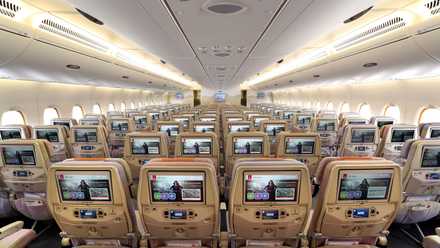
Future Of IFE! Will Traditional IFE Offerings Be Replaced With The Rise Of Starlink Connectivity?
In the past, several airlines were already moving towards removing seat back screens (especially on narrow-body aircraft) and offering content for passengers to screen on their own devices. However, as more airlines around the world are introducing / or looking to introduce Starlink connectivity onboard, or similar high-speed Wi-Fi connectivity (e.g. Delta Air Lines plans to introduce Amazon LEO), the question arises – will there be traditional IFE available in the future?
I personally think the traditional IFE and seat back screens are here to stay, due to two industry trends. The key reason is competition. While Starlink allows passengers to stream pretty much any content they wish, some airlines might still opt to retain their traditional IFE because they are forced by their competitors in the market, who also offer both Starlink connectivity and traditional IFE. This is also why some airlines with Starlink are bringing back seatback screens on their new aircraft / new cabins. The
The Schedule Reality: Why 22 Days Is Actually Closer To 45

Emirates officially states that a complete A380 retrofit takes 22 days, with Boeing 777 retrofits running approximately 18 days. Those figures would, if accurate, imply a manageable production cadence for a fleet of 60 A380s: 60 aircraft × 22 days = 1,320 aircraft-days of downtime, spread across multiple simultaneous retrofit slots at Emirates Engineering facilities in Dubai and, for the Starlink installation specifically, initially at Revima facilities in Newquay, UK.
The problem, according to independent tracking reported by Paxex.aero, is that recent A380 retrofits have actually been averaging closer to 45 days out of service, more than double the official figure. Boeing 777 retrofits have been tracking between 21 and 23 days, broadly in line with the stated 18-day estimate.
The discrepancy on the A380 is not trivially explained. The complexity of the A380 retrofit is genuinely greater than on the 777: an additional passenger deck means additional seat rows, additional IFE screen installations, additional power and data runs, additional structural anchor points for seats, and a third antenna installation for Starlink that requires additional fuselage penetration, certification work, and cabin integration. Basically, the process is similar to a refurbishment of two separate aircraft! For an airline that is simultaneously trying to maintain 110 A380s in active service and fighting against 777X delivery delays that have left it short of the next-generation fleet it planned on, extended retrofit downtime is a real operational pressure. According to TTG Asia, Emirates’ stated goal is to complete the full 219-aircraft program across all phases while minimizing network disruption, a target that becomes progressively more demanding as actual retrofit timelines diverge from projected ones.
The Starlink installations moving to Emirates Engineering facilities in Dubai should help compress the timeline for subsequent A380s. Reducing the ferry cost and logistical overhead of sending each aircraft to Newquay and back eliminates both transit time and the associated displacement from the Emirates network. Whether that change alone can close the gap between 22 days and 45 remains to be seen; the seat and IFE installation work is itself complex enough to extend the timeline independent of connectivity work. What is clear from the math is that the Emirates retrofit program, impressive as its ambitions are, is running on a production cadence that will demand sustained focus if the full 219 aircraft are to complete the program on any recognizable schedule.
Why Emirates Is Making This Bet On An Aircraft Nobody Expected To Still Matter

The context that makes the Emirates retrofit program genuinely interesting is not the technology it is installing — it is why the airline is installing it on an out-of-production aircraft rather than deploying it on a new replacement type. The Boeing 777X, which Emirates ordered in record-breaking quantities (150 of the 777-9 and 777-8 variants), has been delayed by several years from its original service entry target, meaning Emirates arrived at 2026 without the twin-engine modern fleet it had planned to deploy as A380 volumes reduced. As Simple Flying has previously reported, Sir Tim Clark has publicly acknowledged the situation: without the 777X, Emirates had to rethink its growth strategy entirely, opting to acquire additional A380s from lessors and invest in keeping the existing fleet competitive for at least another decade.
The retrofit is therefore simultaneously a response to the 777X delay and a proactive competitive positioning exercise. By equipping all A380s with Starlink and progressively upgrading their cabins, Emirates is ensuring that passengers who choose its superjumbo are receiving connectivity and entertainment that rivals anything on a newer aircraft from a competing carrier — a crucial commercial differentiator at a time when the A380’s age relative to the 787 and A350 family at rival airlines is beginning to become a visible factor in booking decisions. As Simple Flying has detailed, the A380 in 2026 continues to be a genuine revenue-driving asset for Emirates, with hundreds of weekly flights generating premium revenues that the aircraft’s capacity-per-departure efficiency makes exceptionally attractive at slot-constrained airports like London Heathrow, Singapore Changi, and Sydney.
The longer-term calculus is also clear. Emirates’ oldest A380s entered service in 2008 — meaning they will approach 25 years of service life by 2033, well within the aircraft’s certified design life of approximately 19,000 flight cycles or 100,000 flight hours. The retrofit extends the commercial viability of those airframes in a way that no amount of maintenance alone could.
Simple Flying Quiz
Think you really know Emirates?
Answer 10 questions and put your knowledge to the test
Think you really know Emirates?
Answer 10 questions and put your knowledge to the test
Easy (15s)Medium (10s)Hard (5s)