dailynewsnblog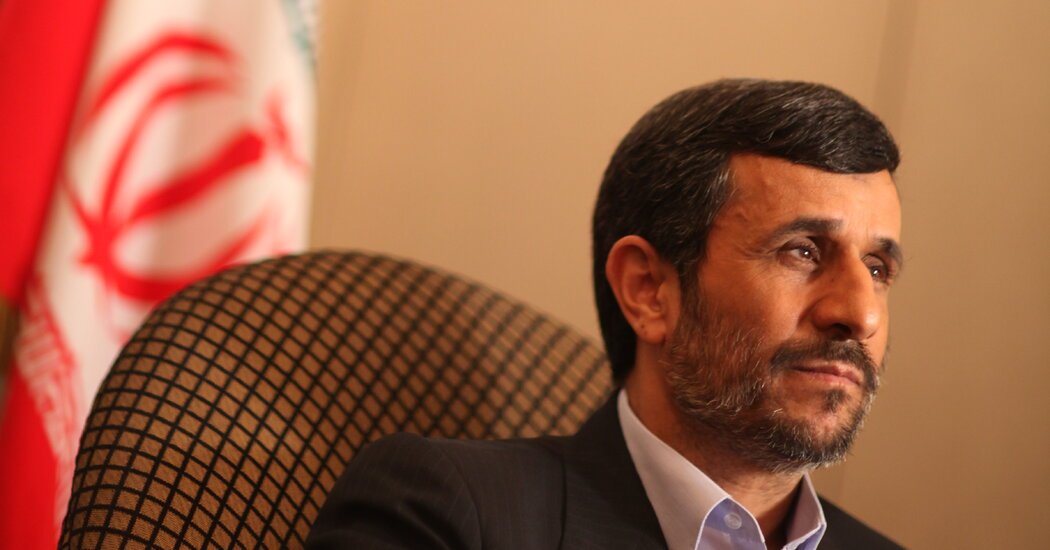
In early 2024, the rector of a university in Budapest received a startling request from a top Hungarian government official.
The official told the rector, Professor Gergely Deli, that Ludovika University of Public Service should hold a climate change conference and extend an invitation to an unlikely guest: Mahmoud Ahmadinejad, the widely reviled former president of Iran.
Even more shocking was the reason. The official told Mr. Deli that the conference was merely a front for Mr. Ahmadinejad to have secret discussions in Budapest with intelligence operatives from Israel, Mr. Ahmadinejad’s avowed enemy.
Mr. Deli knew that the invitation could tarnish both his own reputation and that of the university. But, he said in an interview, he believed he might be playing a role in saving lives.
“You have two enemies, and if these enemies want to talk with each other, then it’s best to do what you can to make them talk,” he said.
Mr. Ahmadinejad’s 2024 visit to the university and a second one the following year were part of a yearslong Israeli effort to groom him as an intelligence asset who, when the time came, could be installed as Iran’s new leader, according to both American and Iranian officials familiar with the operation, who spoke on the condition of anonymity to describe sensitive intelligence.
Recruiting Mr. Ahmadinejad was of such priority for Israel that the country’s then-spy chief David Barnea even traveled to the Hungarian capital in 2024 to meet with Mr. Ahmadinejad personally, according to former American officials. Soon afterward, they said, Mossad, Israel’s foreign intelligence service, notified the C.I.A. that it had been in contact with Mr. Ahmadinejad.
Israel’s decision to build a regime-change plan around Mr. Ahmadinejad is an extraordinary twist in the saga of the country’s relations with the former president, who was known for accelerating Iran’s nuclear program, calling regularly for the destruction of Israel and denying the Holocaust.
In recent years, according to American officials, Israel secretly paid money to Mr. Ahmadinejad for housing and travel, and Israeli operatives met him abroad on several occasions, including during his trips to Budapest.
The effort culminated in late February of this year — during the first days of the U.S.-Israeli war on Iran — with an audacious operation to relocate the former leader, who had been living under strict surveillance in Tehran. The goal: to set in motion the plan to topple the current regime and install Mr. Ahmadinejad.
The plan failed.
On Feb. 28, an Israeli airstrike hit Mr. Ahmadinejad’s compound, targeting the building of his bodyguards and his armored vehicle. After the strike, according to four senior Iranian officials, a black Peugeot car arrived, picked up Mr. Ahmadinejad and whisked him away at high speed from the chaotic scene.
American and Iranian officials with knowledge of the operation said the car had been driven by Mossad operatives, who took Mr. Ahmadinejad to a secret safe house in Iran.
But the former Iranian leader was upset about the frantic rescue operation, and he appeared to be disillusioned about the Israeli plan to return him to power, according to people with knowledge of what occurred.
He eventually left the safe house under circumstances that are still unclear. Mr. Ahmadinejad was not seen in public again until last Monday, when he made a brief appearance at the funeral procession for the slain supreme leader Ayatollah Ali Khamenei.
His current status remains uncertain. But four senior Iranian officials said that Mr. Ahmadinejad was in the custody of the Islamic Revolutionary Guard Corps’ intelligence wing, under house arrest now that Iran has learned about much of his interactions with Israel.
Israeli officials have not commented publicly about the plan to install Mr. Ahmadinejad as Iran’s leader, which was part of a broader attempt to topple the government in Tehran. Another element involved arming and training Iranian Kurdish opposition forces based in northern Iraq to cross into western Iran, hold territory there and eventually move toward the capital Tehran, an effort that never manifested.
The regime-change plan involved a “sequence of special operations, very, very unique, that was supposed to happen,” Tamir Hayman, a former head of intelligence for the Israeli Defense Forces, told the PBS talk show “Firing Line” in May, after The New York Times first revealed details of Mr. Ahmadinejad’s role in the plan. “And Ahmadinejad was part of that sequence.”
Mossad officials did not respond to requests for comment.
Ali Akbar Javanfekr, a spokesman for Mr. Ahmadinejad, declined to comment.
A post-presidential shift
As the president of Iran from 2005 to 2013, Mr. Ahmadinejad was the country’s most prominent hard-line politician. He spoke of eliminating Israel, and under his rule Iran restarted a program to enrich uranium, raising suspicions that it was pursuing a secret nuclear weapons program. Mr. Ahmadinejad ordered violent crackdowns on a nationwide uprising contesting his re-election in 2009, and, under his rule, the judiciary carried out mass executions of dissidents and jailed opponents and rivals.
But in the years after he left the presidency, Mr. Ahmadinejad tempered his views and toned down the anti-Israel rhetoric that had marked his time in office. He was often eager to show off his newly minted moderate side, granting interviews and giving speeches in which he opined on Iran’s pop music culture, criticized the country’s security forces for heavy-handed crackdowns and accused the ruling class of financial corruption.
He abandoned his signature oversize khaki windbreaker and began wearing tailored suits. He groomed his messy beard, appeared to get Botox treatment and began learning English.
In his office in Tehran, he held hourlong public meetings each morning to hear the grievances of ordinary people, some who came to him seeking help navigating government bureaucracy. On occasion, he wrote letters to government ministries recommending petitioners for loans. He traveled regularly around the country, meeting with supporters both in cities and rural provinces.
Mr. Ahmadinejad’s relationship with the Iranian government was complicated. Senior leaders marginalized him and restricted his movements, yet they allowed him a seat alongside other senior officials on a high-level council that advises the supreme leader. He attended the council’s meeting in February, a few days before the war began.
Many in Iran saw cynical political motives in Mr. Ahmadinejad’s transformation, which they viewed as an attempt to burnish his populist credentials and distance himself from ruling officials. He retained a base of support among working-class Iranians, and his advisers were certain that his goal was to one day return to power.
“Ahmadinejad would not do this for money. He has money; he has a wide economic network. He would do it for power. He wants to be at the helm of power,” Abdolreza Davari, a former close associate and senior adviser of Mr. Ahmadinejad, said in a phone interview. The two men had a falling-out several years ago.
Mr. Ahmadinejad told a handful of his closest associates and confidants about his ambitions to become Iran’s future leader with the help of foreign powers, according to an associate in his close circle, who spoke on the condition of anonymity to describe private discussions.
Mr. Ahmadinejad became disillusioned with the Islamic republic system after he was disqualified to run for president three times, the associate said, and concluded that he could not ascend to power as long as the current system remained in place.
He was concerned that, in the event of a war and regime change, Americans and Israelis would choose some opposition figure outside Iran who did not know the country and Iran would be destabilized, the associate said. He described himself to those around him as someone who could play the role of a reformer, like the former Russian president Boris Yeltsin, and said that if he came to power, Iran would recognize Israel and normalize relations as part of President Trump’s Abraham Accords, the associate said.
Israeli intelligence agencies were closely following the brewing rift between Mr. Ahmadinejad and the Iranian regime during this period, according to two Israeli defense officials familiar with intelligence assessments at that time. Of particular interest, the officials said, was Mr. Ahmadinejad’s growing resentment of Ayatollah Khamenei and other senior figures who had disqualified Mr. Ahmadinejad from running for president again.
Mr. Ahmadinejad’s actions began to arouse suspicion within the intelligence branch of Iran’s Revolutionary Guards Corps, which is responsible for safeguarding the Islamic republic against foreign interference. That suspicion grew, according to two members of the Guards and an intelligence official familiar with the case, after Mr. Ahmadinejad began sending public letters in 2017 to Mr. Trump and later to Saudi Arabia’s Crown Prince Mohammed bin Salman. Mr. Trump lavished praise on both men.
After the Israeli strike this year that initially freed Mr. Ahmadinejad from surveillance by the Guards, Iran’s intelligence agencies began investigating and piecing together his connection to Israel, according to the four officials.
Overseas meetings
It is unclear when Israeli operatives first tried to recruit Mr. Ahmadinejad. Iranian officials said there was at least some contact during a 2023 trip that Mr. Ahmadinejad took to Guatemala to attend a conference focused on the environment. The invitation came from the government of Guatemala, a country that has closer diplomatic ties to Israel than most in Latin America.
Mr. Ahmadinejad almost did not make the trip, as he was stopped at the airport in Tehran by security forces who refused to issue him a boarding pass and allow him to leave the country.
He staged an hourslong sit-in at the airport, which became a public spectacle as he took photographs with ordinary Iranian travelers, airport and airline staff and posted updates on his social media pages.
Eventually, Iranian authorities allowed Mr. Ahmadinejad to board the plane and attend the conference.
“Some people told me not to travel to Guatemala; I told them my brother the minister of environment invited me,” Mr. Ahmadinejad said in one the videos of the trip. “This is a very important country in Latin America.”
The following year, he made his first trip to Hungary to attend the Ludovika University conference, meeting in Budapest with Mr. Barnea, who led Mossad for five years, until last month.
Hungary, which was led at that time by the right-wing prime minister Viktor Orban, had perhaps closer ties to Israel than any other European nation, and Mr. Orban and Prime Minister Benjamin Netanyahu of Israel made trips to each other’s countries. Mr. Netanyahu gave a speech of his own in April 2025 at Ludovika University, which presented him with a public service award.
Two months later, Mr. Ahmadinejad returned to Budapest, just days before Israel launched a war in Iran, a visit that was a cover for him to meet with Israeli intelligence operatives.
His Iranian bodyguards from the Guards’ Ansar unit, who accompanied Mr. Ahmadinejad on all his foreign travel, reported that, on at least two occasions, he had managed to shake off his security detail and disappear for long meetings during the June 2025 trip. In a report about the trip, the bodyguards said that they had confronted Mr. Ahmadinejad about his disappearances, and that he had told them he had been meeting with university professors, according to the two Iranian Guards members and one intelligence official.
At the university conference, the former Iranian president delivered a lecture in English, surprising attendees by abandoning the signature Quranic verse he had once recited at the beginning of every speech.
Dressed in a tailored dark blue suit, he spoke about “shared humanity” and a “changing world order,” offering his own views on how a new world could emerge, according to videos from the trip posted on his social media page.
He presented Mr. Deli, the university rector, with a copy of the Book of Kings, by the ancient Iranian poet Ferdowsi. Mr. Deli gave Mr. Ahmadinejad an emblem of the university.
In an interview last month, Mr. Deli said that, in extending an invitation to Mr. Ahmadinejad, he had played the role of a “strohmann” — German for “frontman” or “puppet.”
Until last week, Mr. Ahmadinejad had not been seen in public since late February, when he was whisked away from his Tehran home in the black Peugeot.
Last Monday, he made a brief, surprise appearance as part of Ayatollah Khamenei’s funeral procession. Videos of the procession showed Mr. Ahmadinejad, wearing a heavy jacket in the 90-degree heat, with a surgical mask pulled down to his chin. Iran’s two other living former presidents, Hassan Rouhani and Mohammad Khatami, were not invited and did not appear in any of the funeral ceremonies.
Mr. Ahmadinejad stood with his head down, not speaking, flanked on all sides by what appeared to be security guards.