dailynewsnblog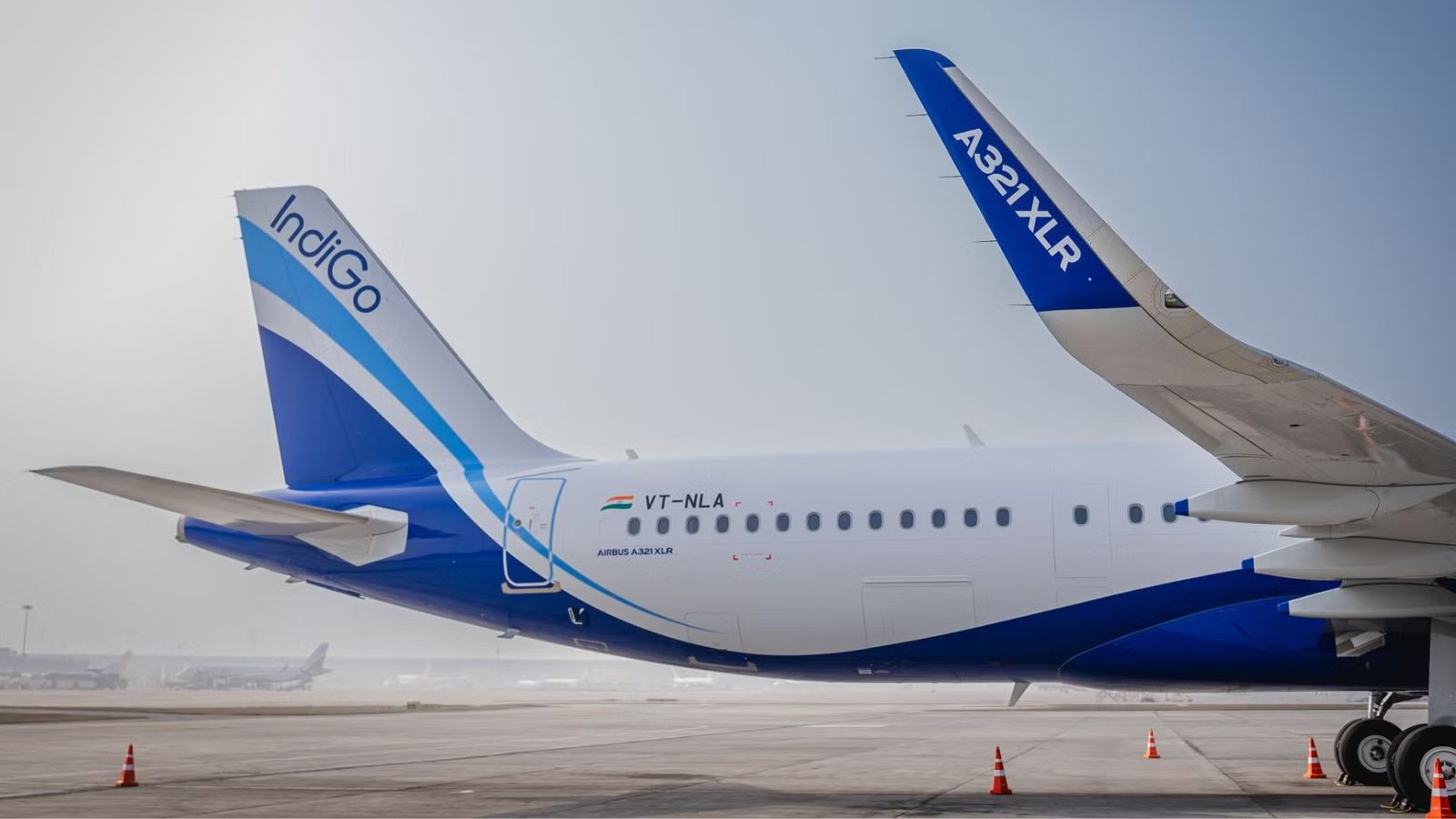
 IndiGo is overwhelmingly India’s largest airline. In the past few days, the low-cost carrier confirmed that it will no longer damp lease Boeing 787-9s from Norse Atlantic, with the European operator largely relying on this revenue to stay afloat. IndiGo’s own Airbus A350-900s will start arriving next year.
The 787-9s are temporarily leased at very high expense to help IndiGo build up its long-haul network and to attain slots. As the aircraft will cease being used at the end of October, some European routes will end. Affected airports include  London Heathrow Airport (LHR), as IndiGo leased slots from another airline that will not be used in the upcoming winter. However, the service to
  Amsterdam Schiphol Airport (AMS) is different, and will temporarily see the Airbus A321XLR.
IndiGo’s A321XLR From India To AMS

As confirmed by Analytic Flying, IndiGo attained slots at the coveted AMS as a new entrant and must use them 80% of the time or lose them. Unsurprisingly, it does not want to give them up. As such, it will temporarily deploy the relatively high-capacity, 195-seat XLR from  Chhatrapati Shivaji Maharaj International Airport (BOM), serving Mumbai, to AMS until the A350-900s begin to be delivered. Effectively a slot-sitting exercise, expect this route to be among the first to see the Airbus widebody.
IndiGo’s XLRs have 12 Stretch seats (with 44″ pitch, which do not become lie-flat beds) and 183 economy seats (with 31″ pitch). While seat-back entertainment is unavailable, passengers can stream entertainment to their own devices. Given the length of this route, they might need to do so.
The XLR is due to fly daily with the following schedule. Notice the one-hour turn in the Netherlands. The critical factor is the maximum block time, which includes the taxi time at both ends of the route, the flight time, and a period for short delays. At up to 11 hours (!), it will be by far the world’s longest nonstop XLR operation.
Frequency | BOM To AMS; Local Times | AMS To BOM; Local Times |
|---|---|---|
Daily | 6:30 AM-1:00 PM (11 hours and 00 minutes)* | 2:00 PM-4:10 AM+1 (9 hours and 40 minutes |
* Increased from a high of 10 hours and 35 minutes with the 787 |
A 14% Detour To Avoid Certain Airspaces

If flights from BOM to AMS followed the shortest path, the operating aircraft would fly over Pakistan, Iran, and parts of Russia and Ukraine en route to Europe. Due to airspace restrictions and closures, IndiGo cannot do this. As such, the airline must detour, which adds to the distance and thus the duration, fuel burn, emissions, competitiveness, and so on.
As shown above, Flightradar24 indicates that the carrier’s 787-9 services tend to fly over Saudi Arabia to Cairo and then up through Europe. The XLR will surely do the same. The shortest path would cover 3,707 nautical miles (6,865 km) each way. While Airbus touts the XLR’s range as 4,700 nautical miles (8,704 km), this is entirely theoretical and should not be misunderstood.
Like all manufacturers, it is based on everything being as light and as optimized as possible to show off the equipment. It does not reflect real-world operations and never will. It is just the brochure range.  Iberia, for example, has stated that its XLRs have a realistic real-world range of about 3,900 nautical miles (7,223 km). As Iberia’s XLRs have 182 seats against IndiGo’s 195 seats, they are lighter. This means that Indigo’s frames will have an even shorter maximum range.
By detouring, the distance increases to approximately 4,200 nautical miles (7,779 km) each way, which is well beyond the real-world range. As such, service to AMS, which will have headwinds, will certainly have a notable payload restriction. This assumes that the aircraft is sufficiently full anyway. However, given the downgauge from the 787-9 to the much smaller XLR, this is a reasonable assumption. Of course, this is only a stop-gap solution until IndiGo’s own widebody aircraft arrive. It is a price that the airline is willing to pay to keep its AMS slots.
A Quick Look At IndiGo On BOM-AMS

Cirium Diio data shows that IndiGo’s AMS debut took place in July 2025. After initially flying three times weekly, the frequency increased to daily from winter 2025/2026 as more slots were obtained. This offering was available through summer 2026 and is scheduled for winter 2026/2027. No wonder IndiGo is so keen to keep them.
IndiGo only flies between BOM and AMS. The carrier was largely attracted to this airport pair because, until then, only KLM served it. In contrast,  Delhi Indira Gandhi International Airport (DEL) has Amsterdam flights by KLM and Air India. Launching BOM service was a way of avoiding more head-to-head competition.
Obviously, many of KLM’s passengers connect to another flight in AMS, with the local AMS-BOM market (of around 70,000 passengers before IndiGo’s arrival) less well-targeted. Many people connected en route at other European hubs or in the Gulf. IndiGo wanted to focus on the local market in particular. Interestingly, both carriers codeshare. IndiGo passengers can reach around 29 airports via AMS, while KLM passengers can reach 21 airports via BOM.
Booking data for July 2025 to May 2026 suggests that IndiGo’s entry grew local traffic between BOM and AMS by a considerable 161% compared to July 2024 to May 2025. Far more of the carrier’s passengers only flew between the two airports than connected elsewhere. Barely a fifth of passengers transferred to another service in BOM or AMS or both.