dailynewsnblog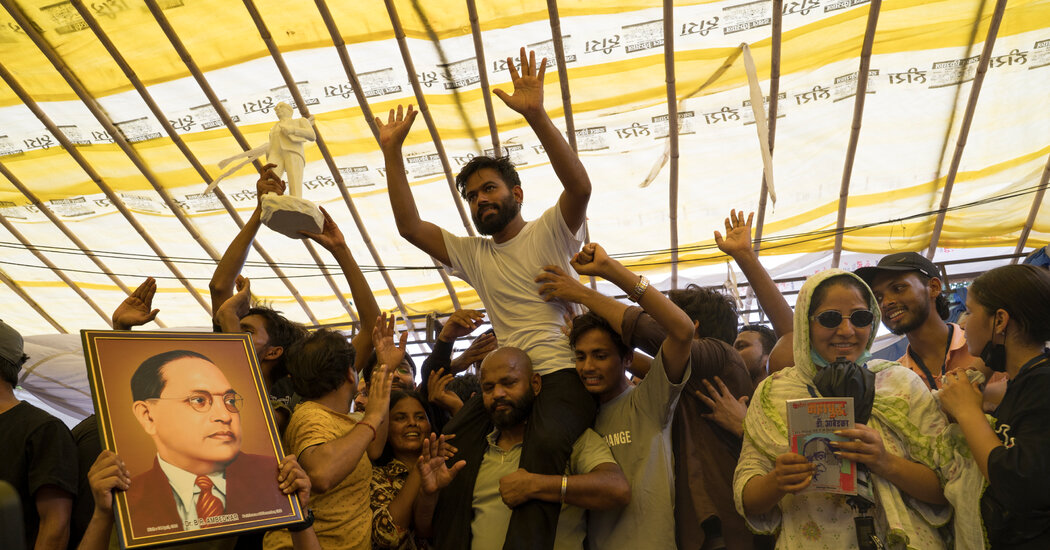
India’s education minister stepped down on Saturday, in a major victory for a student protest movement whose explosive rise has become one of the most serious challenges in years to the power of Prime Minister Narendra Modi.
The education minister, Dharmendra Pradhan, submitted his resignation to Mr. Modi, bowing to weeks of public pressure that culminated in nationwide street protests from Delhi and Mumbai to Kolkata and Chennai.
Mr. Pradhan said he had been “deeply pained” by the events of recent days, but he pointed a finger at what he called “anti-national forces,” saying he did not want them to take advantage of the massive protests.
The movement emerged in May, powered by widespread anger and frustration after the government ordered millions of students to retake an extremely competitive national medical school entrance exam because test questions had been leaked. Students held Mr. Pradhan, under whose watch several national exams were marred by leaks, responsible.
Loud cheers erupted at the protest site near Jantar Mantar, an 18th century observatory in New Delhi, as protesters heard the news that Mr. Pradhan had resigned.
“This is democracy,” said Abhijeet Dipke, the 30-year-old founder of a youth movement that in two months has jolted Indian politics. But it wasn’t immediately clear that the protesters would call it a day. In a statement, Mr. Dipke said protesters had made more demands of the government. “We won’t go like this.”
Mr. Dipke founded a satirical party called the Cockroach Janta Party in May after a disparaging remark by India’s top judge comparing India’s youth to cockroaches. The party quickly became the vehicle through which millions of young Indians began to express their frustrations about a troubled education system and a lack of job opportunities.
The C.J.P. was founded just days after the medical school exam was canceled. Mr. Pradhan’s education ministry announced a fresh date for the test, but in the interim, at least 21 students died by suicide, according to the C.J.P.’s count.
Mr. Dipke’s C.J.P. began protesting in June, but the movement gained momentum this month, after the police cracked down with force on demonstrators as thousands marched to Parliament in New Delhi on Monday. Protests had spread to major cities across India.
One of the demands Mr. Dipke and other leaders of the movement put before the government was compensation of 10 million rupees (about $103,000) for the families of the children who took their own lives.
Mr. Dipke said his group also wanted accountability for security forces who cracked down on Monday’s peaceful protesters. “Action must be taken against the police officers for that,” he said.
Mr. Pradhan was previously largely dismissive of the protests. In a social media post he accused opposition parties of exploiting students to “manufacture disruption,” and in a June interview with a local media outlet referred to the student protesters as “the B-team of terrorists.” But that appeared only to strengthen the resolve of the students to remove him. Despite winning some rare concessions from the government, they vowed to continue the protests until the minister was dismissed.
The call to remove Mr. Pradhan forced Mr. Modi to balance loyalty to his supporters against the need to placate young people, who account for 40 percent of India’s population. An operative of the ruling Bharatiya Janata Party, Mr. Pradhan was credited with helping the B.J.P. come to power in some recent state elections. Over a nearly three-decade political career, he has held various positions in the party.
But the exam leak scandal in May triggered long-simmering frustrations about government accountability and a lack of jobs and opportunity that Mr. Modi cannot immediately address. India puts students through a pressure-cooker education system, and yet nearly 40 percent of graduates between the ages of 15 and 25 are unemployed, according to a 2026 study. Student suicides are increasing faster than those of the overall population.
The students’ victory could motivate them to push their demands further. Aside from education, the C.J.P. is also asking the government to consider its far more sweeping agenda for change, including judicial reforms and gender quotas for Parliament.