dailynewsnblog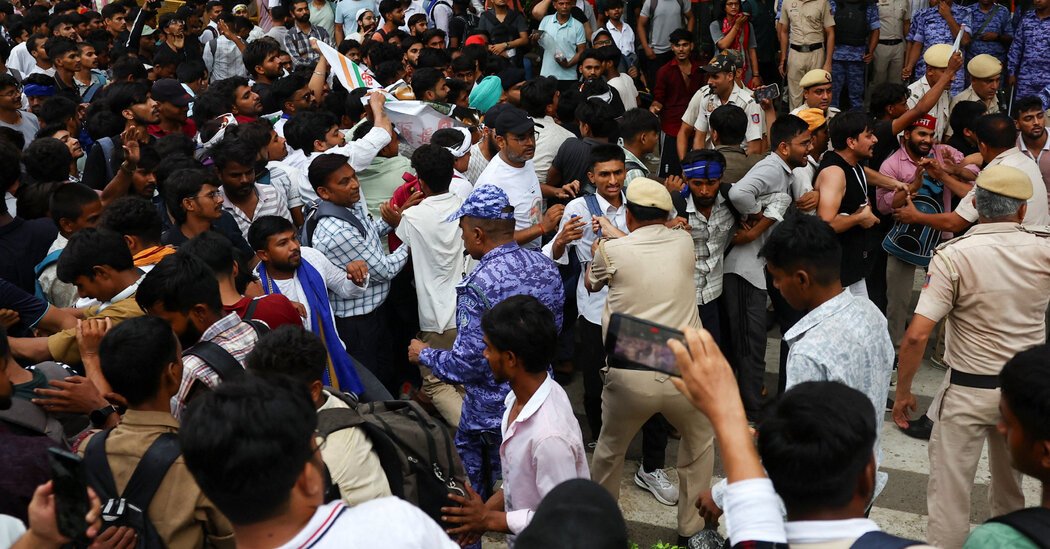
Thousands of Indian protesters gathered to march on Parliament on Monday to demand the resignation of the country’s education minister over botched entrance exams that affected millions of students.
The protest, one of the capital’s largest in years, sets up a potential showdown with the New Delhi police, which has said it would stop unauthorized gatherings.
A weekslong demonstration in the capital swelled on Sunday, a day after police forcibly removed Sonam Wangchuk, a prominent activist who has been on hunger strike for more than 20 days. They moved him to a hospital saying it was for court-ordered essential medical care, despite opposition from his family and fellow protesters.
On Monday morning, crowds started pouring into Jantar Mantar, the site where protests have largely been restricted to in New Delhi in recent years. Mr. Wangchuk has continued his fast at the hospital. His wife, Gitanjali J Angmo, has said that he still hopes to attend Monday’s march, and she has filed a court petition describing her husband’s detention as an illegal abduction.
The government of Prime Minister Narendra Modi has not responded to the protesters’ demands and has warned protesters not to break the law.
Many protesters said they had joined after seeing the government’s heavy-handedness with Mr. Wangchuk. They are angry at the government’s lack of response on an issue that has caused anger across India, where some students have died by suicide because of the stress of exam mismanagement, according to Indian media reports.
“People didn’t raise their voices for long, and those in government think that they don’t have to listen,” Amrita Srivastav, 30, a schoolteacher, who was at the protest site on Sunday along with her partner. “We will make sure they hear us.”
What are the protesters demanding?
The protesters are demanding the resignation of Dharmendra Pradhan, the education minister whom they blame for his handling of the exam leaks.
A tipping point came in May, when more than two million students who took India’s biggest entrance exam for medical school found out that the results would be scrapped because exam questions were leaked and that they would have to retake it.
Those exams — whether for a higher education or for a coveted government job — can be a ticket to a better life. Many families sell land, or borrow money to pay for private tutoring and allow students a chance of success — only to find out that exam questions had leaked and been sold.
Priyam Dubey, 26, a Ph.D. student, said he was told after taking an entrance exam for a fellowship that could fund his graduate degree that the exam was scrapped and that he had to sit for it again.
He said he had also been a victim of the exam leaks in 2024, which forced him to seek doctorate opportunities abroad.
“I gave in the paper, it went really well and next morning when I woke up, the paper got leaked and they canceled the examination,” he said, “I didn’t want to prepare again,” he said.
What is the government’s stance?
Protest leaders say the government has not engaged with them or fostered dialogue. Mr. Pradhan has brushed the protest aside, calling the “the B-team of terrorists.”
Bharti Ghosh, a national spokesperson for Mr. Modi’s ruling Bharatiya Janata Party said there were no restrictions on protest as long as demonstrators have the required permissions and are not breaking the law. She said the government “has no compulsions” to speak to the protesters, referring to Mr. Wangchuk as someone who perpetually engages in hunger strikes.
“The B.J.P. government senses, understands and responds to its people. We are not sensing that the entire country is angry or frustrated,” she said. Police had arrested those responsible for the leaks, and the law will take its course, she added.
The space for protest and dissent in India’s traditionally raucous democracy has shrunk significantly during Mr. Modi’s 12 years in office. His government has cracked down on protests and put activists behind bars, creating a chilling effect on public opposition.
Who are the protesters?
The Cockroach Janta Party, a grass-roots movement, was founded just two months ago and has come to symbolize the anger among India’s youth. It started in response to a rant by India’s chief justice comparing the country’s unemployed youth to cockroaches and parasites. In June, they launched a protest movement demanding accountability over the series of exam leaks.
Mr. Wangchuk, a prominent education and climate activist from the Himalayan region of Ladakh, joined the protest movement and announced a hunger strike until the education minister resigned.
Mr. Wangchuk previously went on a hunger strike last year, demanding that Mr. Modi’s administration fulfill its promise of increased autonomy and development for Ladakh, a strategically important region. Halfway through his 35-day fast, the protest turned violent. The government blamed him and booked him under strict national security law. While Mr. Wangchuk was released about six months later, his detention was seen by other activists as a warning against dissent.
Pragati K.B. contributed reporting.