dailynewsnblog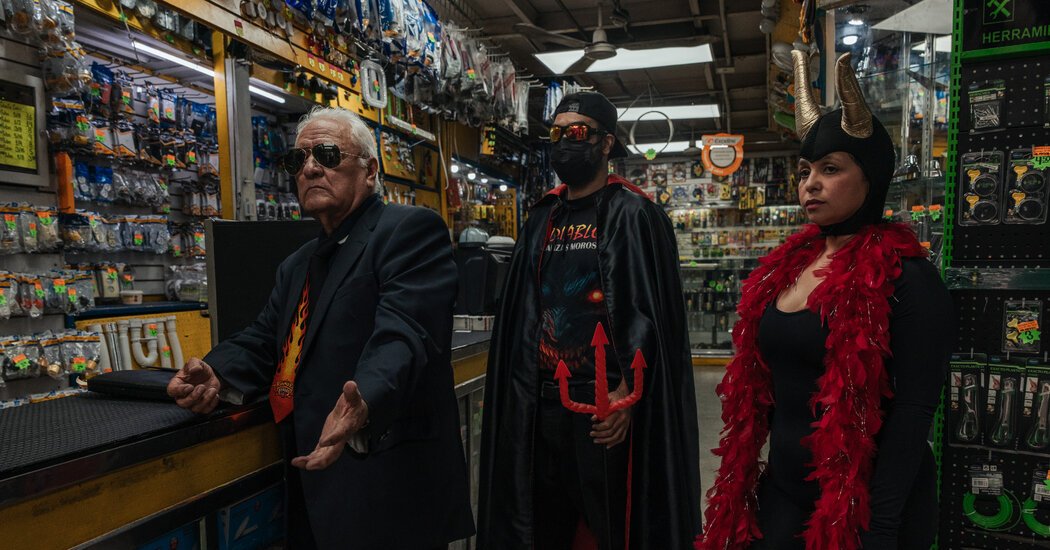
To reach Dr. Diablo’s sanctum, I descended into the basement of a complex of Brutalist towers, its concrete walls heavily stained by decades of vehicle exhaust and tropical humidity.
“Welcome to Purgatory,” proclaimed a sign above a commanding statue of a winged demon.
Swords and antique pistols bedeck the shelves of the windowless room. An illustrated Bible on a book stand was opened to the Flemish Baroque artist Anthony van Dyck’s painting “The Brazen Serpent.”
“I like to make a strong first impression,” said Rodrigo Herrera, arguably Venezuela’s best-known debt collector, as he splashed on some cologne.
His premise is simple: Individuals and companies hire him to collect debts ranging from hundreds to thousands of dollars. As Dr. Diablo, he then uses public humiliation to pressure deadbeats into paying up. Many do after his “Anti-Debtor Mobile Squad” ambushes them, often at work.
This entourage includes a pitchfork-wielding right-hand man clad as the devil; a female “diablita” in demon horns, skintight pants and a sequined red boa; and Mr. Herrera himself in dark sunglasses, a black suit and a flame-adorned necktie.
Such circuslike street tactics reflect the imaginative ways Venezuelans find to resolve disputes in a country where rule of law has been gutted by corruption and one-party rule.
Debts are collected in other ways, and traditionally these methods often involve violence. But Mr. Herrera, 75, explicitly rejects physical intimidation, opting instead for something resembling performance art.
Born in Ecuador, he emigrated to Caracas at age 20 in 1970, when Venezuela ranked among Latin America’s richest nations. After obtaining a law degree, he said he saw Venezuela’s legal system develop into a slow-moving “sewer reeking of corruption.”
But Mr. Herrera said he also smelled a business opportunity in such impunity.
He started his venture, called Dr. Diablo’s, in the 1990s, when a crisis of confidence in Venezuela’s institutions was opening the way for Hugo Chávez’s rise to the presidency.
Since then, Mr. Herrera has charged a commission of about 20 percent of the debts he is hired to collect.
Inspiration for his devilish venture, he said, came from “Curse of the Demon,” a 1957 horror film he saw as a boy. It stars Dana Andrews as an American who travels to London to debunk a satanic cult, only to find its powers are real.
With a flair for the dramatic, the silver-haired Mr. Herrera has taken the prince of darkness routine to a whole other level.
When his retinue headed out one afternoon in May to mortify a debtor, they strutted through the streets of Caracas in full regalia. “It’s the devil!” passers-by yelled, whipping out phones to take pictures.
“I’m a lawyer and I know how the system works,” said Ada Gallardo, 69, one observer. “No one trusts a judge. We need more people like Dr. Diablo to get things done.”
Mr. Herrera and his aides climbed into two flame-emblazoned, smoke-belching vintage pickup trucks, one a 1951 Ford F100, the other a souped-up 1955 Chevrolet Apache called El Demolidor.
The only license plate on the back of The Demolisher was in English. It said, “Viagra: Spice up your life!”
The trucks wound their way through Caracas traffic, drawing more cheers. Then they arrived at their destination: a hardware store in the city center. Its owner, Mr. Herrera said, owed his client thousands of dollars for paint.
Jaws dropped among bystanders as Dr. Diablo’s posse approached the store. He politely asked to speak with the owner. Almost in a whisper, Mr. Herrera told the man he still had debts to pay.
Visibly ruffled, the owner, José Gómez, insisted he was paying in installments. He showed his ledger. Mr. Herrera shrugged. “It’s not enough,” he replied.
“This is absolutely ridiculous,” said Mr. Gómez, 60. “I work hard, I have diabetes, and now I have to deal with this kind of crap.”
Mr. Herrera left, but warned that he’d be back if the debt remained unpaid.
Away from the scene, Mr. Herrera insisted that such work isn’t for the fainthearted. He always packs a gun for self-defense, and said he was largely successful getting his clients money they are owed.
Years ago, when an oil boom lifted Venezuela’s economy and people were spending freely and taking on greater debt, his company was thriving. Dozens of Dr. Diablo billboards decorated Caracas.
One large U.S. law firm once hired him to successfully collect a $1.5 million debt, he reminisced. He walked around with three scantily clad diablitas in tow. A Great Dane, Damián, would accompany him on his rounds.
“Damián’s in heaven now,” Mr. Herrera said.
Business dried up when Venezuela’s economy cratered a decade ago. Clients and debtors alike fled the country. The Covid-19 pandemic forced him to temporarily suspend operations. A leaking roof damaged his subterranean office.
He recently decided to get back in the game. Mr. Herrera said he was now pinning his hopes on oil money pumping life back into the economy after U.S. forces deposed Venezuela’s former leader earlier this year.
“Oil generates spending and spending generates debt,” he explained. “Brother, even the devil has to eat.”