dailynewsnblog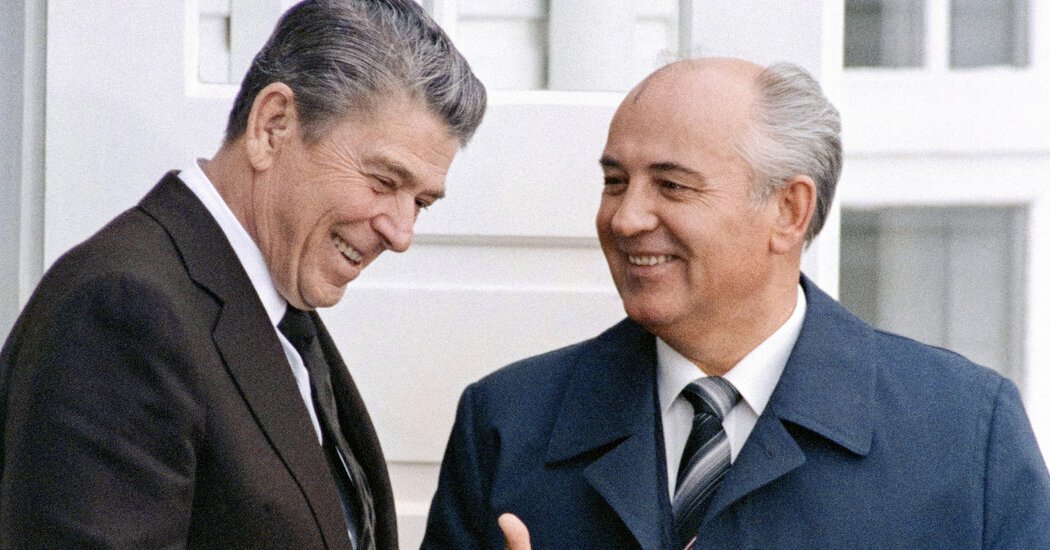
It was, as one person in the room described it, something of an Agatha Christie thriller, if Agatha Christie had written about superpower summits.
There were the leaders of the two nuclear giants huddled in a supposedly haunted house built on top of lava along a windswept coast, with rain lashing the windows and the fate of the world at stake.
The arms control meeting in Reykjavik, Iceland, between Ronald Reagan and Mikhail S. Gorbachev in 1986 has slipped into the fog of history. But the tense, unscripted encounter that was deemed a failure at the time arguably proved to be the beginning of the end of the Cold War.
Now 40 years later, Hollywood has embarked on a mission to rescue Reykjavik from obscurity with a star-studded movie, “The Brink of War,” featuring Jeff Daniels as Mr. Reagan, Jared Harris as Mr. Gorbachev and J.K. Simmons as Secretary of State George P. Shultz. The film, out this weekend, serves as a kind of bookend to the 2023 hit “Oppenheimer,” taking the nuclear arms race born in the remote desert of Los Alamos to its crescendo in the Arctic frontier of Iceland.
“Like any great story, there was a lot at stake,” Mr. Daniels said in a joint interview with Mr. Harris last week. “It was life or death. There were 70,000 nuclear weapons pointed at each other, and nothing to stop them, and that whole mutual assured destruction was not even a deterrent. It was the end of the world.”
Mr. Harris, a British actor, recalled that it felt even more real at the time growing up in Europe. “We were aware that we were on a knife’s edge,” he said. “We were on the front doorstep of any nuclear exchange.”
This is not just history, in the eyes of the filmmakers, but a parable for the current day as well. As wars rage and the world’s superpowers appear headed once again for an arms race, the film is a reminder that in an age of polarization even vast divisions can be bridged.
Somehow, the world’s most famous cold warrior, the man who had condemned the Soviet Union as an “evil empire” that would be left on “the ash heap of history,” found himself in a room with the leader of international communism. And the two agreed that it was time to step back from the precipice of planetary destruction.
“You don’t know if you’re going to find common ground or not until you do,” said Michael Russell Gunn, who wrote the film and made his feature film directorial debut. “I want to encourage people to have courage to talk to one another.”
Mr. Gunn’s movie seeks to make two days of talking into a gripping drama. The film revolves almost entirely around these two leaders, presenting them as fully realized flesh-and-blood figures struggling to overcome profound differences during a weekend at Hofdi House in Reykjavik.
There was, indeed, something cinematic about the real-life Reykjavik meeting. Unlike nearly every other presidential summit, the two leaders sat down without a set agenda and without a pre-agreed outcome. Dispensing with talking points and entourages, they spent more than 10 hours together over the weekend of Oct. 11-12, 1986, talking, arguing, cajoling, needling, haggling and even dreaming. At one point, Mr. Reagan and Mr. Gorbachev decided the United States and the Soviet Union should give up their nuclear weapons — all of them.
“The Brink of War” was shot in Iceland, in the house used for the 1986 summit, with Mr. Daniels, Mr. Harris and Mr. Simmons sitting at the same modest walnut table in the same modest room where Mr. Reagan, Mr. Gorbachev and Mr. Shultz sat along with Eduard Shevardnadze, the Soviet foreign minister.
Mr. Daniels made a point of visiting the house the day before shooting started and just sitting there for a couple hours going over lines and absorbing the history. “You can feel it,” he said. “There’s a presence.”
Mr. Gunn received an alarmed call telling him that Mr. Daniels was at the house. “I get this frantic call from the gaffer,” Mr. Gunn recalled. “‘Jeff’s here! He’s in the chair, like in the dark in the room!’ And I was like, ‘Leave! Get out of there! Leave him be!’ And he was just there to like soak it in.”
By legend, Hofdi House, built in 1909, is haunted by the ghosts either of Viking warriors or a woman who died there called “the White Lady.” The British ambassador in the 1950s was spooked enough to force his ministry to sell the property. Mr. Harris said he never saw any spirits, but joked, “I think the ghost stole my beanie hat, which you know you need in Iceland.”
The White Lady’s accommodations were so small that the C.I.A. and K.G.B. officers who accompanied the leaders quarreled over who got the better bathroom, negotiators drafted documents while sitting on plywood on top of a bathtub and a Reagan aide had to crouch on the floor next to the president’s knees during a staff meeting in a secure room. U.S. and Soviet military officers carrying the two nuclear footballs, which could be used to launch world-ending strikes, stood at attention near each other outside the negotiating room.
Mr. Daniels’s Reagan is not the “Saturday Night Live” version, but a serious figure, at once idealistic yet stubborn, mindful of his brush with death at the hands of a would-be assassin five years earlier and determined to use his additional lease on life to end the nightmare of nuclear Armageddon.
To that end, the moviemakers did not press the physical likeness too much. “We could have put plastic cheekbones,” Mr. Daniels said. “We could have redone my whole face with plastics.” But, he added, “you push the audience away, so that’s what they see are all the externals.”
Instead, he said, he focused on Mr. Reagan’s voice and mannerisms, the cocking of the head. “I had a hook for me, which got me into it, which was the way he said the word, ‘well,’” he said, adopting Mr. Reagan’s husky voice for a moment. “You land that, it’s like a hook in a fish.”
Until the 1986 meeting, the history of arms control talks between the United States and the Soviet Union had all been about slowing the growth of their mutual nuclear arsenals. But there in that whiteboard house on the edge of nowhere the American president and Soviet general secretary decided for the first time to actually reduce the number of nuclear weapons in the world. And they got so excited at one point that they agreed to abolish all of their nuclear weapons.
The unexpected grand bargain fell apart at the last minute over Mr. Gorbachev’s insistence that Mr. Reagan give up plans to try to build a nuclear shield in the form of a missile defense system called the Strategic Defense Initiative, or S.D.I. in the jargon of the day or “Star Wars” to the skeptics. Reagan refused and the two men took leave of each other angry and disappointed.
But what seemed like a letdown changed the course of history and set their two countries on a path toward the destruction of tens of thousands of nuclear warheads. Barely a year later, Mr. Reagan and Mr. Gorbachev signed the first agreement eliminating a whole category of nuclear weapons, the Intermediate-Range Nuclear Forces Treaty, or I.N.F., which led to subsequent pacts negotiated or ratified by George H.W. Bush, Bill Clinton, George W. Bush and Barack Obama bringing down nuclear stockpiles even further.
“It started a precipitous decline in nuclear weapons,” Ken Adelman, who served as the director of the U.S. Arms Control and Disarmament Agency and had to sit at Mr. Reagan’s knees at Reykjavik, said in an interview.
When Mr. Reagan and Mr. Gorbachev met, the Soviet Union had more than 40,000 nuclear warheads and the United States more than 23,000, according to the Federation of American Scientists. Russia now has about 4,400 and the United States about 3,700, or collectively about 13 percent of the Reykjavik-era totals.
Today, however, the world appears heading in a different direction. President Trump withdrew from the I.N.F. treaty in 2019, citing Russian cheating, and the New Start treaty signed by Mr. Obama, the last legal limit on the size of the nuclear arsenals, lapsed in February. While Mr. Trump has talked about brokering a new three-way treaty with both Russia and China, he has done little to actually pursue it.
Mr. Adelman, who chronicled the summit in his 2014 book “Reagan at Reykjavik” and issued a revised version this summer adopting the film’s name, “The Brink of War,” said Mr. Gunn’s film captured “the tension in the room.”
The improvisational approach the two leaders took, he recalled, stunned everyone. “It was going to be a come-as-you-are, a grip-and-grin summit,” Mr. Adelman said. “We were shocked out of our minds that Gorbachev was ready to roll. He wanted something done.”
As for Mr. Reagan, Mr. Adelman said, he too proved something. “What was surprising to me at Reykjavik was how antinuclear Reagan was,” he said. “I didn’t know that. We were mocking the ban-the-bomb guys. We were sneering at them.” And it turned out that, in his own way, Mr. Reagan was one of them.
Mr. Adelman said that while Mr. Reagan’s original S.D.I. vision was fantasy at the time and still has not yet emerged all these decades later, he paved the way for a future focused on defensive weapons, which in recent years have shown their worth in missile systems like Israel’s Iron Dome and America’s Patriots.
Mr. Gunn said he became interested in telling the story of Reykjavik when he was introduced to Mr. Shultz at Stanford’s Hoover Institution. He ultimately dedicated the movie to the former secretary of state, who died at 100 in 2021. “He said even he didn’t truly believe that the Soviet Union could end,” Mr. Gunn said. “It was only Reagan that had this kind of leap of imagination.”
Mr. Daniels said he hopes the film will inspire others to make a similar leap. “I would like to think that the leaders of the world today would have the courage to do what these two guys tried to do back in 1986,” he said. “Get into a room and figure out how to make us a safer world for all of us.”