dailynewsnblog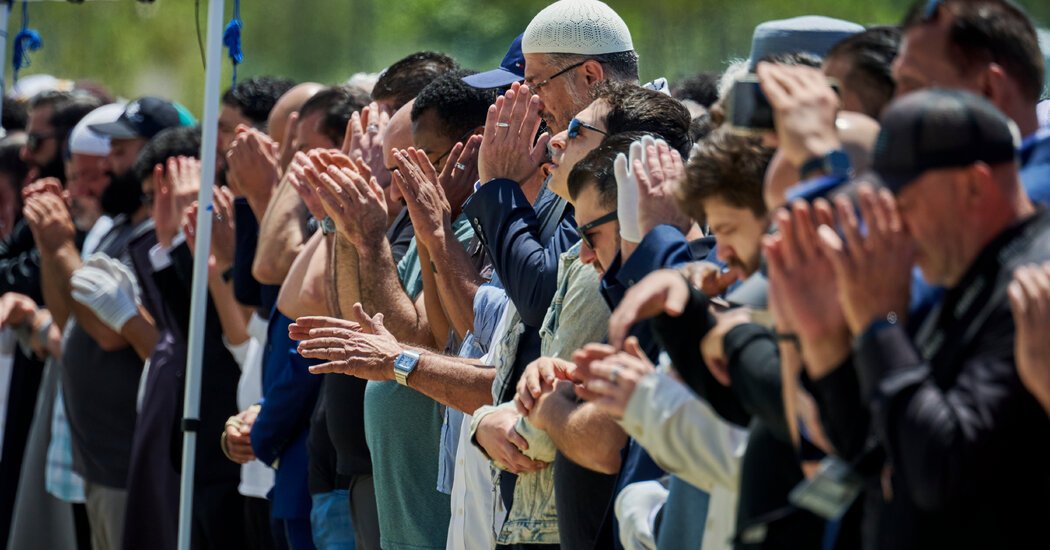
The three hearses rolled into the crowded parking lot and backed up against the edge of the grass at a park.
Muslim mourners typically recite the Janazah, an Islamic funeral prayer, at a mosque. But the three men being buried later on Thursday died as heroes, so the walls of the Islamic Center of San Diego could not hold the vast number of people who wanted to pay tribute to them.
San Diegans will remember the men for years to come. They will think of Amin Abdullah, 51, the security guard who made sure the mosque’s campus, with more than 100 schoolchildren on site, was locked down before he confronted the heavily armed teenagers who seemed intent on carrying out a mass shooting on Monday.
They will recall Mansour Kaziha, 78, the Islamic Center’s store manager and handyman who did whatever the community needed. And they will think about Nader Awad, 57, a worshiper who ran to the mosque from his nearby home and joined Mr. Kaziha in luring the shooters out of the mosque.
All three men were shot dead that day. But the magnitude of their final deeds was so significant that the funeral prayer had to be held at San Diego State University Mission Valley River Park.
Under the late morning sun, the green expanse gradually filled with thousands of people who lined up shoulder to shoulder in rows that covered the length of a football field. Some had traveled from different states. Some had slipped out of work.
They faced in the direction of a small pop-up canopy where the three men’s bodies lay, each draped in a covering. Abdeljalil Mezgouri, an imam at the Islamic Center, led a brief prayer.
The large showing was not simply a matter of paying respects. It was an act of defiance against the hate that had targeted the community and the rise in anti-Muslim rhetoric across the country.
“We are mourning,” Imam Taha Hassane said before the ceremony. “We got hurt. But we are not scared.”
After the prayer, Idi Cisse, 37, spoke in low tones and sounded hoarse when he reflected on his friend, Mr. Abdullah.
He pulled up a video on his phone taken during a recent Ramadan event at the center. It showed Mr. Abdullah, at his post, stepping forward with a smile to greet Mr. Cisse, who was filming. It was one of the last times the two men saw each other, Mr. Cisse said.
“Look around, this is unbelievable,” he said of Thursday’s turnout.
“We don’t hear the outside noise,” he said, alluding to Islamophobic sentiment. “We’re still a community. We love each other.”
As attendees stood in prayer for the three men, some kept returning to the thought of what might have happened had it not been for their actions.
Rana Dbeis, whose 5-year-old son was in school at the Islamic Center on Monday, said it was the largest turnout in the community she had seen.
“Specifically, as parents, we look at our children and we can’t believe they’re still alive,” she said, “but we remember the sacrifice those three individuals made to protect our children.”
She, like many parents, understood that school shootings were a part of American life. So, too, was anti-Muslim sentiment.
For those reasons, she was anxious before signing up her son to attend an Islamic school. Her husband reassured her that the school — unlike other campuses — had security.
“It was because of the security that our kids were kept safe,” she said.
Ms. Dbeis said her son heard the gunshots, and that he was feeling scared. She has been careful not to retraumatize him in conversations, she said.
One point she has gotten across, though, is the bravery of the dead. She explained that Mr. Kaziha was the man who gave out snacks at the center’s store and that the security guard was in fact the man who would meet him with the Islamic greeting of “Assalam Alaikum” every morning.
“So I told him yesterday those men are cooler and braver and stronger than Batman and Superman and Spiderman,” she said. “They protected you guys.”