dailynewsnblog
The takeoff roll of an aircraft is a carefully choreographed transition from a ground vehicle to a flying machine. This phase of flight is governed by a series of critical velocities, but none carries more weight or greater potential for disaster than V1. It is the specific speed beyond which the takeoff must continue even if a major failure occurs. This guide explores the razor-thin margin of error involved in this decision, revealing why a hesitation of just two seconds can transform a safe abort into a catastrophic runway excursion.
The process of a rejected takeoff (RTO) is quite complex and demonstrates the true risks of high-speed operations. While modern jet engines are incredibly reliable, the rare instances of fire, engine failure, or structural damage during the takeoff roll require a split-second commitment to either stay on the ground or take the problem into the sky.
When Is the Right Time To Stop?

The most common misconception regarding V1 is that it represents the speed at which a pilot decides whether to stop or go. In actuality, this definition is dangerously inaccurate. For a pilot to safely stop an aircraft on the remaining runway, the decision to abort must be finalized, and the first physical action must be initiated by the time the aircraft reaches V1. If the decision-making process begins only when the airspeed indicator hits the V1 mark, the aircraft will likely lack the distance to come to a halt before the pavement ends.
Federal Aviation Administration (FAA) and European Union Aviation Safety Agency ( EASA) regulations are very specific about this timeline. These authorities define V1 as the maximum speed at which the pilot must have already recognized a failure and initiated the first action to stop the aircraft. This first action typically involves slamming the thrust levers to idle, applying maximum braking, or deploying spoilers. At this moment, the aircraft is accelerating rapidly, often at a rate of three to six knots per second, so waiting for the non-flying pilot to announce V1 before evaluating the situation is a recipe for an overrun.
As the aircraft nears V1, the mental focus shifts from looking for reasons to stop to looking for reasons to fly. Typically, training programs emphasize that the closer the aircraft gets to V1, the higher the risks of an abort become. By the time the callout is heard, the planning phase is over; now, the pilot is no longer a decision-maker but an executor of a pre-determined flight path.
Sometimes The Sky Is Safer Than The Ground

A fundamental component of the takeoff briefing is the establishment of a line in the sand that divides the ground roll into low-speed and high-speed regimes. For most aircraft, this transition occurs at 100 knots (185 km/h), though some smaller regional jets use 80 knots (148 km/h) as their benchmark. Below this speed, the kinetic energy of the aircraft is manageable, and the risks associated with heavy braking are relatively low. Consequently, pilots are trained to reject the takeoff for almost any anomaly, including minor system alerts, door lights, or non-critical instrumentation failures.
Once the airspeed indicator sweeps past 100 knots (185 km/h), the philosophy of the cockpit undergoes a radical shift. The kinetic energy of the aircraft increases with the square of its velocity, meaning a rejection at high speed is exponentially more dangerous than one at low speed. The formula for kinetic energy dictates that doubling the speed quadruples the energy that the brakes must dissipate as heat. To avoid the extreme risks of tire fires, brake failure, or runway excursions, pilots will only abort the takeoff in the high-speed regime for three specific categories: engine failure, a fire, or a condition that makes the aircraft unflyable.
Scenario | Low-Speed ( | High-Speed (> 100 Knots) |
Engine Failure | Abort | Abort |
Engine Fire | Abort | Abort |
Master Caution / Amber Alert | Abort | Continue |
Unflyable Condition | Abort | Abort |
Open Door / Window | Abort | Continue |
Tire Failure | Abort | Continue (Usually) |
The logic behind continuing with a tire failure at high speed is particularly counterintuitive to the public but vital for safety. Attempting to stop a heavy aircraft on a damaged tire at 130 knots (241 km/h) often leads to a loss of directional control or a fire in the wheel as well as the remaining tires are overloaded. Taking that problem into the air, the crew gains time to burn off fuel, reduce the aircraft’s weight, and prepare for a landing where the full length of a runway and emergency services are ready and waiting. This transition emphasizes that as V1 approaches, the sky becomes a much safer place than the ground.
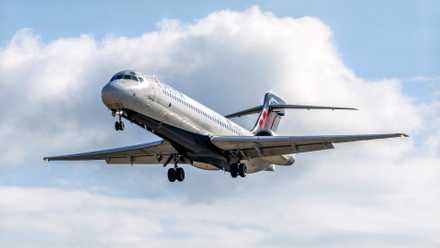
Delta Air Lines Boeing 717-200 Tire Blew Out On Takeoff, But The Pilots Thought An Engine Failed
The aircraft safely returned to Louisville.
Little Room For Error

The margin for error during a high-speed takeoff roll is measured not in minutes or even long seconds, but in the distance an aircraft covers in a heartbeat. At a typical V1 speed of 150 knots (278 km/h), an aircraft is traveling at approximately 253 feet (77 meters) every single second. This means that in the time it takes to blink, the aircraft has already traversed the length of nearly an entire football field. If a pilot hesitates to initiate an abort by even a small fraction of time, the physical runway remaining quickly becomes insufficient to dissipate the massive kinetic energy of the machine.
Certification standards under US code 14 CFR § 25.109 account for this human limitation by building a specific recognition-and-reaction time into the accelerate-stop distance calculations. Regulatory bodies such as the FAA and EASA grant pilots a two-second buffer to recognize a failure and take the first physical action to stop. This two-second window is the razor’s edge of aviation safety, assuming that the pilot will identify the problem in one second and execute the first stopping action in the next. If the startle effect or simple indecision extends this reaction time to three seconds or four seconds, the aircraft will likely enter the grass at the end of the runway at a lethal velocity.
The physics of the stopway become even more unforgiving when environmental factors like rain or slush are introduced. On a balanced field, or a runway where the length exactly matches the minimum required to either fly or stop, there is zero surplus pavement. If a pilot initiates a rejected takeoff at exactly V1, but the runway is contaminated with water, the braking effectiveness can drop by as much as 50%. In these conditions, even a perfect two-second reaction might not prevent a runway excursion. This is why many airlines utilize reduced V1 speeds on contaminated runways, artificially lowering the point of no return to ensure the aircraft can actually stop before the pavement ends.
Saved By The Brakes

When a pilot initiates a high-speed rejected takeoff, the aircraft’s massive kinetic energy does not simply vanish. Instead, it is converted almost entirely into thermal energy through the braking system. For a heavy wide-body jet, the amount of heat generated during a stop from 140 knots (259 km/h) is staggering. To combat this, modern aircraft are equipped with carbon brake discs that can withstand temperatures exceeding 1,832°F (1,000°C), but even these high-tech materials have a breaking point known as the maximum brake energy speed. If an abort is attempted above this speed, the brakes may fuse together or fail entirely, leaving the crew with no way to stop before the runway ends.
To prevent catastrophic tire explosions caused by this extreme heat, engineers use three distinct safety mechanisms within the wheel assembly. The most critical is the fusible plug, a small, threaded bolt with a hollow center filled with a low-melting-point alloy. When the temperature inside the wheel well reaches a critical threshold, these plugs melt, allowing the high-pressure nitrogen in the tires to bleed out in a controlled manner. This prevents the tires from bursting like bombs, which could otherwise sever hydraulic lines or puncture fuel tanks.
Feature | Steel Brakes (Older Jets) | Carbon Brakes (Modern Jets) |
Max Operating Temp | 1,112°F (600°C) | 1,832°F (1,000°C) |
Weight | Heavy / High Mass | 40% Lighter |
Wear Characteristics | Wear faster when hot | Wear faster when cold |
Cooling Time | 45-60 Minutes | 30-45 Minutes |
The cooling period after a high-energy stop is a mandatory safety requirement. Pilots must consult brake cooling charts to determine how long the aircraft must remain on the ground before it is safe to attempt another takeoff. If a crew ignores these canned cooling times and attempts to depart again, they risk a tire fire or a complete loss of braking capability during a second, subsequent abort. This thermal reality reinforces why the decision to stop must be made with absolute certainty: once the brakes are applied at high speed, the aircraft is effectively grounded for the foreseeable future.
Why Pilots Sometimes Land Hard On Purpose
A harder landing often feels dramatic, but it is frequently the safer landing.
Who Has The Authority?

The greatest enemy of a pilot during the takeoff roll is not a mechanical failure, but the startle reflex. When a loud bang or a master warning occurs at 130 knots (241 km/h), the human brain requires time to process the sensory input through the OODA loop: Observe, Orient, Decide, and Act. In a flight simulator, where pilots expect a failure, reaction times are crisp, but in the real world, the sudden transition from a routine takeoff to a life-threatening emergency can cause a cognitive freeze that lasts three to five seconds, well beyond the two-second margin built into the aircraft’s certification.
To combat this, professional flight crews utilize canned decisions and standardized briefings. By pre-determining exactly what failures warrant a stop before they ever push the thrust levers forward, the pilot removes the need for complex analysis during the high-stress roll. If the failure is not on the shortlist for a high-speed abort, then the flight continues as normal. This mental discipline prevents the pilot from hesitating at the V1 mark, ensuring that they do not waste precious feet of runway trying to diagnose a problem that is better solved at 3,000 feet (914 meters).
Training also focuses on the rejected takeoff callout hierarchy. In most modern cockpits, only the captain has the authority to call for an abort, regardless of who is flying the aircraft. This clear line of command eliminates the potential for conflicting actions or dual-control confusion at the most critical moment of the flight.
The Point Of No Return

V1 is mathematically the point of no return, but there exists a vanishingly small category of emergencies where a pilot must choose to abort even after the speed has been exceeded. These scenarios involve unflyable conditions where taking the aircraft into the air would result in an almost certain crash. Examples include a total loss of elevator control, a major structural failure, or a sudden, uncontrollable shift in weight. In these rare cases, hitting the blast fence at the end of the runway is considered a better outcome than falling out of the sky from 500 feet (152 meters).
Key examples, such as the Kalitta AirBoeing 747 overrun in Brussels, highlight the dangers of these high-speed decisions. In that incident, the aircraft suffered an engine failure near V1, and the crew attempted to stop, but the heavy weight and high speed resulted in the aircraft breaking into three pieces after overshooting the runway. Conversely, Garuda Indonesia Flight 865 involved an abort initiated after V1 due to an engine failure. In this event, the aircraft overran the runway and caught fire, resulting in fatalities. These cases serve as a sobering reminder that once V1 is passed, the physics of the stop are no longer in the pilot’s favor.
Some newer avionics suites are being designed to calculate the aircraft’s actual acceleration and remaining runway in real-time, adjusting the V1 speed on the fly to account for wind gusts or engine degradation. Until these systems become universal, the safety of millions of passengers continues to rest on the shoulders of pilots who must be prepared to make a life-altering decision in less time than it takes to read this sentence.