dailynewsnblog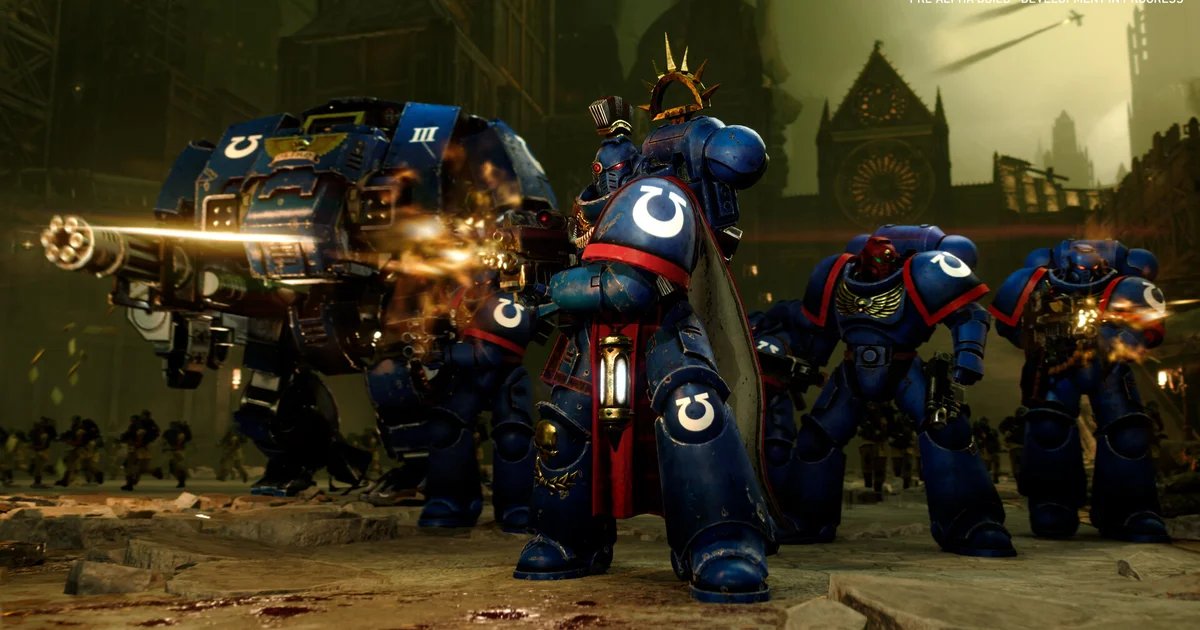
Demo sessions are often terrible ways to see a game, doubly so at conferences. You want to sink into a game at your own pace (and with unbroken access to fresh cups of tea), not get dropped into the middle of the action, hoisted up again 20 minutes later and plonked into another section of a game. However, that’s the nature of these things sometimes and it suits some games more than others.
Total War: Warhammer absolutely does not suit it.
Grand strategy games are built for armchair generals. Not just any armchair, either, a wingback one where the leather on the arms is nearly worn through where said general has rested their elbows in deep contemplation. They’re not games made to be played in short bursts. As such, I can’t really speak to Total War: Warhammer 40,000’s end quality from its Gamescom demo, but perhaps it says something that after an hour where I played 20 minutes of the battle tutorial, 20 minutes of the campaign tutorial, and 20 minutes in a scenario where my Space Marine army faced an overwhelming assault from an ork horde, I still came away keen as the baked beans found in an Astra Militarium ration pack to play the full game.
Watch on YouTube
I think we’ll largely skip over the two tutorial stages, they showed off what you would expect from a Total War game: battles take place on large maps and to succeed you need to wield your units’ strengths and mitigate their weaknesses, largely through how you position them on the terrain. Unlike other games in the series, pretty much every soldier in Total War: Warhammer 40,000 is armed with a gun, so there is a greater emphasis on ranged combat. Maps also revive Empire: Total War#s cover system, so that focus on ranged weapons is matched with choices you can make in positioning. Basically, if you stick your Space Marines in a covered position on the top of a hill, they will eviscerate any Ork Boyz that try to run up the hill to meet the Imperium of Man’s boys in blue in hand to hand combat. Reverse their positions and the Space Marines may become overwhelmed by the charging masses.
“A lot of RTS games are more focused on the matchup,” battle product owner David Petry tells me after my demo, referring to the rock, paper, scissors tactics of games like Age of Empires, where you use cavalry against archers, archers against infantry, and infantry against cavalry. “We care a lot about matchup, it’s really important. But positioning also really matters. Positioning is one of the most important things in Total War. It should almost trump match up.”

As for the sliver of campaign I saw, I built up bases, I moved armies, I launched into battles. It’s very Total War. Though, I didn’t get to see any of the interplanetary gubbins that mark this game out from others in the series. Nor did I see much of the base building that gives you additional support in battles. Though, as Petry says, that part of the game will be important for “teeing up the right stuff for a battle.”
When you’re eyeing up a battle ahead, in traditional Total War games, the best preparation will be to bolster your army. In Total War: Warhammer 40,000, there are off-map playing pieces you can use to tip the odds in your favour. If you have a fleet in orbit on the planet, they can provide bombardment abilities, great big flesh-melting lasers and strafing runs from gunships. You can also build massive howitzers that launch cannon shots on your enemy from miles away. “Making sure that you’ve got a fleet with the right stuff on it, with the right people in the drop pods, and all of that ready to help you out in that battle [means] you can deploy the things that you need where you need them in order to win,” Petry says.
Though, as I say, I didn’t see the link up between these off-map components in the demo I played, in all my battles that prep work had already been arranged.
Instead, rather than talk about the tutorial matches that had been heavily weighted in my favour, I want to talk about the skirmish where I got completely whomped.

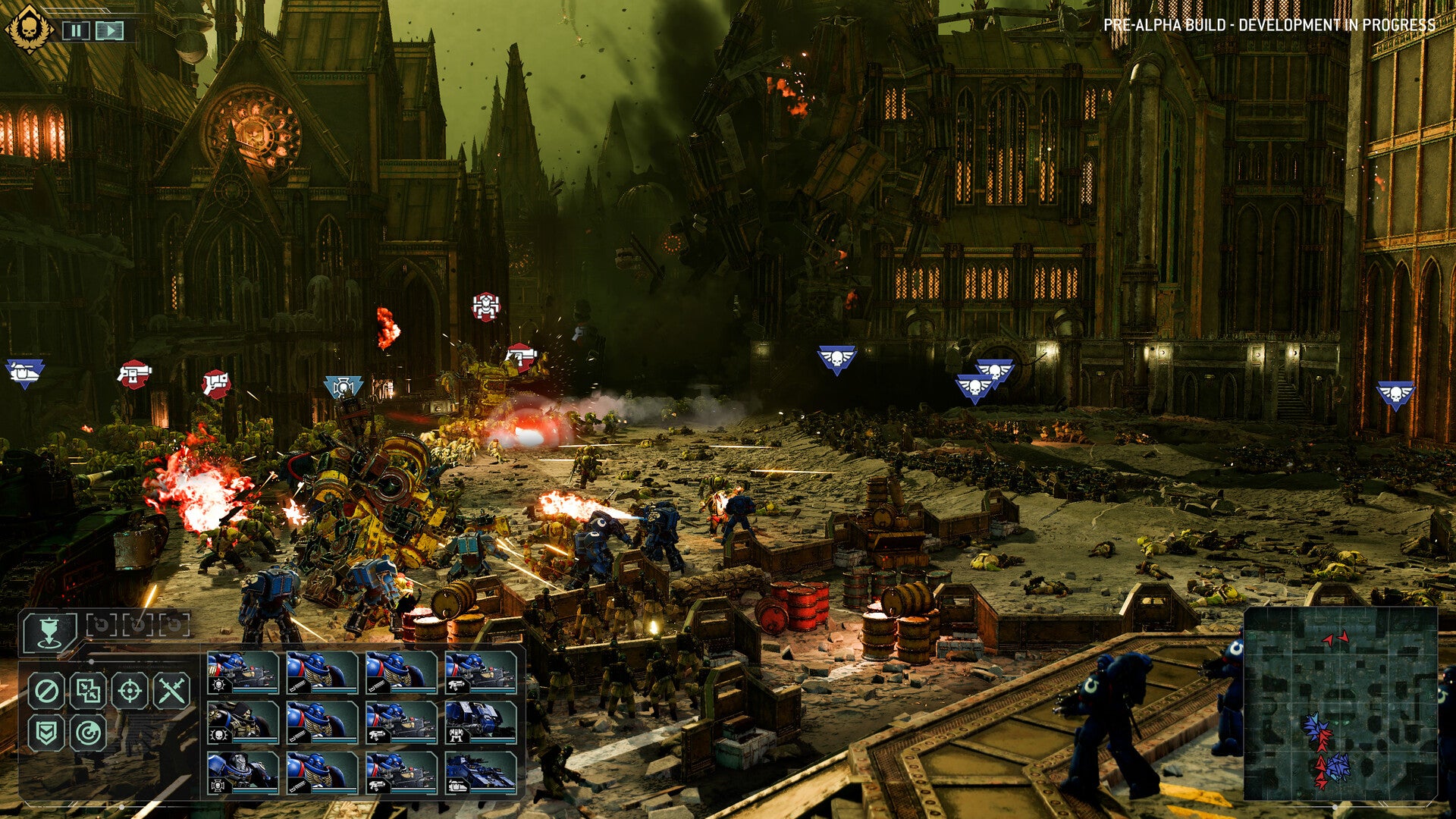
The scenario is simple. The Orks are attacking and, despite giving it their all, the Astra Militarium units holding the line are about to buckle. My job is to take my small Space Marine army and shore up the defenses, cutting down the greenskins and ending their assault. Making things more challenging is that the defensive line has three different capture points I need to hold.
At the start of the match I split up my forces evenly, paying little regard to what types of units I’m sending to each position. That’s my first mistake. The Orks wash across the map like a wave. Unlike my Space Marines that cluster in tens and twenties, each Ork unit looks to be made up of 100 units. I had positioned my troops in cover but their fire does little to thin out the horde. One problem is that the Orks weren’t hitting each spot equally, they’re focusing their numbers on the capture point to the west. My split force means the western Space Marines are facing a huge assault while the others to the east are sat twiddling their thumbs. I hesitate before shifting my forces to the west and too late realise how slow Space Marine infantry is to move. I guess it’s all that heavy blue armour and the fact they’re too proud to run.

Another issue I run into is that I don’t really know what any of my units do. While the Intercessor units I recognise from the battle tutorial are straightforward enough to use as they’re armed with bolt rifles and are good against lightly-armoured personnel, they’re having little effect on the heavily-armoured Orks running them down. As for my other troops, I’ve not seen any of them before and I’m trying to learn their match ups on the fly. I’ve played the tabletop game before, but not for a good 20 years, so most of my Warhammer 40,000 knowledge comes from the Dawn of War games. And, even then, those are played much closer to the battlefield, from my current perspective, many of the troops look indistinguishable to my untrained eye.
I know what I need is Terminators and, while I don’t have any on the field, I do have them in storage up in space. Whoever’s done the prep work for this battle against the Orks made sure my Space Marines have some tricks up their metallic sleeves. Hanging in orbit is a spaceship loaded with some of the Emperor’s finest, ready and waiting in drop pods to join me on the battlefield. And, if you’re dropping the equivalent of a block of flats on the battlefield, you may as well make it work for you. I tell the Terminators to land in the thick of the Ork advance and they plummet right on the heads of some Boyz who are giving my troops grief. My terminators burst out into the fray, ready to split some heads.
Yet, even armed with their storm bolters and powerfists, it’s not enough and, being right in the thick of the horde, they are quickly overwhelmed. I call in orbital weapons – the flesh-melting space lasers, strafing runs, howitzer blasts – but none of it is enough. The battle is well and truly lost. I’d tell my Space Marines to run and fight another day but, well, they’re too proud for that.
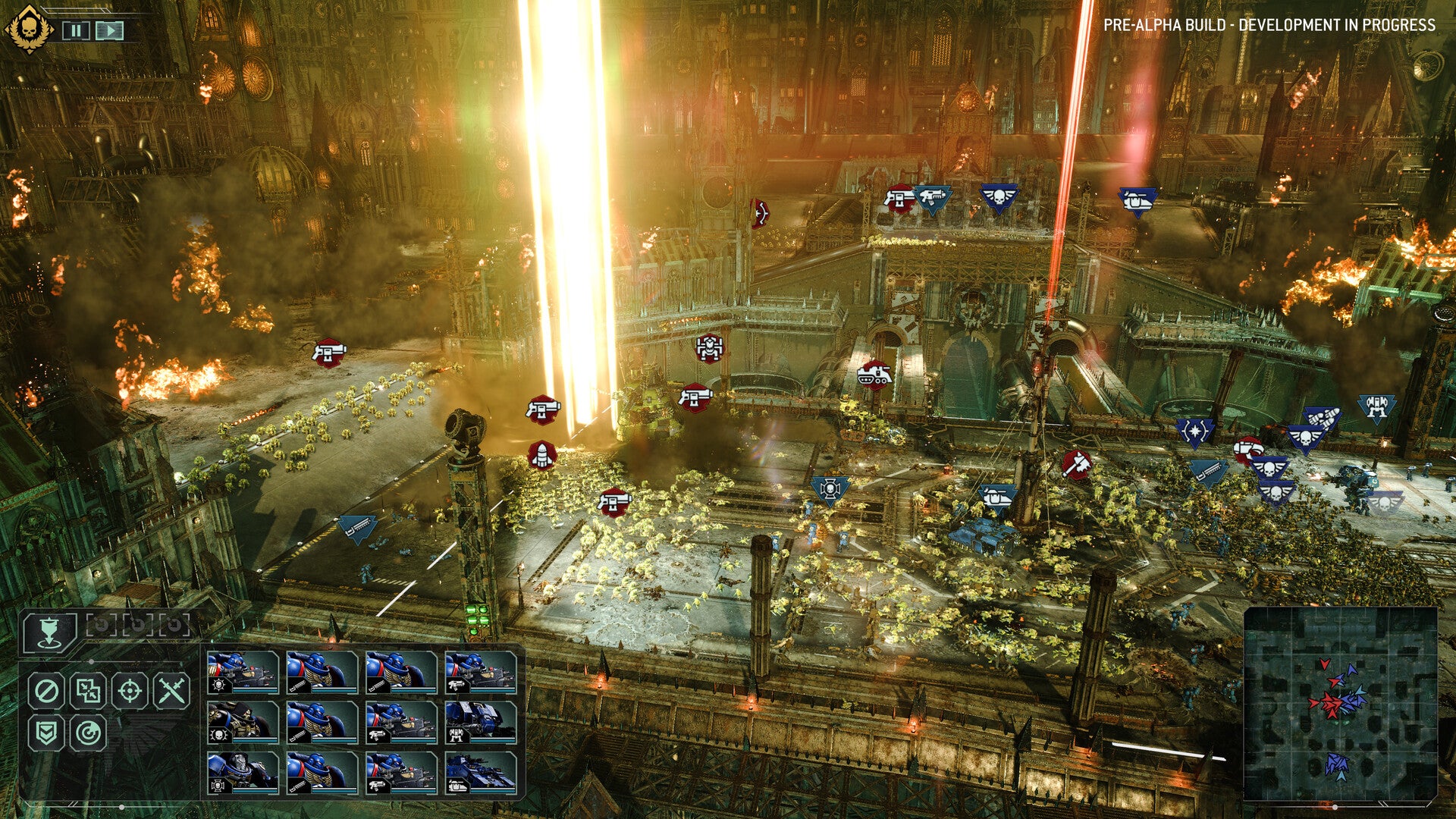
It was a truly sorry effort on my part, and I will lie through my teeth and say it was always intended as a demonstration of the importance of positioning in Total War: Warhammer 40,000. If I had just placed my troops more effectively, and matched my army’s strengths to the Ork’s weaknesses I would have seen off the assault.
Though, I’m also not sure it was entirely my fault. Before I call foul, I will caveat this to my Ultramarine shoulder pads: the structure of this demo was really working against the needs of the game. In normal circumstances, I would likely have arrived at this mission after hours of playing with my army, becoming familiar with its roster and the troops being fielded by my enemy, so I could better exploit the strengths and weaknesses. That said, I will say, I found it a lot harder to read the battlefield than I have in other Total War games. All my Space Marine units were firing on the Orks, but some of them were firing much more effectively than others and I couldn’t immediately tell the difference. In traditional Total War, where most your units are quite obviously melee, ranged, or cavalry, it’s easier to parse what’s happening in the action and how your should adjust your tactics. I struggled with that in this battle. Again, though, with practice will come familiarity.
Something else that came out in the interview after my demo, hints at a tactical depth that will further muddy the ability to tell what’s going on in a battle. Unlike other Total War games where you upgrade your forces universally, in Total War: Warhammer 40,000 you can customise and specialise each individual unit in your army.
“Throughout your campaign, you’re going to be able to upgrade your units and change their equipment in meaningful and punchy ways,” Petry tells me. You can, for instance, replace your Intercessors bolt rifles with shorter range autobolters or longer range stalker bolt rifle. You can also give the unit different sergeants with different abilities. As Petry says, it allows you to “take that army and grow and adjust them as you go, and tune them towards different specialisations.” However, it does also mean that you will need to retain each unit’s differences in your head as you play, making sure that you’re putting the right Intercessor squad in the right position. Mix them up and you might think you’ve got your long-range specialists on the high ground defended by a squad of autobolter-armed troops at the foot of the hill, when in fact your snipers are on the low ground and your short range troops are too far away to provide covering fire when the Ork wave rolls in.
Petry does stress that each unit will have a “core function” and specialisation won’t pull them away from completely, but it’s something I’ll be paying close attention to when we get a longer look at Total War: Warhammer 40,000 in the future.
Travel and accommodation to Gamescom was provided by the conference organisers.