dailynewsnblog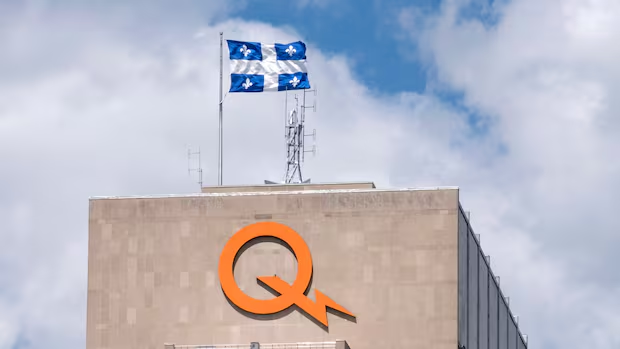

Listen to this article
Estimated 3 minutes
The audio version of this article is generated by AI-based technology. Mispronunciations can occur. We are working with our partners to continually review and improve the results.
A report commissioned by Hydro-Québec is recommending the utility forgive more than $250 million in unpaid electricity bills owed by members of some First Nations and Inuit communities.
The report, prepared by retired Quebec judge François Rolland, was commissioned by Hydro-Québec after a 2024 Radio-Canada investigation revealed the scale of unpaid electricity bills by people living in 15 communities.
According to the utility, nearly half the customers in those communities have outstanding balances.
The report’s central recommendation is for Hydro-Québec to transfer the debts to the communities themselves and let them decide whether to collect the money, reduce the debts or forgive them altogether.
Rolland said the recommendation is intended to support “economic reconciliation” by building new relationships based on respect, trust and recognition of the historical and contemporary realities experienced by members of First Nations and Inuit communities, he told Radio-Canada.
Years-long struggle for Hydro-Québec
Radio-Canada previously reported that in some communities, the average amount owed by residential customers had reached tens of thousands of dollars. In Matimekush-Lac John, the average unpaid balance was about $65,000 in 2024, while averages in Chisasibi and Nutashkuan were about $39,000 and $35,000, respectively.
For years, Hydro-Québec has struggled with how to address the growing debts, often avoiding aggressive collection efforts or electricity disconnections while also maintaining that all customers should be treated fairly.
The report also recommends giving communities the option of receiving a single electricity bill rather than billing each household individually. The community would then be responsible for distributing the costs among residents.
In a statement, Hydro-Québec said it is reviewing the recommendations and assessing their feasibility, as well as their implications for fairness to all customers and compliance with Quebec’s energy regulations.
The utility said some of Rolland’s recommendations are already being implemented, including improving communications with Indigenous customers and expanding energy-efficiency initiatives in communities.
Cree chief doesn’t support forgiving debts
Irene Neeposh, the outgoing chief of Waswanipi, said she does not support erasing all outstanding bills or transferring the responsibility for collecting them to Indigenous communities.
“If they want to pass this off to the communities and leave it up to them to collect [the money] if they can — and then wash their hands of it — they won’t solve the problem,” she told Radio-Canada.
According to her, this will further marginalize Indigenous people from the rest of the population.

Neeposh said she believes communities located next to hydroelectric generating stations should receive free electricity, but that most customers should still be expected to pay for the power they use.
She also said Hydro-Québec should invest in financial literacy programs and liaison officers who can help residents better understand their bills and “the importance of being an economically independent citizen.”
The Assembly of First Nations Quebec-Labrador, which advised Rolland during his review, told Radio-Canada it intends to study the recommendations before commenting publicly.
Meanwhile, Hydro-Québec has not indicated when it expects to decide whether to adopt the report’s recommendations.