dailynewsnblog
So much for that theory.
Welcome to the world’s first plague cemetery
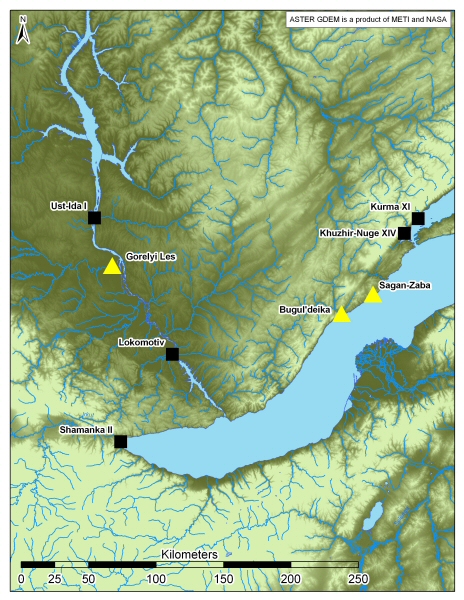
The Angara River flows from the depths of Lake Baikal. The people who lived along it thousands of years ago survived by hunting, foraging, and fishing. They would have lived in relatively small groups, but they seem to have stayed connected across hundreds of kilometers through marriage and family ties. Although their lifestyle would have been one of constant movement, they buried their dead in cemeteries such as Ust’-Ida, interring them with offerings of clay pots, stone tools, and bone and antler points.
Credit:
By Tara Young, taray@ualberta.ca and NASA https://wist.echo.nasa.gov/api/ – NASA’s freely offered GDEM https://wist.echo.nasa.gov/api/, Public Domain, https://commons.wikimedia.org/w/index.php?curid=21156871
This map shows the location of Ust’-Ida I and Shumilikha cemeteries near Lake Baikal and the Angara River
Credit:
By Tara Young, taray@ualberta.ca and NASA https://wist.echo.nasa.gov/api/ – NASA’s freely offered GDEM https://wist.echo.nasa.gov/api/, Public Domain, https://commons.wikimedia.org/w/index.php?curid=21156871
At Ust’-Ida, archaeologists with the Baikal Archaeology Project unearthed a grim mystery: an unusually high number of dead children, a cluster of radiocarbon dates suggesting that many of the cemetery’s occupants died at around the same time, and no evidence of violence. Something tragic happened to this ancient hunter-gatherer community, but what? Archaeologists thought ancient DNA might shed some light on the mystery.
Macleod and his colleagues started with shotgun sequencing, a technique used to identify the DNA sequences in a sample when scientists don’t know exactly which organisms they’re looking for. They used samples from the roots of 46 ancient people’s teeth from four different cemeteries along the Angara River.
And to their complete surprise, they found plague.
Fun fact: Because dental roots are fed by lots of blood vessels, anything in your bloodstream is likely to pass through your teeth at some point, which means if you die with the plague, it may leave its DNA behind in your teeth. “This is really cool evidence that the plague was in the bloodstream, which is lethal,” said co-author Frederik Seersholm, a University of Copenhagen ancient DNA researcher who clearly knows a fun fact when he sees one, in a press conference.
About 11 of the 31 people Macleod and his colleagues tested at Ust’-Ida had Y. pestis DNA in their teeth, and Macleod says that’s “consistent with pretty much everybody [in the cemetery] having died of plague,” not just those 11. That’s because the detection rate for plague DNA in the remains at Ust’-Ida matches that at Smithfield’s, a known mass grave specifically for plague victims in London. It’s safe to assume everyone buried there had the plague.