dailynewsnblog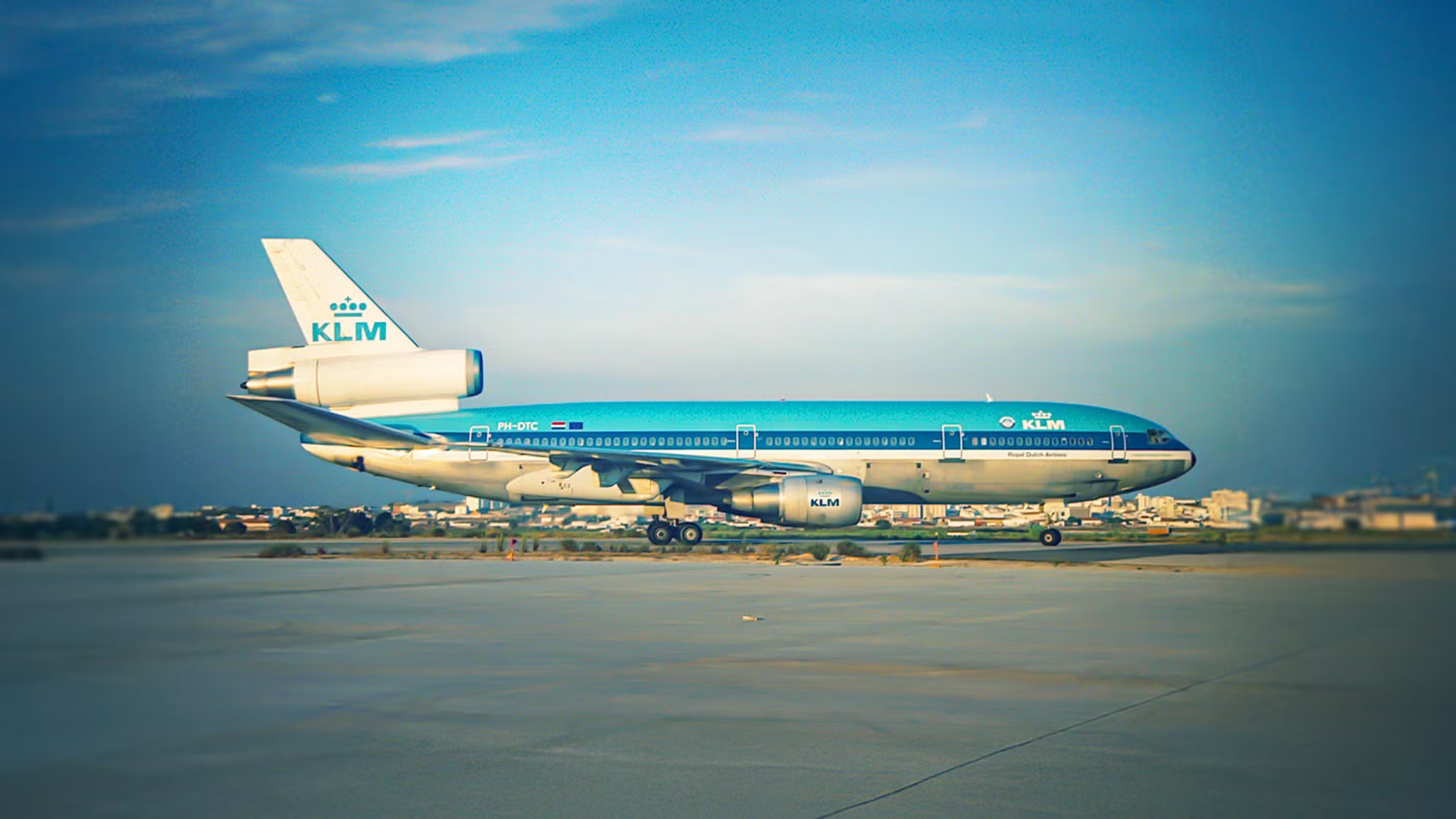
During the late 1960s and early 1970s, European flag carriers were confronted with a challenging commercial reality. The massive Boeing 747 offered unparalleled passenger capacity, but its immense size left it highly uneconomical on long-haul routes that required frequency rather than sheer volume. Airlines desperately needed a flexible, long-legged widebody capable of anchoring thinner intercontinental routes across the Atlantic, Africa, and Asia without draining cash reserves on half-empty flights.
Enter the McDonnell Douglas DC-10, an extended-range trijet that quietly transformed the intercontinental strategy of Europe’s top airlines. By introducing an upgraded powerplant and a vital structural modification to support heavier fuel loads, this aircraft gave carriers the exact tool they required. It became the operational spine for cross-continental expansion during a period of intense economic volatility.
A New European Standard

The massive financial commitment required to purchase and maintain a fleet of modern widebody aircraft led to an unprecedented corporate alliance across European borders. Four prominent airlines joined forces to form the KSSU consortium: KLM, Swissair,  SAS, and Union de Transport Aériens (UTA). Together, these companies standardized their aircraft specifications down to the smallest detail. It meant that an aircraft built for Swissair possessed the exact same galley inserts, cockpit instrumentation layouts, and mechanical subsystems as one delivered to KLM.
The consortium achieved massive economies of scale that changed the economics of maintenance. Instead of each airline purchasing specialized tooling and training separate workforces for every complex system, they divided the maintenance responsibilities. KLM took charge of overhauling the massive General Electric CF6 turbofan engines, while Swissair managed the heavy airframe maintenance at its Zurich engineering base. Meanwhile, SAS focused on specialized component overhauls across its Scandinavian facilities.
The specific long-range variant of the DC-10 chosen by the consortium required extensive structural enhancements to operate effectively over vast distances. To carry the extra fuel required for grueling transatlantic and trans-Asian routes, the maximum takeoff weight escalated to 580,000 lb (263,084 kilograms). This added weight necessitated an additional two-wheel landing gear leg mounted directly on the centerline of the fuselage, a modification designed to protect airport runways from excessive structural stress during heavy arrivals and departures.
Some Catastrophic Flaws

The early operational history of the widebody trijet was marred by severe engineering challenges that required immediate, decisive action from global operators. The primary vulnerability lay in the cargo door design, which utilized an electrical latching mechanism that could close the exterior door without completely engaging the internal locking pins. If a ground handler forced the external locking handle shut, the cockpit indicator light would turn off, signaling a secure door, when it was actually highly vulnerable to pressure changes. This catastrophic flaw resulted in the Turkish Airlines Flight 981 incident.
European operators responded to these crises by implementing immediate, rigorous inspection regimes and demanding permanent engineering redesigns from the factory. McDonnell Douglas rectified the issue by installing an inspection window, allowing ground crews to visually verify that the internal locking pins were fully engaged before flight. They also added heavy steel support plates to prevent the latching hooks from slipping under immense cabin pressure.
European carriers also completely overhauled their flight crew training procedures to handle critical inflight emergencies. The aim was to enable pilots to successfully control the heavy widebody even if critical hydraulic lines running through the tail section were compromised. These combined engineering and training achievements successfully restored public confidence, transforming the trijet into a reliable long-haul asset.

The Striking Differences Between The McDonnell Douglas DC-10 & MD-11
Discover how the DC-10 and MD-11 reshaped wide-body design, defined the trijet era, and why their legacy still lingers in today’s skies.
Working Around The Rules

Before the advent of modern twin-engine regulatory frameworks, ocean crossings were heavily restricted by global aviation authorities. The strict 60-minute rule prevented twin-engine aircraft from operating routes that took them more than one hour away from an adequate diversion airport. While a four-engine jumbo jet could fly anywhere in the world without these geographic restrictions, it remained far too large to operate profitably on thinner long-haul routes. The trijet configuration offered the perfect economic compromise for European network planners.
Using its three engines, the aircraft completely bypassed the restrictive 60-minute rule while burning significantly less fuel than a traditional four-engine jumbo jet. KLM utilized its fleet to connect Amsterdam to destinations across the Caribbean and the mid-Atlantic, and Swissair leveraged the long range of the airframe to link Zurich with rapidly growing markets in South America and West Africa. The aircraft allowed these mid-sized European nations to sustain profitable intercontinental operations across distances exceeding 5,400 nautical miles (10,000 kilometers) without relying on massive passenger volumes.
Those high volumes were the key and became the core reason carriers across Europe opted for the type. The aircraft’s characteristics made it a long-haul powerhouse while also being more than suitable for intra-European routes, where demand was high, and a high-volume aircraft was needed to stay on top.
What It Was Like To Fly

Operating the intercontinental trijet meant a three-person flight crew, which today seems a lifetime away from the standard two-person crew. The cockpit environment featured positions for the captain, the first officer, and a dedicated flight engineer, who managed an expansive wall of mechanical gauges, switches, and system controls located on the right side of the flight deck. It may not have been a role at the controls, but it was equally demanding, constantly monitoring fuel balancing, electrical distribution systems, and cabin environmental controls, freeing the two pilots to focus completely on navigating the heavy widebody.
Handling the aircraft was also sometimes challenging, requiring significant physical effort from the pilots, particularly during the critical landing flare. The number two engine was mounted high in the vertical stabilizer, and reducing power during landing created a distinct aerodynamic pitch-up moment. Unlike the S-duct configuration found on competing trijets, this aircraft utilized a straight-through tunnel design. This layout optimized airflow and maximized the aerodynamic efficiency of the powerplant, but any adjustment to the throttle directly altered the aircraft’s pitch attitude.
Handling was not always an arduous task, and pilots developed a deep respect for the airframe due to its robust design and predictable handling qualities in turbulent, high-altitude air. The massive control surfaces provided highly responsive handling despite the sheer scale of the airframe. The wide flight deck windows also offered excellent external visibility, which significantly aided pilots during manual visual approaches into challenging airfields across Africa and South America.
Where In The World Is The DC-10 Still Flying?
Only eight DC-10s remain operational around the world – mostly in the United States as firebombers and tankers.
A New Lease Of Life

After many years at the peak of its powers, the appeal of the DC-10 began to fade in the face of newer, twin-engine efficiency. Many legacy airframes face the scrap heap, but the rugged construction and excellent load distribution of the long-range trijet made it an ideal candidate for a completely different operational chapter. Major global freight operators quickly recognized that the aircraft’s strong floor structure and spacious main deck could easily be repurposed to handle heavy cargo containers on demanding overnight routes.
Catch what other flight trackers miss
Emergency squawks, holds, NOTAMs — live signals, no signup.
Open tracker
Catch what other flight trackers miss
Emergency squawks, holds, NOTAMs — live signals, no signup.
Open tracker
To make these older jets economically viable in a modern aviation environment, a massive technology refresh was developed. The modification retrofitted the digital two-crew glass cockpit of the newer MD-11 directly into the older airframes. Just this single upgrade completely eliminated the need for a flight engineer, allowing cargo carriers to operate the aircraft with just two pilots at the controls, which drastically lowered daily operating costs and simplified crew scheduling.
Specialized Variant / Role | Fleet Production Metrics | Key Operational Enhancements |
MD-10 Freighter Conversion | Extensive retrofits for cargo carriers | Digital two-crew flight deck that eliminated the flight engineer role |
KC-10 Extender Tanker | 60 airframes built for military service | Advanced aerial refueling booms and auxiliary center fuel bladders |
10 Tanker Air Carrier | Specialized wildland firefighting conversions | Exterior belly tanks holding 11,600 gallons (43,910 liters) of retardant |
The airframe’s remarkable structural adaptability extended far beyond standard commercial cargo hauling. The United States Air Force capitalized on the trijet’s immense fuel capacity by ordering 60 bespoke variants, designated KC-10 Extender, to serve as advanced aerial refueling tankers. In civil defense, massive tanks were mounted underneath the fuselage to create the 10 Tanker Air Carrier, turning the former passenger jet into a highly effective aerial firefighter capable of dropping thousands of gallons of fire retardant over roaring wildfires within seconds.
The Final Example

The commercial passenger story of the historic widebody finally reached its ultimate conclusion in February 2014. At this point, global airlines had long since transitioned to computerized twin-jets. Biman Bangladesh Airlines continued to operate a single pristine -30 model, registered as S2-ACR, on its scheduled international network. This lone survivor became a magnet for aviation purists eager to experience the distinctive mechanical roar of the straight-through-the-center-tail engine one last time before the type left passenger service forever.
Between February 20 and February 24 of that year, the airline operated a series of special farewell flights from Dhaka to Birmingham, drawing traveling enthusiasts from across the globe. These final rotations reminded the world just how incredible the durability of an airframe that had spent more than four decades cutting through global airspace without losing its structural integrity really was. The successful completion of these flights put an end to the DC-10’s time conquering the world.
Today, the architectural legacy of this iconic widebody lives on in the very structure of the modern networks it helped create. The reliable operations maintained by the early European pioneers made long-haul flying both highly predictable and financially sustainable on secondary routes. The rugged trijet provided the foundational proof of concept that directly paved the way for the high-efficiency twin-engine operations that dominate global travel today.