dailynewsnblog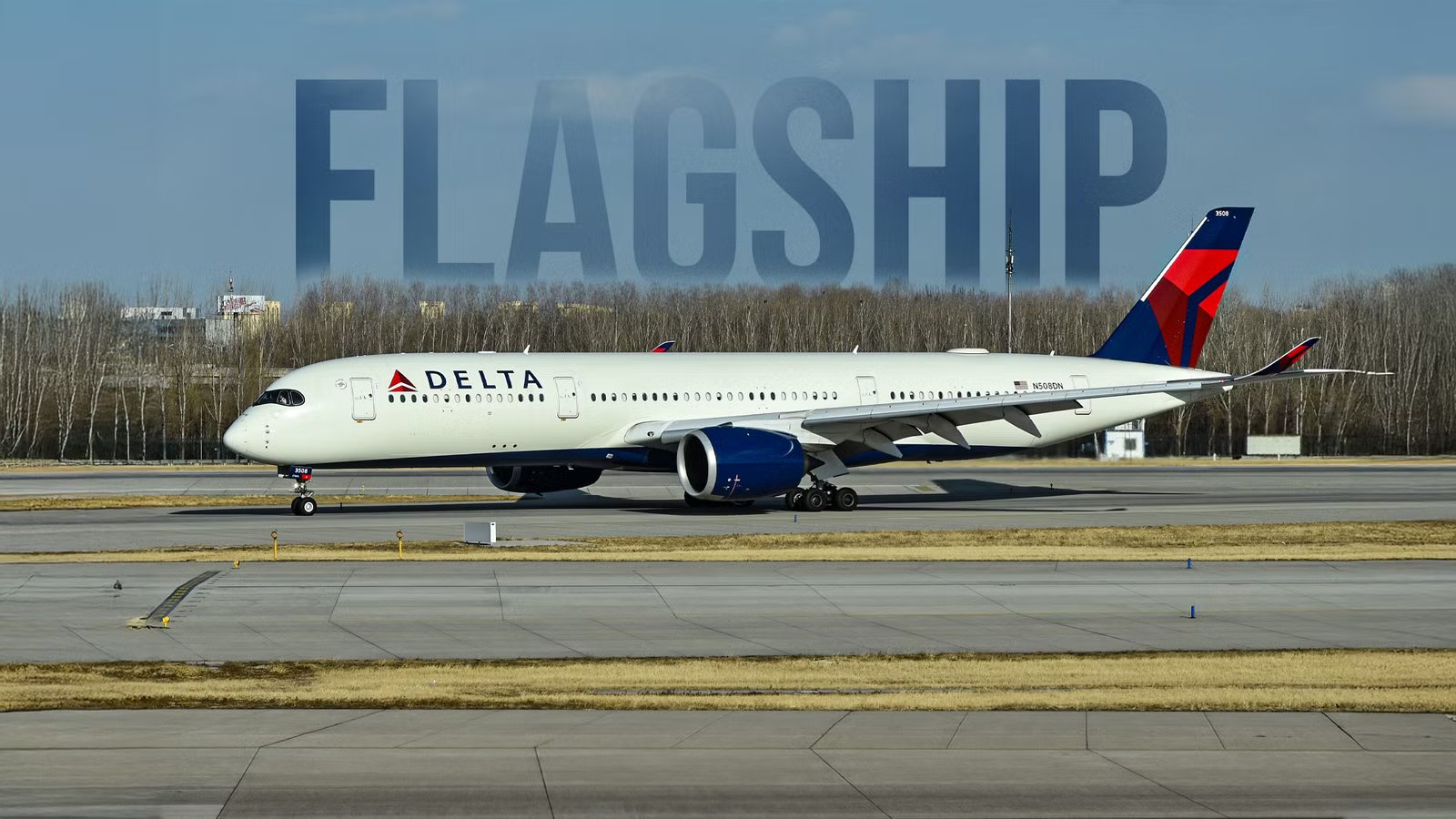
The global pandemic upended commercial aviation significantly, and during this time,  Delta Air Lines made a decisive fleet choice that set it apart from its legacy domestic peers.
  United Airlines and
  American Airlines maintained their extensive Boeing 777 fleets, but Delta accelerated the full retirement of its 18 777-200ER and 777-200LR jets. In doing so, the Atlanta-based carrier raised the Airbus A350-900 to sole flagship status across its long-haul international network. Today, Delta remains the only US airline operating the A350, using the twin-aisle jet as the anchor for its most lucrative transoceanic routes and premium passenger products.
Delta operates a growing core fleet of A350-900s, with additional deliveries planned to bring its primary A350-900 commitment to over 40 airframes before new options begin arriving later in the decade. Plenty of A350 operators distribute these widebodies thinly across their global hubs, whereas Delta utilizes the A350 as a targeted strategic instrument.
Leading The Fleet

Transpacific flying is one of the most demanding operational environments in civil aviation, where airframes cover vast distances over the Pacific Ocean while carrying heavy payloads against strong seasonal headwinds. To solidify its long-haul presence across East Asia and Oceania, Delta standardized all 17 of its continental US-to-transpacific routes exclusively on the A350-900 by spring 2026, as reported by Aeronautics Magazine.
Delta previously utilized a mix of Airbus A330-900neos and A350-900s across Pacific corridors; however, deep ocean sectors, such as  Hartsfield-Jackson Atlanta International Airport (ATL) to
  Seoul Incheon (ICN) and
  Detroit Metropolitan Wayne County Airport (DTW) to
  Tokyo Haneda Airport (HND), benefit significantly from the A350-900’s extended range of up to 8,100 nautical miles (15,000 km) and higher maximum takeoff weight. Moving the A330neo family off deep Pacific routes allows Delta to redeploy those aircraft onto transatlantic sectors, where shorter stage lengths better match the A330’s operational sweet spot.
A major driver behind this transpacific concentration is Delta’s strategic joint venture with Korean Air. Operating from Korean Air’s hub at ICN, Delta uses the A350-900 to deliver high volumes of premium travelers connecting across Southeast Asia and East Asia. As noted by Simple Flying, equipping these transpacific flagships with 40 enclosed Delta One Suites and 40 Premium Select recliners enables Delta to capture high-yielding corporate demand and keep the highest operational reliability on routes spanning over 7,000 miles (11,265 km).
Making The A350 An Integral Part Of Delta

Among the three major legacy carriers in the US, widebody fleet selection has split into two distinctly different paths. In the case of United Airlines, it built its long-haul network around the Boeing 787predominantly. American Airlines similarly standardized strictly on 777 and 787 airframes, whereas Delta Air Lines charted an independent course centered on Airbus twinjets. Delta placed its international long-haul strategy in the hands of the Airbus A330neo for transatlantic routes and the A350 as its flagship, deepening that commitment by ordering 20 Airbus A350-1000 aircraft with 20 additional options, as per Simple Flying reporting.
As industry analysis from Cranky Flier highlights, acquiring the larger A350-1000 brings a strategic upgauging play on high-volume routes without introducing separate fleet complexity. Because both A350 variants share a single pilot type rating, simulator network, and maintenance infrastructure at Delta TechOps, crew allocation is remarkably efficient. In contrast, while United relies heavily on the Boeing 787-9 and 787-10, as per Simple Flying, those airframes cannot match the combination of a 9,000 nautical miles (16,668 km) range and massive payload capacity offered by the A350-1000.
Measuring 242 feet (73.78 meters) in length, the A350-1000 gives Delta a direct and immediate answer to the delayed Boeing 777X program, bringing in high-capacity long-haul capability years before competing aircraft reach rival domestic fleets. Crucially, introducing the -1000 initiates a structured fleet cascade across Delta’s global network. The larger flagship will take over primary trunk routes out of Atlanta, Detroit, and Los Angeles, and those displaced A350-900s shift to replace Boeing 767-300ER and 767-400ER jets. With that, the -1000 lowers unit fuel burn by roughly 25% compared to previous-generation widebodies while establishing Delta as the exclusive operator of the largest A350 variant in North America.
Why Is The A350 So Important?

Targeting entry into service in mid-2027, the A350-1000 offers Delta a critical growth mechanism in an era of severe airport infrastructure limits. At slot-constrained global gateways such as  London Heathrow Airport (LHR) and Tokyo Haneda Airport (HND), adding extra flight frequencies is frequently impossible due to strict environmental caps and runway congestion. This is precisely why Delta opted for the A350-1000. With an extended range of 8,700 nautical miles (16,112 km) and a significantly larger fuselage capacity, Delta can expand available seat count and belly-hold cargo volume on high-density corridors without needing to find those scarce additional departure slots.
When the A350-1000 takes over premier trunk routes from the largest hubs, displaced A350-900s push down into secondary long-haul markets. In turn, those A350-900s step in to replace the outgoing older aircraft in the fleet on high-volume transatlantic routes out of  New York JFK Airport (JFK) and
  Boston Logan International Airport (BOS), ultimately allowing smaller A330neos to backfill those routes and give Delta a more manageable fleet retirement plan.
Maintaining premium revenue density across every level of this fleet shift remains central to the operational plan. Equipping the incoming A350-1000 fleet with next-generation Delta One Suites and expanded Delta Premium Select cabins allows the airline to protect its highest-yielding passenger segments and scale capacity. Critically for Delta, maintaining a uniform high-end cabin product across both A350 variants ensures commercial consistency, getting the most passenger revenue per departure throughout the international network.
A Perfect Match?

Beyond expanding passenger capacity and network reach, keeping the long-haul flagship under a single aircraft family provides significant operational efficiencies for flight operations. A core strength of the Airbus widebody ecosystem is the shared Same Type Rating between the A350-900 and A350-1000, as noted by The Points Guy. Flight crews can transition between the two variants with minimal flight training, giving dispatch schedulers the ability to deploy pilots flexibly across either model. Furthermore, Airbus flight deck commonality extends across the wider long-haul fleet, reducing training overhead and enabling smoother crew scheduling across international pilot bases.
The economic benefits are equally pronounced on the technical and maintenance side, where Delta TechOps plays a pivotal role. As an authorized maintenance, repair, and overhaul center for Rolls-Royce Trent powerplants, Delta manages engine shop visits and maintenance for both the Trent XWB-84 and the higher-thrust Trent XWB-97 in-house. Operating a 130,000-square-foot (12,077-square-meter) engine facility in Atlanta allows the carrier to keep engine turn times low, maintain strict quality control, and mitigate global supply chain issues. Instead of paying third-party overhaul rates, Delta leans on its technical division to generate auxiliary revenue by servicing Trent engines for global airline customers.
The deep technical integration Delta has reduces capital expenditure when introducing the larger variant. According to Airbus, the A350-900 and A350-1000 share a high degree of airframe, avionics, and line-replaceable unit commonality, allowing line maintenance stations worldwide to use existing ground support equipment and spare parts inventory. With a streamlined widebody fleet focused on the A330neo and two A350 variants, Delta avoids the cost penalties and spare engine burdens associated with operating competing airframe and engine types.
The Era Of Premium

Delta has increasingly leaned into premium seating as a core differentiator for its long-haul international strategy. Nowhere is this shift more evident than in the cabin modifications introduced across the A350 fleet. On select ultra-long-haul routes where payload restrictions frequently challenge economics, such as non-stop flights from ATL to  Johannesburg Airport (JNB) and Cape Town International Airport (CPT), Delta configured a higher-density premium A350-900 variant, as noted by Simple Flying. By increasing Delta One suites from 32 to 40 while reducing Main Cabin capacity from 190 to 159 seats, the carrier shed 30 total seats. The airline was able to take out low-yield weight to up the revenue per available seat mile, allowing the aircraft to operate at full passenger load without sacrificing valuable belly cargo capacity.
The upcoming arrival of the A350-1000 will mark the next step in Delta’s long-haul passenger experience. Including all of the aforementioned benefits that the aircraft brings to Delta, the flagship widebody will debut the next-generation Delta One suite. Designed around customer feedback, these new suites feature full-height sliding privacy doors, memory foam cushions with pillow-top layers, and 24-inch (61-cm) 4K QLED seatback entertainment screens, the largest installed across the carrier’s fleet, as per Head For Points. Every cabin will also incorporate Bluetooth connectivity, USB-C ports, and universal AC outlets. Combined with expanded Delta One dedicated lounges at gateways like  Los Angeles International Airport (LAX), Delta is crafting a unified end-to-end premium journey aimed squarely at high-yield business travelers and affluent leisure passengers.
Older variants are fast approaching retirement, and so the strategic pairing of the A330neo for transatlantic leisure flows and the A350-900 and A350-1000 for long-haul flagship routes gives the airline an enviable fleet structure. What is clear is that Delta stands well positioned to command transpacific market share, expand deep south long-haul flying, and preserve premium margin superiority over its legacy domestic rivals; the only question is how large that margin will be.
The Right Choice?

Delta Air Lines’ intentional decision to build its long-haul flagship strategy around the Airbus A350 ecosystem is a safe bet, but one that just works given the airline’s current situation. Splitting widebody orders across competing original equipment manufacturers would prove to be problematic, so Delta carved out a distinct competitive advantage through operational simplicity, high-thrust Trent powerplants, and shared crew type ratings.
Global long-haul demand on the whole is leaning heavily toward premium seating and operational reliability, and Delta’s tailored A350 cabin configurations bring the high profitability per block hour that so many airlines are chasing. From transpacific trunk routes connecting Asian financial centers to hot-and-high ultra-long-haul sectors into Southern Africa, the twinjet provides the range, lift, and cargo capabilities required to win in complex international markets.