dailynewsnblog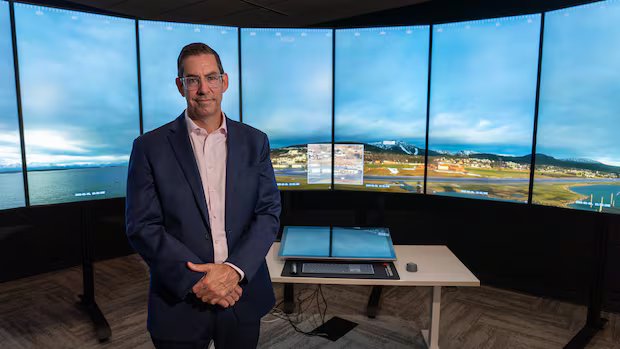
When Nav Canada’s Dave Sheppard saw towers popping up at airports abroad that were packed with new technology and devoid of physical staff, he had one thought: this is the future.
“When you hear the concept of the model, it seems a little bit far out there,” said Sheppard, the chief technology officer for the not-for-profit corporation that oversees Canada’s air traffic controllers.
“But … we looked at it and said, you know, this is a great fit for Canada.”
After years of testing cameras under intense Canadian climates, working to reassure staff of the benefits and getting the ball rolling on regulatory approvals, it seems like the future is now.
The newly completed digital aerodrome air traffic control tower in Kingston, Ont., is the first of its kind in Canada.
It’s topped with a camera that rotates around it, and others which can pan, tilt and zoom in on potential obstacles.

Also at the airport is a new digital control centre, where people can direct traffic by remotely monitoring information fed from the tower.
The next step is building a similar tower in Hamilton, to be monitored by staff 150 kilometres away at the Kingston facility. Eventually, air traffic controllers for 10 to 15 airports could all be stationed at the eastern Ontario site.
Sheppard says the move will provide a new level of flexibility at a time of global staffing pressures, while allowing air controllers to see more than they ever have.
The union representing these workers, though, is bracing for turbulence.
Canada still 200 controllers short of target
The global shortage of air traffic controllers worsened significantly during the COVID-19 pandemic, which rocked the aviation industry.
It’s been blamed for delayed or cancelled flights.
Some have also questioned if even more serious staffing pressures in the United States have contributed to deadly incidents, like the fatal March 2026 collision involving a fire truck and an Air Canada plane at New York’s LaGuardia Airport.
While Nav Canada remains about 200 people short of staffing targets, the organization says it’s quickly filling the gap through a ramped-up training regime.
“This allows us to bring people in and actually recruit individuals into a location that’s central where they would like to stay and live and work,” Sheppard said.
It’s what Nav Canada says led them to station the pilot project in Kingston, a community he also says has a healthy pool of qualified talent.
Once it’s fully set up, Nav Canada should be able to more easily fill unexpected absences that could impact service because trained backfill options are a workstation — not a city — away.

Union closely watching the transition
But the big idea requires buy-in from its labour force, and the Canadian Air Traffic Control Association (CATCA) has some concerns.
Union president Nick von Schoenberg called it a “significant shift,” one he feels could provide equivalent service but doesn’t seem poised to make travel safer.
The industry is facing a “demographic bubble,” von Schoenberg said, with many controllers nearing the end of their careers.
Some may choose to leave the field altogether rather than uproot their families, he said.
“Even if that attrition is only … 10 or 20 per cent, we can’t afford to lose a single air traffic controller right now in Canada,” von Schoenberg said.

Von Schoenberg also raised a raft of potential questions, both technical and on a human level.
“[This involves] replacing an existing model that has been demonstrated to work very well, and that comes at a cost — a financial and human resource cost,” he said.
“I don’t think [that’s] probably the wisest strategy in the near term.”
While Nav Canada has been “open and transparent” through the process, von Schoenberg said many still worry what will happen should the technology fail.

What is the technology like?
The new tower at Kingston is obviously different from a traditional control tower with a bulbous top ringed by windows.
Rather than sitting in the middle of things, controllers are stationed at remote workspaces behind 12 large screens positioned in a gentle curve — providing a flattened, 360-degree view.
Kongsberg Geospatial, Nav Canada’s project partner, is deploying technology already used by its parent company in Norway.
“This technology significantly improves safety from an air traffic control perspective,” argued president Jordan Freed.
New features allow controllers to toggle to an infrared view, handy during low-vision weather and at night. Moving objects are highlighted and tracked so they can zoom in to investigate.
“We’re seeing the development and implementation of AI into more and more technology,” said Freed.
The system “can continue to learn” as it’s used, he said, becoming better at identifying aircraft, weather patterns and potential dangers.
Both Nav Canada and CATCA stress that any artificial intelligence used will leave humans firmly in the driver’s seat.

The new global standard?
Experts say this move has been a long time coming and is certain to benefit the sector.
“Ten years from now, it’ll be the standard,” said John Gradek, an aviation expert at McGill University.
The technology is much more efficient, Gradek said, and closer to what air traffic controllers already do than people might think.
“What Nav Canada is doing with this technology is adding a toolkit. It’s not changing the fundamental jobs of air traffic control,” he said.
“Whether you’re managing St. Thomas or London or Sarnia or Windsor from one seat, you’re still managing airspace.”

The technology is already being used in well over a dozen nations, including at the London City Airport in the United Kingdom.
It’s also in place at the Bodø Airport in Norway. Freed says the country has used this new form of remote work to expand air service to isolated areas where it’s hard to attract skilled workers.
“Now you can bring them into a larger city. You can actually have a team. There’s not two people working remotely, but there’s a whole team,” he said. “In fact, the first thing that strikes you when you walk into the Bodø centre is how young the team of air traffic controllers are.”
Von Schoenberg argues that this is the direction Canada should be moving in: expanding service, rather than replacing existing towers.
But with Hamilton topping the list of planned airports, the union leader says it’s clear that’s not on Canada’s trajectory — or at least, not yet.
How to ensure it’s safe
Nav Canada is right now focused on the many Canadian control towers built in the ’50s, ’60s and ’70s that need to be replaced or significantly renovated.
Sheppard says expanding the scope of its work geographically is far in the future, but it remains a goal.
When Canada is ready to add air traffic control to areas where none exist, building a remotely monitored digital aerodrome tower will be much faster, easier and cheaper, he said.
What’s mainly holding the group back is connectivity.

To build safety and redundancy into the system, Sheppard says there should be two telecommunications service providers. That is not yet the reality in many isolated communities.
As for other failsafes, Nav Canada says the towers come with backup power and extra cameras in case one breaks or becomes obscured. Each remote-control station also has a full backup.
There’s still a lot of testing to come.
Starting this fall, a shadow team of air traffic controllers will spend a year at remote stations on site.
Once the concept has been proven safe and regulatory approvals are secured, Nav Canada will begin the transition in Hamilton.
CBC reached out to Transport Canada to find out more about the process and how it’s addressing any potential concerns about automation in the industry. It did not provide a response by deadline.