dailynewsnblog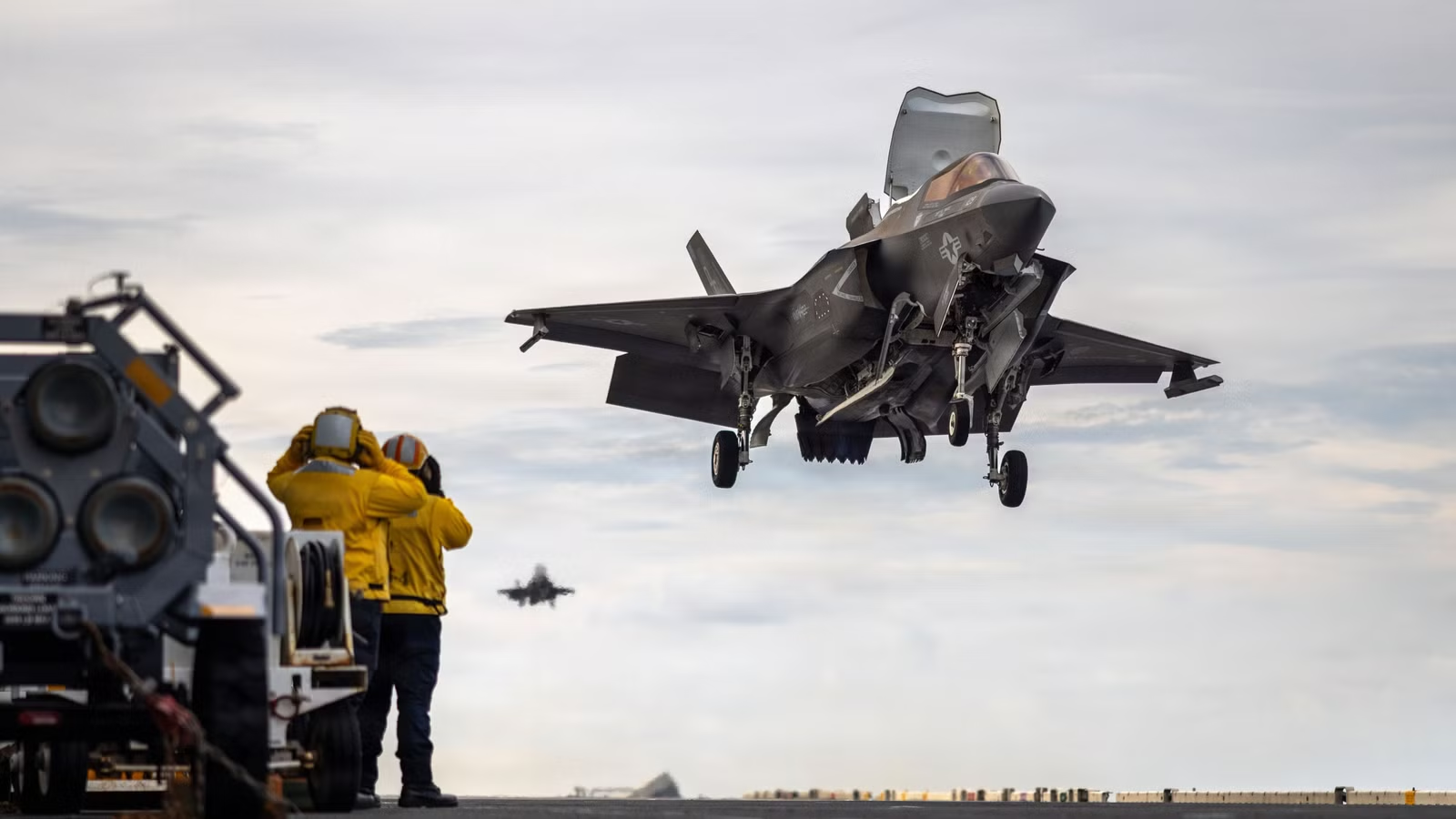
The Lockheed Martin F-35B Lightning II is a comprehensive generational upgrade over the legacy AV-8B Harrier II jump jets and their related British variants. The Harrier was a marvel of engineering when it first entered service, and it enabled modern fighter jets to operate on smaller aircraft carriers and amphibious assault ships. The type became iconic in the Falklands War of 1982, when they reclaimed control of the skies over the Argentine land-based fighter jets.
However, now their time is quickly coming to an end. The first-generation Harrier jump jet saw service in the Indian, Italian, Spanish, Thai, Royal, and US navies/Marine Corps, while the second-generation AV-8B was purchased by the US, Spain, and Italy. Lockheed Martin’s F-35B is well on its way to replacing the Harrier in the Marine Corps and some of the allied/export navies.
The First/Second Gen Harrier

The first-generation Hawker Siddeley Harrier was designed by the British and developed by Hawker Siddeley in the 1960s and was the first practical naval fighter jet able to perform V/STOL operations. The second-generation McDonnell Douglas AV-8B Harrier II was the upgraded variant built in the United States primarily for the Marine Corps. Hawker’s Harrier was able to accomplish what no other fighter had been capable of before.
However, it was forced to make compromises. Early variants only had a combat radius of around 200 nautical miles, although that increased to 300 nautical miles for the later Harrier GR.9 and AV-8B variants. The limited range of the Harrier was demonstrated when a British Harrier was lost from the fleet in 1983 during an exercise in 1983 and successfully made an emergency landing on a cargo ship, the Alarigo.
Amusingly, history repeated itself in 2025 when a wayward British F-35B was forced to land in India, with the carrier completing its tour of the Asia-Pacific before returning to collect it. The Harrier’s payloads were also significantly restricted, being able to carry up to 9,700 lbs. As the Harrier was not a stealth jet, all its munitions were carried externally on seven stores.
One thing linking the legacy Harrier, the failed Boeing X-32 demonstrator, and the F-35B is Rolls-Royce, which has built the vertical lift system for all of them. The British contractor claims that it is “the world’s only STOVL technology for supersonic jets. Since 1969 we’ve delivered unrivalled STOVL expertise.” The Harrier was famous for being difficult to land as it had to balance on a single column of air; the F-35B spreads this out and is more stable.
The F-35B Lightning II

The F-35B is the STOVL variant specifically designed by Lockheed Martin to replace the Harrier. Compared with its F-35A and F-35C variants, the F-35B comes with compromises on its range and payloads, but it is also a major leap over the Harrier. Phil “Rowdy” Yates is a former chief test pilot for the X-32 and flew the aircraft during the concept demonstration phase of the Joint Strike Fighter Program, the effort to replace the Harrier.
Rowdy noted that “the Boeing design used mostly the design from the Harrier. And redirected thrust from the main engine with some thrust posts. We call them out-on-the-wing-tip to provide the control we needed there. So the Boeing design was largely an updated Harrier design.” He said that Lockheed’s X-35 design was revolutionary and a generational upgrade over the Harrier.
He adds that “the Lockheed design was much more technologically advanced. I call it the ’17 Miracles’ that had to happen for that aircraft to go into hovering flight. To Lockheed’s credit, they all happened effectively and safely.” The F-35B has a combat range of between 450 and 505 nautical miles and a maximum payload of up to 15,000 lbs with external pylons. Internally, it is able to carry up to 5,500 lbs.
How The Royal Navy Replaced Its Sea Harriers

The Royal Navy retired its dedicated Sea Harriers in 2006 and then retired its joint Royal Navy/RAF Harrier GR.9s in 2010 due to deep budget cuts. The British also retired their Illustrious-class aircraft carriers in 2010, leaving a gap in naval capabilities for around ten years until the replacement HMS Queen Elizabeth entered service in 2020. Today, the British carrier and fighter jet capability has been restored with two in-service carriers and 47 F-35Bs shared with the RAF.
In late 2011, the US Marines purchased the UK’s retired fleet of 72 Harrier GR.9 jump jets and associated spare parts to sustain its fleet until 2026. Looking forward, the UK is preparing to place its next order for another batch, which is expected to include 27 aircraft made up of 12 F-35As for the RAF and 15 F-35Bs for the Royal Navy and RAF.
While the Harrier was initially a British project and the F-35B is primarily an American one, the F-35B has plenty of British DNA. Like the Harrier, the ejection seat is supplied by Martin Baker, and like the Harrier, the LiftSystem is built by Rolls-Royce. BAE Systems is a major Tier 1 partner in the F-35 Lightning II program (along with Northrop Grumman), holding a 13% to 15% workshare on every aircraft. Lockheed leads the program as the prime contractor.
US Marine Corps

The US Marine Corps was the largest customer for the F-35B, and it sustained its fleet for 16 years more than the Royal Navy. However, the sun set on the last Harriers in Marine service in 2026. This came as the USS Iwo Jima (LHD-7) returned to port for its extended retrofit after its Caribbean deployment.
This meant that Operation Southern Spear to capture Venezuela’s Maduro was the last significant US deployment of the Harrier. The USS Iwo Jima is the final US amphibious assault ship to head into retrofit to receive upgrades to operate F-35Bs. When it reenters service, all the US Marine flattops will be able to operate the F-35B.
Harrier/F-35B operators | Operates/ed Harrier family (Y/N) | Operates F-35B per F-35.com (Y/N) |
|---|---|---|
United States Marine Corps | Yes (retired) | Yes |
United Kingdom Royal Navy/RAF | Yes (retired) | Yes |
Italian Navy | Yes | Yes |
Spanish Navy | Yes | No (maybe future) |
Japanese Navy | No | Yes |
Thai Navy | Yes | No (denied) |
Indian Navy | Yes | No (unlikely eligible) |
The Marines are gradually transitioning to an all-F-35 fleet that will be a mixture of F-35B and F-35C aircraft. The service continues to operate the F/A-18 legacy Hornet, and with the last of the Harriers retired, the Marines will be phasing these out. Lockheed has delivered around 250 of the intended 420 F-35s to the Marines.
The Italian Navy & Spanish Navy

The Italian Navy is the other US-allied navy currently moving to the F-35B away from the Harrier. The Italian Navy is currently in a state of transition. As of mid-2026, it appears Italy has a dozen legacy Harriers remaining in service, with these expected to retire around 2028. Italy also has around 15 F-35Bs in service along with a fleet of around 42 conventional F-35As.
Italy has a program of record of 75 F-35As and 40 F-35Bs. As with the United Kingdom, these F-35Bs are to be shared with the Air Force. While the UK has a larger workshare in the F-35 program, Italy is also a significant partner (a Tier 2 partner with the Netherlands), and it has one of only two final assembly and checkout facilities for the F-35 outside of the United States (the other being in Japan).
The other US ally operating Harriers is Spain. It was long assumed that Spain would choose to purchase the F-35B to replace its roughly dozen Harriers. However, in 2025, Spain ruled that out. This leaves the replacement in question, as there is no other crewed fighter jet able to replace it: perhaps it will take the Turkish route and operate drones from its sole flattop.
It is also worth noting that this is a politicized question in Spain. The ruling left-wing government is against purchasing the American F-35, while the conservative opposition is in favor. The next Spanish elections are in May 2027.
Other F-35B/Harrier Operators

Japan is currently the only other country purchasing the F-35B. However, in the case of Japan, it is not replacing the Harrier, as this is the first time since WWII that it is restoring its aircraft carrier and fighter jet capability. With that being said, legally, the Izumo-class carriers (the Kaga and Izumo) are aircraft-carrying multi-role cruisers. Japan is purchasing at least 27 and up to 42 F-35Bs.
Thailand is another country that formerly operated the Harrier. These were operated on the mini 11,500-tonne HTMS Chakri Naruebet aircraft carrier. However, Thailand retired its Harriers by 2006 without replacement. Today, the ship is a helicopter carrier operating US-built SH-70 Seahawk and MH-60 Knighthawk helicopters. Thailand did request to purchase the F-35, but it is one of the countries that the US has refused to sell its precious fighter jet. The other former Harrier operator is India.
India is often misunderstood: it is not an ally of the United States, but a strategic partner. India also maintains close relations with Russia and operates domestically built Su-30MKI Flankers and Russian S-400 air defense systems. While Trump reportedly offered to sell F-35s to India in 2025, it is not likely a customer that the Pentagon or Congress would allow to operate the fighter jet. Instead, India is purchasing French Rafale M fighter jets for its future carrier-based fighter jet capability.