dailynewsnblog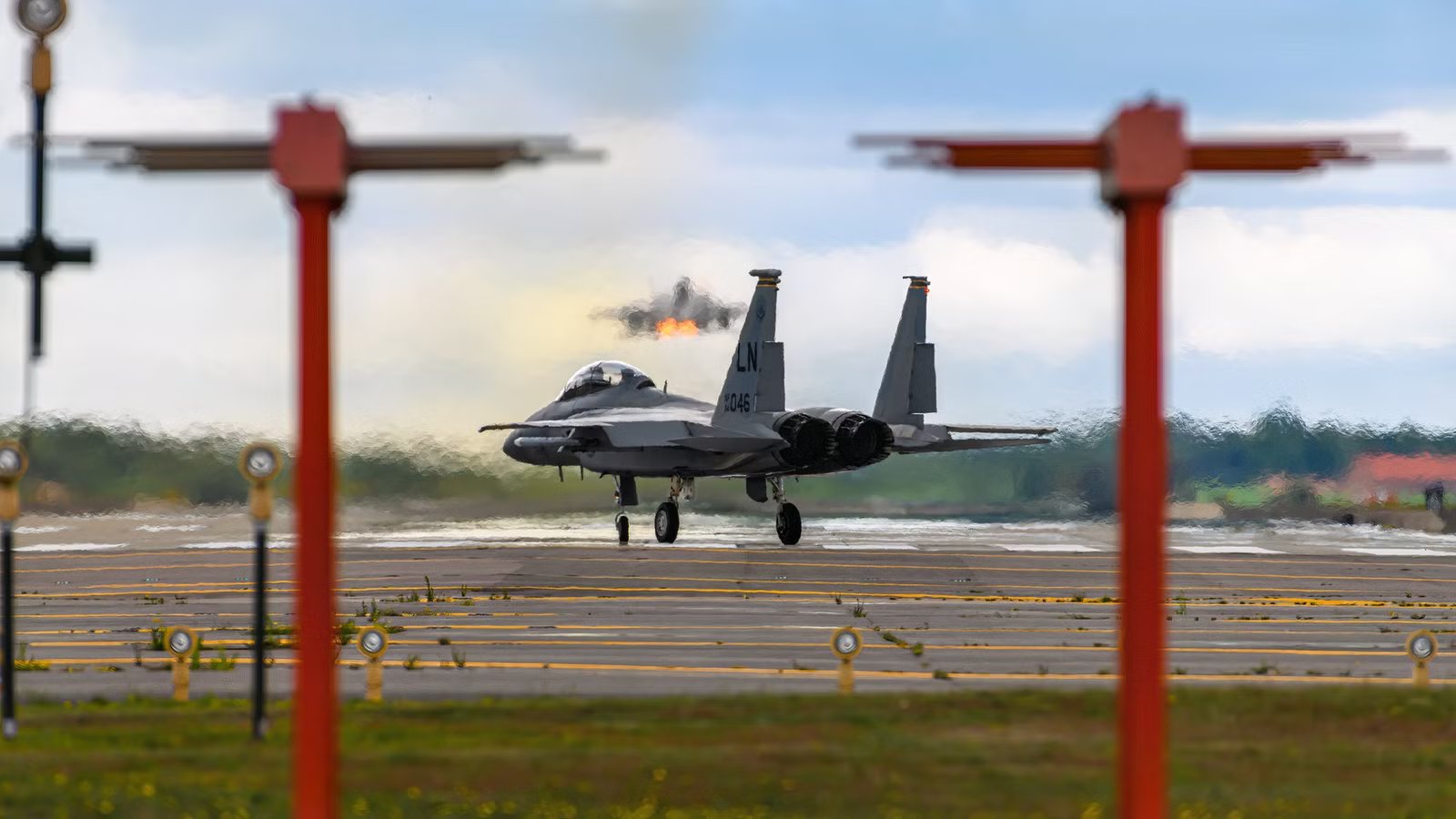
The Eurofighter Typhoon and the F-15 Eagle are some of the highest-rated combat aircraft in the world, with both seeing continuing service with their respective countries. We will take a look at different aspects of the aircraft, ranging from payload, radar, and combat history to their strategic utility.Let’s take a look at why these combat aircraft are so effective and respected, and given the current climate of simmering interstate competition, why they will remain in service for possibly decades to come.
The Origins And Design Philosophy Of The F-15EX And The Eurofighter

The development of the F-15EX traces its roots to the Cold War, specifically over the skies of Vietnam, when US aviators faced serious challenges from Soviet aircraft such as the MiG-17, MiG-19, and MiG-21. This competition only allowed for a 1 to 1.5 kill ratio in aerial combat. Putting this into perspective, during the war, the US Navy, Marine Corps, and Air Force lost about a little over 750 F-4 Phantom IIs and approximately 395 F-105 Thunderchiefs were also downed in combat over Vietnam.
The unforgiving skies over Vietnam prompted the USAF to request a study for a Fighter Experimental (FX) in 1965; amongst the competitors, McDonnell Douglas was selected for design and production. This led to the F-15A, purpose-built to dominate the skies with a laser focus on engaging and defeating Soviet aircraft, particularly MiG and Sukhoi fighters and the Tupolev and Ilyushin bombers.
To accomplish this, the F-15 was armed with a 20mm General Electric M61A1 Vulcan rotary cannon, four Raytheon AIM-7 Sparrow, and four AIM-9 Sidewinder Air-to-Air Missiles. The first of 30 F-15As rolled off the assembly line in 1973 at the McDonnell Douglas assembly line in St. Louis.
Presently, the  Boeing F-15EX, the most advanced iteration of the aircraft, is in production to meet the USAF’s need to maintain an aircraft that is tactically efficient and has the ability to carry a heavy payload. To this point, the F-15 can accommodate 29,500 pounds (13,381 kilograms) of ordnance.
As it was with the F-15, the Eurofighter Typhoon has its roots in the Cold War. There was a need in Western Europe to develop a next-generation air-superiority fighter, driven by the strategic necessity to counter Soviet aircraft and replace aging fleets of aircraft such as the Jaguar and Phantom for the RAF and similar jets for partner nations.
In 1986, the strategic needs of Western European states brought together the defense expertise of British Aerospace (UK), MBB (Germany), Aeritalia (Italy), and CASA (Spain), to produce an advanced, next-generation, agile air-superiority fighter. The collaboration was driven by the need to share the high costs and technical risks of development, which would have been significantly greater for any single nation. The Eurofighter Typhoon entered serial production in 1998 and has been a mainstay of European air forces since the early 2000s.
Speed, Range, And Payload

The F-15EX is generally listed at a maximum speed of Mach 2.5; it is powered by two Pratt & Whitney F100-PW-100, 220 or 229 turbofan engines with afterburners. These powerplants produce 23,450 pounds of thrust per engine (10,637 kilograms), and this aircraft has a maximum ferry range of 3,450 miles (5,552 kilometers) when equipped with conformal fuel tanks and three external fuel tanks.
In terms of armament, the F-15EX is equipped with one internally mounted M-61A1 20-mm, six-barrel rotary cannon with 940 rounds of ammunition. On its external hardpoints, this aircraft can carry four AIM-9 Sidewinders and four AIM-120 AMRAAMs or eight AIM-120 AMRAAMs. It has a maximum payload of 29,500 pounds (13,400 kilograms).
Rather than fly laden with weapons, the Typhoon was designed for extraordinary agility and lift at high angles of attack. Therefore, its maximum payload is 19,842 pounds (9,000 kilograms). It can carry a wide variety of NATO weapons, including AMRAAM, IRIS-T, ASRAAM, JDAM, Storm Shadow, and Brimstone. To propel the Typhoon through the air, it is powered by two Eurojet EJ200 reheated turbofan engines, giving it a maximum speed of Mach 2.0.
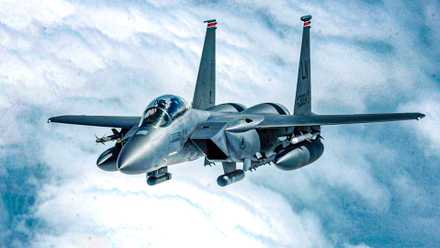
5 Reasons The United States Air Force Continues To Operate The F-15 Strike Eagle
Find out some characteristics that make the Strike Eagle a core combat aircraft.
Radar And Electronic Warfare

A combat aircraft’s radar is one of the primary sensors in a layered detection system used to identify aircraft, drones, and some missiles. It also supports target tracking and weapons guidance, enhances situational awareness beyond visual range, and provides early cueing for weapons and other onboard sensors.
The F-15EX is equipped with the powerful Raytheon AN/APG-82(V)1 AESA radar. This piece of equipment combines the antenna of the APG-63(V)3 with the processor from the F/A-18E/F’s APG-79 and the BAE Systems AN/ALQ-250 EPAWSS. Operationally, it provides full-spectrum radar warning, threat triangulation.
The AESA systems provide full-spectrum radar warning, provide high-resolution tracking, countermeasure integration, and support electronic attack functions such as jamming. When combined with other onboard sensors, these capabilities significantly enhance aircrew survivability in contested or degraded airspace.
The latest production upgrade for the Typhoon, Tranche 4, provides the aircraft with Captor-E AESA radar. Captor-E provides the Typhoon with the ability to detect numerous targets simultaneously and at longer ranges. The radar also facilitates enhanced performance against stealthy or low-observable aircraft and improved target lock during high-G maneuvers.
Looking at electronic warfare, Captor-E allows the Typhoon to jam enemy radars, conduct electronic attack, and support missions involving the suppression of enemy air defenses. In a brief comparison, the F-15EX has the advantage of sheer power as it has a larger airframe that allows it to carry a larger AESA radar, providing excellent long-range detection and strike capability.
The Eurofighter’s radar, on the other hand, has a unique swiveling design, giving it a wider field of regard and increased tracking during aggressive maneuvering. On the whole, the F-15EX is more finely tuned as a powerful long-range sensor and missile platform, while the Typhoon is focused on agile air-superiority combat with its advanced radar and electronic warfare features.
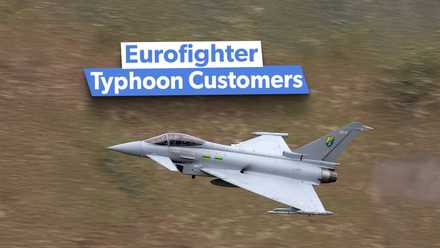
What Countries Have Acquired The Eurofighter Typhoon?
The Typhoon has had moderate export success having been ordered by five countries in addition to the four that developed it.
Combat Record And Deployments

With 50 years of service, the F-15(EX) by far has the greatest proven combat effectiveness between the two planes. Its first combat missions were completed with the Israeli Air Force (IAF) on June 27, 1979, when IAF pilot Moshe Melnik earned the first air-to-air victory in an F-15, while engaging Syrian fighters.
Since that historic day, the F-15 has been involved in Operation Desert Storm, the Iraq War in 2003, and served in the skies over Afghanistan and Libya for Operations Odyssey Dawn and Unified Protector. Similarly, Saudi Arabia has utilized its F-15 fleet to engage targets in Yemen and other smaller engagements.
In all of these operations (and others), the F-15s have been used for missions such as close air support, precision bombing, armed overwatch, and interdiction. Across all of its operators and variants, the F-15EX has been confirmed to have downed over 100 aircraft, with the majority of these victories going to the IAF.
Having roughly the service record of the F-15(EX), and no known confirmed kills, the Typhoon is still an incredibly formidable aircraft, and it has been amassing its own record of combat reliability. Its first combat missions were during Operation Odyssey Dawn.
At that time, the Typhoon participated in air patrol missions, no-fly zone enforcement, and finally, precision strike missions. The Typhoons flown by the Royal Air Force (RAF) targeted command-and-control infrastructure, storage areas, and ammunition bunkers.
In operations over Iraq and Syria, targeting the Islamic State, the Typhoon has proven its reliability. Notably, during the initial combat phase of Operation Shader, the RAF conducted over 1,700 strikes, of which 1,400 took place in Iraq, and the Typhoon has been an integral component throughout.
Strategic Role And Fleet Size

Within the realm of overall strategic purpose, the Eurofighter is a key component in the security and aerial sovereignty of the European Union. The aircraft’s multirole capabilities allow it to engage in air policing, deterrence, and dedicated combat missions. Each of these critical aspects is essential in its role as a guardian of European airspace.
The strategic mission of supporting the integrity of European airspace is highlighted by the fact that, in 2024 alone, air forces across Europe scrambled aircraft over 300 times to intercept approaching Russian military aircraft. With 610 Typhoons in active operation (the majority in Europe), the skies of Europe are certainly secure.
In terms of overall strategy, the F-15EX is optimized to gain and maintain control of the air during a combat mission and to protect high-value assets such as bombers, AWACS, and tankers. The aircraft is also an asset for deterrence, given its heavy payload capacity and extended range.
An excellent example of its deterrent capability is on display in the Indo-Pacific region, as the US actively seeks to dissuade China from engaging in potential military coercion against regional allies such as Japan, the Philippines, and Taiwan. As part of this overall strategy, F-15EXs will be deployed or rotated through Kadena Air Base, contributing to regional air superiority and alliance assurance. In sum, the USAF operates 400 to 450 F-15s with the EX variants currently entering its inventory.
Throwback: When A US Air Force F-15 Shot Down A Satellite
The Cold War was all about competition, for the first time this included competing for dominance in space.
Cold War Roots To Modern Day Utility

Both the Typhoon and the F-15(EX) began their lives as a consequence of the Cold War with an eye to competing with Soviet aircraft. While the Typhoon is the younger aircraft, both have proven themselves to be highly reliable and capable fighters.
For this reason, they are not only still in use today but will continue to serve as their manufacturers continue to provide these planes with upgrades to maintain their combat edge. With conflict seemingly looming on the horizon both across Europe and in the Indo-Pacific, these combat aircraft may see action again soon.

![Allegiant Air’s Massive Expansion: 7 New Routes Announced [Map]](https://dailynewsnblog.com/wp-content/uploads/2026/08/allegiant-air-takeoff.jpg)