dailynewsnblog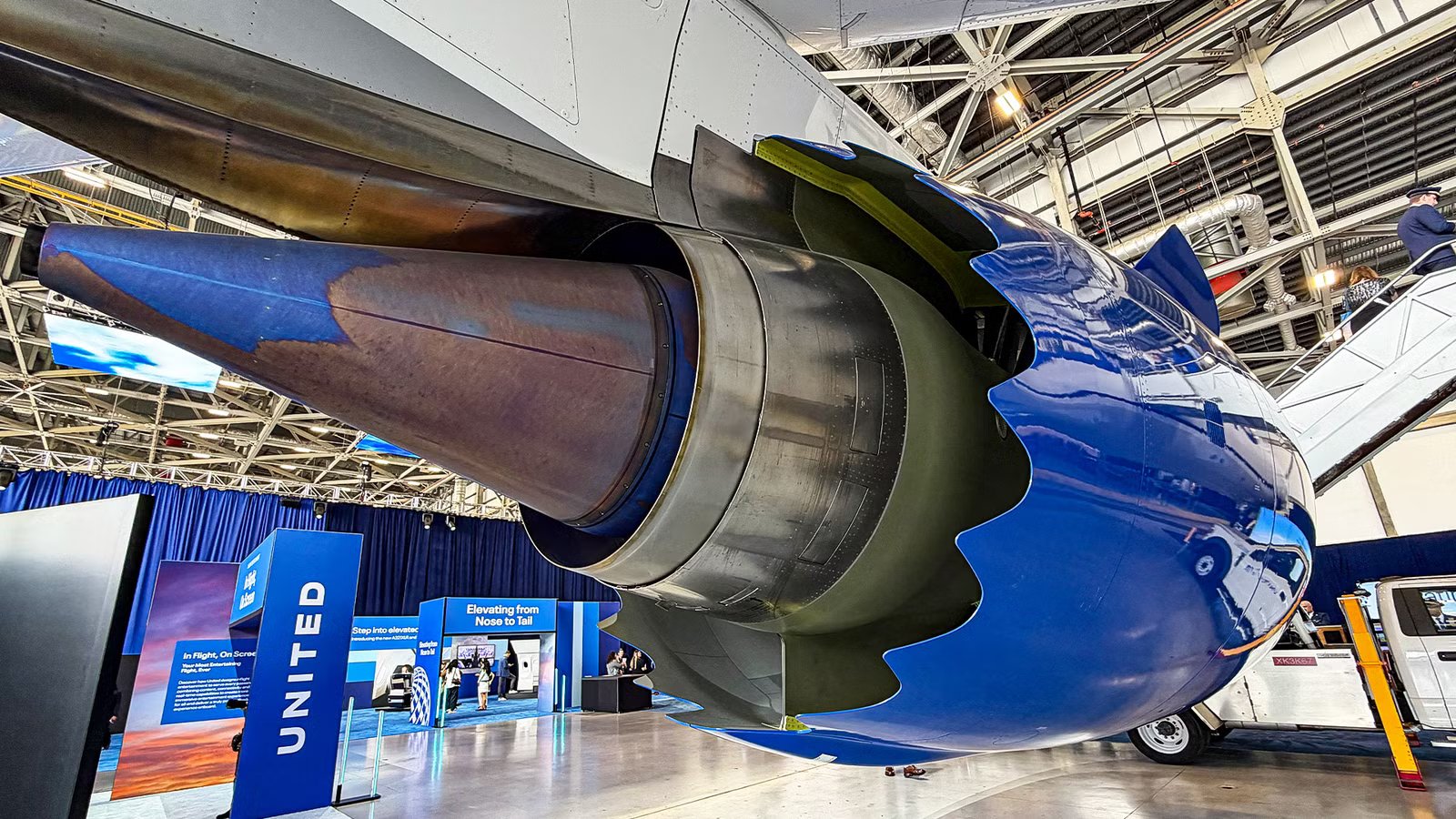
Modern commercial jet engines are among the most refined pieces of engineering ever developed. They are quieter, more fuel-efficient, and dramatically cleaner than the engines that powered earlier generations of airliners. Yet three of Boeing’s most important aircraft families, the Boeing 737 MAX, Boeing 747-8, and Boeing 787 Dreamliner, carry an unusual design feature that introduces a problem almost no competing modern jet faces: serrated engine exhaust nozzles known as chevrons.
The distinctive sawtooth patterns visible on the rear edges of the engine nacelles were designed primarily to reduce noise. Boeing developed the concept alongside General Electric and NASA as airlines faced increasingly strict airport noise regulations and growing community pressure around major hubs. The system succeeded in making aircraft quieter during takeoff and landing, particularly on the Dreamliner. However, the solution came with a trade-off. The same aerodynamic mixing effect that lowers noise also creates drag and slightly reduces engine thrust during all phases of flight, including cruise, where noise reduction provides little operational benefit. Over time, Boeing itself began searching for alternatives, eventually abandoning chevrons entirely. The result is a fascinating engineering story about how one innovation solved a regulatory challenge while simultaneously creating a performance penalty that no other major aircraft manufacturer chose to accept.
What Boeing’s Engine Chevrons Actually Do

Chevrons are serrated trailing edges built into the rear section of an engine nozzle. Instead of a smooth circular exhaust outlet, the nozzle edge features a repeating sawtooth pattern extending into the exhaust flow. Boeing introduced the technology commercially on the 787 before expanding it to the 747-8 and the 737 MAX family. Every 787 engine variant uses chevrons, regardless of whether the aircraft is powered by Rolls-Royce Trent 1000s or General Electric GEnx engines. The 747-8 and all 737 MAX variants also feature this design.
The engineering principle behind chevrons is relatively straightforward. Modern turbofan engines produce two separate exhaust flows: a hot, high-velocity core stream from the combustion section and a cooler bypass airflow generated by the fan. The interaction between these two flows creates turbulence, which is a major source of jet engine noise. Chevrons reduce that turbulence by generating controlled vortices that mix the exhaust streams together more gradually. The smoother transition lowers the acoustic intensity of the exhaust plume, particularly during high thrust operations such as takeoff and initial climb. NASA research conducted during the technology’s development confirmed measurable reductions in perceived engine noise around airports.
The concept emerged during a period when airport noise regulations were becoming increasingly restrictive worldwide. Airlines operating large fleets at densely populated urban airports faced growing pressure to reduce community noise exposure. Boeing saw chevrons as a way to improve compliance without fundamentally redesigning engine architecture. Visually, the feature also became associated with Boeing’s next-generation aircraft branding. The scalloped nacelle edges gave the 787 a distinctive appearance that emphasized technological innovation and acoustic refinement. For many passengers, the chevrons became symbolic of quieter modern air travel. Yet the aerodynamic realities behind the design created complications that became increasingly apparent over time.
Noise Reduction Technology Comes At A Performance Cost

The central problem with chevrons is that the vortices they intentionally create do not simply disappear once the aircraft leaves the airport environment. The aerodynamic mixing process continues throughout the entire flight, including cruise conditions where noise reduction is far less important. Those vortices slightly disrupt the exhaust flow and increase drag, which reduces overall engine efficiency and marginally lowers thrust output. Aviation analyst Petter Hörnfeldt, better known through Mentour Pilot, has estimated that the thrust penalty from chevrons is approximately 0.5%. While that figure appears small, aviation economics are built around extremely thin performance margins where even fractional efficiency losses matter significantly.
For high-utilization aircraft such as the 737 MAX, the effect becomes cumulative. Narrowbody airliners often perform multiple short-haul sectors daily, so a minor efficiency penalty applied continuously across thousands of annual flights translates into meaningful fuel burn increases over the lifespan of the aircraft. This creates the core engineering contradiction behind chevrons. The system addresses a problem most critical during takeoff and landing, but imposes its aerodynamic penalty continuously. Unlike deployable aerodynamic devices that activate only when needed, chevrons are fixed structures permanently protruding into the exhaust stream.
The issue becomes especially relevant during cruise flight. At high altitude, engines operate in carefully optimized conditions designed to minimize drag and maximize fuel efficiency. Any disruption to exhaust flow can slightly degrade propulsion efficiency. Airlines closely monitor these performance margins because fuel remains one of the largest operating expenses in commercial aviation. The penalty also affects thrust generation. While passengers would never perceive a half percent reduction in performance directly, aircraft manufacturers compete intensely over efficiency metrics. Modern airliner programs are often marketed around fuel burn improvements measured in single digit percentages. In that context, a permanent efficiency loss becomes strategically important. As noise regulations evolved and engine technology improved independently, the industry began exploring whether chevrons were still the best solution available.
Why Airbus Refused To Follow Boeing’s Approach

Airbus | Simple Flying
One of the most revealing aspects of the story is that Airbus never adopted the technology on any of its competing modern aircraft programs. The European manufacturer chose an entirely different path for noise reduction, relying instead on nacelle acoustic treatments, advanced fan designs, and high bypass ratio engines. Initially, Boeing’s patented chevron design prevented competitors from using the concept commercially. That patent protection remained in place until 2021. However, even after the patent expired, Airbus still showed no interest in integrating chevrons into aircraft such as the Airbus A350 or Airbus A320neo family.
The company’s reasoning was unusually direct. A350 Chief Engineer Dougie Hunter publicly explained that Airbus found no compelling advantage in the technology. According to Hunter, Airbus engineers determined that chevrons did not provide sufficient noise benefits to justify the associated specific fuel consumption penalty. That statement highlights an important philosophical difference between Boeing and Airbus during the development of next-generation aircraft. Boeing embraced a visible mechanical solution to tackle airport noise. Airbus instead prioritized improvements inside the nacelle and engine architecture itself, reducing noise without altering external exhaust geometry.
High bypass turbofan engines already produce significantly less noise than older designs because more thrust comes from slower-moving bypass airflow rather than the high-velocity exhaust core. Airbus engineers concluded they could meet regulatory requirements without introducing additional drag-inducing structures into the exhaust stream. The divergence also reflects how aircraft manufacturers balance competing priorities differently. Boeing accepted a measurable efficiency compromise to secure stronger community noise performance. Airbus decided the operational costs outweighed the acoustic gains. Over time, Boeing itself appeared to move closer to Airbus’ position.
777X Shows Boeing’s Own Shift Away From Chevrons

The clearest evidence that Boeing recognized the limitations of chevrons emerged during the development of the Boeing 777X and its GE9X engines. Despite the feature appearing prominently on the 787, 747-8, and 737 MAX, Boeing abandoned chevrons entirely for its newest flagship widebody. Instead, Boeing and General Electric developed a radically different nozzle architecture using ceramic matrix composites, or CMCs. These advanced materials tolerate extremely high temperatures while remaining substantially lighter than traditional metallic structures. Their thermal resistance allowed engineers to create a more compact and aerodynamically efficient mixed exhaust nozzle without relying on serrated trailing edges.
The result achieved a similar acoustic performance while reducing drag and weight simultaneously. GE9X Chief Project Engineer Terry Beezhold explained that the new nozzle technology provides equivalent cabin and community noise levels but with lower drag and lighter construction. The GE9X nozzle system is reportedly around 20% lighter than older designs. This transition is significant because it effectively acknowledges the trade-offs associated with chevrons. If the technology represented the optimal long-term solution, Boeing likely would have retained it on the 777X. Instead, the company invested heavily in eliminating the feature while preserving its acoustic benefits.
The move also illustrates broader trends in engine development. Modern aerospace engineering increasingly favors integrated aerodynamic efficiency over external add-on solutions. Advanced materials, computational fluid dynamics, and improved nacelle shaping now allow manufacturers to address noise problems more elegantly than was possible when chevrons first emerged. In many ways, the 777X represents Boeing’s attempt to solve the same challenge without inheriting the same penalties.
Chevrons Still Made Sense On The 787 Dreamliner

Despite their drawbacks, chevrons were not necessarily a mistake, particularly on the Dreamliner. Boeing found a secondary advantage that partially offset the performance penalty and made the overall trade-off more acceptable for that aircraft specifically.
Because the engines were substantially quieter externally, Boeing was able to reduce the amount of sound insulation material installed throughout the fuselage. Reports indicate the company eliminated up to 600 pounds, or roughly 272 kilograms, of acoustic insulation compared with what otherwise might have been required. That weight reduction improved fuel efficiency and helped compensate for the thrust and drag penalties created by the chevrons themselves. On a long-range aircraft such as the 787, where weight savings compound significantly across intercontinental missions, the trade-off became economically viable.
The Dreamliner’s broader design philosophy also supported the decision. Boeing engineered the aircraft around aggressive efficiency goals using composite materials, advanced aerodynamics, and next-generation engines. The chevrons fit within that larger optimization strategy, even if they were not an aerodynamically perfect solution in isolation. The equation was less favorable on smaller aircraft such as the 737 MAX. Narrowbody jets generally lack the same opportunities for large-scale insulation weight savings, while their high cycle utilization amplifies fuel burn penalties over time. This partly explains why criticism surrounding chevrons became more pronounced as the technology spread across Boeing’s lineup.
Still, the system undeniably succeeded in one important area: noise reduction. Airports and communities benefited from quieter operations, and airlines operating at noise-sensitive hubs gained regulatory and operational advantages. The problem was never that chevrons failed technically. The issue was that they solved one problem while creating another.
Engineering Compromise

That trade-off created a challenge virtually unique among major modern airliners because Airbus rejected the concept entirely, preferring alternative acoustic technologies that avoided continuous performance penalties. Boeing itself eventually moved away from chevrons on the 777X, replacing them with a more advanced low-drag nozzle architecture built around ceramic matrix composites. The story illustrates how aviation engineering rarely produces perfect solutions. Every design decision involves balancing competing priorities, including noise, fuel efficiency, weight, emissions, maintenance, and regulatory compliance. Chevrons solved a real operational problem during a critical period in commercial aviation development. But over time, advances in engine and materials technology revealed that quieter aircraft did not necessarily require permanent aerodynamic compromises.


![American Airlines Launches 10 Nonstop Routes From New York-JFK To Europe [List & Map]](https://dailynewsnblog.com/wp-content/uploads/2026/09/aa.png)