 dailynewsnblog
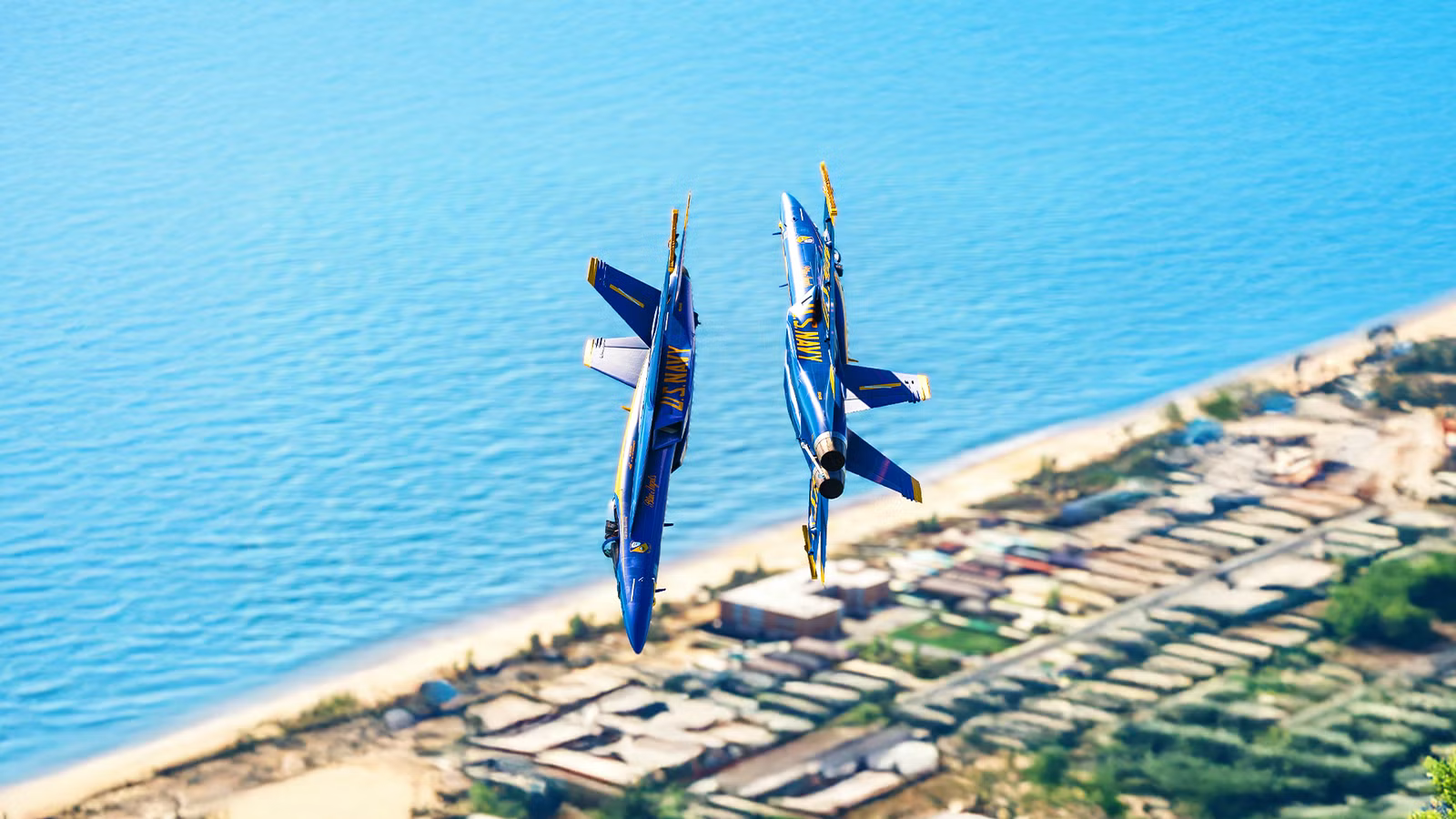
The Blue Angels’ astounding ability to fly at high speed just 12-to-18-inches (30-45 cm) apart is the result of intense training, custom flight controls, and extreme physical endurance by the US Navy and Marine Corps aviators in the cockpit. The wingmen focus all of their attention on the flight leader’s aircraft rather than using autonomous onboard flight computers or conventional cockpit instruments. Pilots make constant micro-adjustments to keep precisely aligned inside the tight diamond by concentrating on a hyper-specific visual marker, such as a single rivet or a jet’s paint stripe.
One of the primary technological characteristics that enable the team to consistently achieve this extremely narrow margin of error is unique to the team’s  Boeing F/A-18 Super Hornets. Based on the same airframe used by combat squadrons, the Blues’ jets are outfitted with a customized, extremely heavy spring on the control stick. This change makes sure that the flight surfaces won’t be unintentionally jarred by brief bursts of air turbulence. Pilots physically press their right forearm firmly against their right thigh when flying in order to maintain perfect precision against this stiff spring tension. This technique avoids undesired hand tremors during close formation maneuvers by providing a sturdy mechanical bracing.
In order to avoid fatal mid-air crashes, physical discipline is equally important. Blue Angels flight crews don’t use the standard inflatable G-suits worn by fighter pilots. A pilot’s arm could be gently nudged by the standard suit’s expanding and contracting air bladders, causing an uncommanded stick input. Instead, they stave off blackouts by relying on an intense muscle-straining breathing technique. This grueling physical routine is perfected over hundreds of rigorous winter training flights before the public ever sees a show.
Why The Diamond 360 Is The Blues’ Closest Point Of Approach

The team performs three separation intervals throughout a show season, known as ‘Sets.’ Set One uses a wider, conservative spacing for early winter training. Set Two represents the standard public show interval, keeping the wingtips just 18 inches (45 cm) from the adjacent canopy. Set Three, or the Yankee Set, is the ultimate high-precision configuration, compressing that distance down even closer to only 12 inches (30 cm).
The Diamond 360 formation is the showcase for the closest flying in the Blues’ routine because it is a flat, continuous banked turn rather than a dynamic aerobatic maneuver. Because the Diamond 360 lacks extreme vertical climbs or rapid rolling changes, it provides the exclusive platform where the flight leader can safely call “take it in” over the radio. On that command, the wingmen and the slot pilot slide smoothly into the Yankee Set. This maneuver locks the four aircraft together at the minimum safe distance possible by physics.
The show’s fastest pass, about 700 mph (1,127 km/h), and the slowest, about 120 mph (193 km/h), both belong to the solo pilots, as do the highest maneuver and the lowest. In a flat, steady turn, like the Diamond 360, the plane stays at the exact same altitude, speed, and angle. The G-forces stay perfectly locked in and constant. Because the air flowing over the wings is completely smooth and predictable, the jets behave exactly how the pilots expect.
The 2019 Tip Touch Mishap Over Blue Angels Home Field

On August 14, 2019, the canopy of the left wing jet made momentary contact with the underside of the lead jet’s outer wing during a Diamond 360 practice flight at Naval Air Station Pensacola. This minor mid-air touch occurred within the exact wingtip-to-canopy formation that defines the team’s unique close-flying performance. Fortunately, nobody was injured. The Navy Times reported that the squadron immediately called a precautionary safety stand-down to assess the aircraft.
A post-flight inspection revealed only a minimal surface scratch, prompting the Blue Angels to keep their scheduled weekend appearance at the Chicago Air and Water Show. While the two legacy F/A-18 Hornets were swapped for backup jets, both pilots remained in the active weekend lineup. This rapid turnaround suggests the squadron treats a minor touch as a serious procedural lesson rather than an existential flight crisis.
This incident involved legacy Hornets right before the team transitioned to the larger F/A-18E/F Super Hornet for the 2021 show season. Former team members spent years modifying the diamond, solo, and delta flight profiles to accommodate the massive new airframe. Pilots flew the Super Hornet diamond for the first time in late November 2020, forcing a much larger aircraft to safely maintain that same tiny, 18-inch (45 cm) gap.
The Rhino In The Diamond: Upgauging The Jet Without Giving Up An Inch

The introduction of the Super Hornet marked the team’s first major change of aircraft type in decades. Switching to the ‘Rhino,’ as the larger and newer variants are also known, ended a 34-year run by the Blues’ legacy Hornets. The classic F/A-18s themselves had replaced the A-4 Skyhawk in 1986, as the Military Times wrote.
Despite sharing a common lineage, the newer Rhino actually has larger dimensions overall, wider wings, and significantly more powerful engines. This ‘upgauging’ forced the team to adapt the traditional routine. Even with a major airframe upgrade, the legendary 18-inch (45 cm) flight spacing survived the Blues’ fleet transition. The Super Hornet brings a modernized glass cockpit and updated flight management software, giving pilots quicker access to critical system information while making every control input smoother.
Still, to maintain the demanding precision required for stunningly close formation flying, Boeing engineers embedded a custom modification to ensure the familiar, heavier control-stick spring feeling carried over from the legacy fleet. The nuanced difference in how the plane’s analog interface feels to the touch is vital for the pilots to perform such painstakingly choreographed movements and fly hundreds of miles an hour just inches apart from each other.
Defying Physics Without A G-suit: The Battle Inside The Blues’ Cockpit

Blue Angels pilots operate under a strict Department of Defense waiver that allows them to fly without traditional inflatable G-suits. In standard fighter operations, a G-suit’s leg bladders inflate automatically to force blood to the brain, but this swelling can dangerously nudge a pilot’s arm during maneuvers. Because the Blues tightly brace their right forearm against their right thigh for stability, any uncommanded suit inflation could cause a catastrophe in the 18-inch (45 cm) diamond.
To counter this lack of physiological aid, the Rhino control stick’s heavy spring mechanism applies constant nose-down pressure. This mechanical resistance gives the pilot’s forearm a steady counterforce to push against, dampening minor hand movements to increase precision flying in all phases of the show, even upside down. Rather than relieving physical strain, this control posture demands even more immense muscle tension than normal Super Hornets.
Specification | A-4 Skyhawk | F/A-18A-D Legacy Hornet | F/A-18E/F Super Hornet |
|---|---|---|---|
Powerplant Type | One Pratt & Whitney J52 turbojet | Two General Electric F404 turbofan | Two General Electric F414 turbofan |
Wingspan | 27 feet, 6 inches (8.38 meters) | 40 feet, 5 inches (12.32 meters) | 44 feet, 9 inches (13.64 meters) |
Maximum Speed | Mach 0.88 | Mach 1.7 to 1.8 | Mach 1.8+ |
Max Takeoff Weight | 24,500 lb (11,113 kg) | 51,900 lb (23,541 kg) | 66,000 lb (29,937 kg) |
Blue Angels Service Years | 1974 – 1986 | 1986 – 2020 | 2020 – Present |
Beyond the unique stick, without an inflatable G-suit, the Blues’ pilots rely on intense anti-G straining maneuver as well. The aviators clench their leg and abdominal muscles while executing carefully timed breathing patterns to manually force blood to their brains and prevent blackout during high-G maneuvers.
The Blue Angels’ pilots know the entire show routine by heart, allowing them to brace their core muscles in perfect sync for every intense turn, bank, climb, or dive. This absolute professionalism serves as their real protection, but it makes flight safety depend entirely on human execution.
The Human Variable: Building The Safety Margin Through Brutal Repetition

The tragic 2007 crash near Beaufort, South Carolina, brutally exposed the razor-thin margins of flying without automated life-support hardware. A Navy investigation revealed that a highly experienced pilot experienced tunnel vision and spatial disorientation under a 6-G load while executing a routine turn. Investigators also discovered the team’s official G-suit waiver had inadvertently expired.
Rather than mandating inflatable flight garments, the Navy permanently extended the waiver and aggressively raised physical training benchmarks, focusing heavily on core abdominal conditioning. This decision firmly treated the incident as a human performance variable, reinforcing that relentless manual repetition must supply the safety margins that equipment does not.
To build this vital muscle memory, the Blue Angels undergo an intense winter training cycle at Naval Air Facility El Centro, California, every January. This grueling preparation culminates when leadership certifies the squadron as airshow-ready. The 2026 season marks the team’s historic 80th anniversary, celebrating a rich flight demonstration heritage tracing back to 1946.
However, heightened military security postures driven by operations in Iran forced a sudden shift in the schedule, according to AVweb. In early March 2026, both El Centro and Naval Air Station Lemoore canceled their public airshows to meet strict force protection requirements. These cancellations stripped the squadron of its traditional public debut, forcing the pilots to launch their historic demonstration season without a live warm-up crowd.
The anniversary tour is now scheduled to conclude with the Homecoming Air Show at Naval Air Station Pensacola on November 6, 2026, where spectators can verify the team’s legendary 18-inch (45 cm) flight separation by watching where the wingmen’s canopies line up against the lead jet’s wings.