dailynewsnblog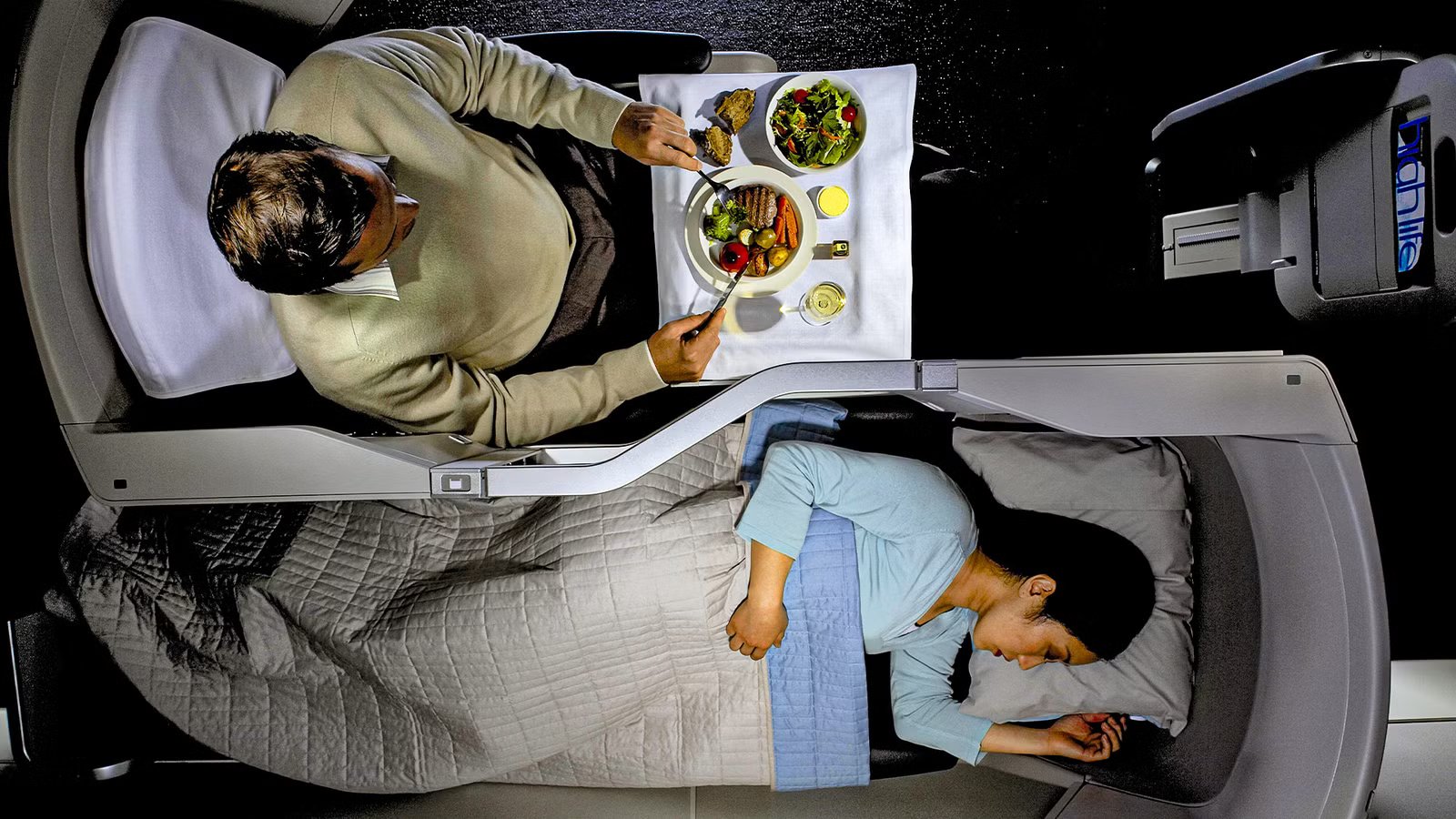
The Origin Story

The foundation of modern premium aviation hardware traces back to when British Airways sought to completely redefine the transatlantic flight experience. In 1995, the airline introduced the first horizontal sleeping surfaces to its first class cabins, setting a brand-new baseline for elite travel. However, the true architectural challenge lay in translating this ultra-luxury concept into a commercially viable business class cabin without destroying the underlying aircraft economics.
To solve this complex spatial puzzle, the carrier commissioned Tangerine, a London-based interior design firm, in 1998 with a bold and open-ended brief. The designers realized that conventional rows of forward-facing seats could never accommodate a fully horizontal body without drastically reducing the total passenger capacity of the widebody airframe. Their solution was an unconventional, patented yin-yang layout that alternated forward- and rear-facing seats to utilize the available cabin width far more intelligently. It allowed the airline to fit flat beds into the exact same footprint as legacy reclining cradles, rewriting the rules of premium cabin engineering.
The revolutionary configuration officially entered service in March 2000, deployed on flagship Boeing 747 routes connecting London and New York. The carrier triggered a massive hardware race among global competitors who were suddenly forced to develop their own horizontal products, especially as it was being deployed at scale. This single architectural decision transformed business class from a slightly upgraded economy experience into a genuine premium experience, establishing an industry-wide design philosophy centered on maximizing yield per square inch.
The Start Of The Club Suite

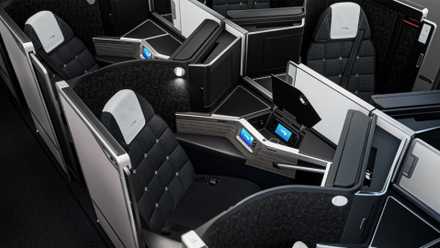
With the aviation industry evolving over the next two decades, long-haul passengers began prioritizing deep personal isolation over a basic sleeping surface. The carrier responded to this generational shift in consumer demand by introducing the Club Suite, which debuted as its next-generation flagship business class product on the Airbus A350-1000. The design represents a complete abandonment of the legacy interlocking layout in favor of a modern, highly functional workspace.
Catch what other flight trackers miss
Emergency squawks, holds, NOTAMs — live signals, no signup.
Open tracker
Catch what other flight trackers miss
Emergency squawks, holds, NOTAMs — live signals, no signup.
Open tracker
Built on a customized version of the Collins Aerospace Super Diamond platform, the current product rearranges the cabin into a highly efficient 1-2-1 configuration. This layout guarantees direct aisle access for every traveler, completely eliminating the awkward need to step over a neighbor’s feet mid-flight. The architecture integrates a 79-inch (200.6 cm) fully flat bed, 40% more personal storage space than its predecessor, and a bespoke sliding privacy door that seals the traveler away from aisle traffic.
|
Hardware Metric |
Legacy Business Cabin |
Flagship Club Suite |
|
Aisle Access |
Interlocking layout |
Direct aisle access for all passengers |
|
Privacy Profile |
Open shell configuration |
Sliding privacy door |
|
Bed Length |
Standard flat surface |
79 inches (200.6 cm) fully flat bed |
|
Storage Capacity |
Baseline compartments |
40% increase in designated space |
It really is the start of a new direction for British Airways, with an all-new flagship product that seeks to outperform the best the world has to offer. The airline has taken note from the books of leading Middle Eastern carriers like  Emirates, using the A380’s halo factor to its advantage, as opposed to totally phasing out the type.
How Airline Cabins Have Changed Since 2000
The year 2000 marked a turning point in airline cabin design. How far have these designs come in the years since?
A New Era For The A380

Maintaining a competitive edge in the luxury market means that these modern layout standards need to be added to the largest aircraft in the fleet. Beginning in mid-2026 and stretching into 2028, the airline is embarking on the most ambitious nose-to-tail cabin transformation in its operational history. This capital-intensive project targets all 12 of its active Airbus A380 superjumbos, which have historically carried older generations of seating hardware.
The extensive retrofit will completely replace legacy configurations with the doored Club Suite, expanding the business class cabin to a staggering 110 berths across both decks. This modification represents a 13% increase in total business class capacity, making it one of the largest premium upper-deck profiles in commercial aviation. At the same time, the airline is nearly doubling its premium economy footprint from 55 seats to 84, ensuring that high-yield leisure demand is fully captured.
Once the entire superjumbo fleet is modified, a striking 49% of the reconfigured A380 airframe will be entirely dedicated to premium cabins. The intense real estate allocation reflects a broader airline strategy that prioritizes high-yield premium passengers over raw economy volume. By re-engineering its largest double-decker jets to maximize doored suites and enhanced seating options, the carrier is positioning its flagship fleet to dominate lucrative long-haul business routes for the next decade.
All New First Class

The massive fleet refurbishment plans directly influence the crown jewel of the double-decker aircraft, which is the completely redesigned first class cabin. Aiming to replicate the atmosphere of a modern luxury hotel room, this top-tier environment focuses heavily on high-end artisanal details and custom structural acoustics. The airline sourced primary materials and manufacturing partners from across Great Britain and Ireland to ensure the final product reflects traditional regional craftsmanship.
The technical specifications of each workspace show a massive spatial upgrade designed to compete with the most exclusive options in the sky right now. Each individual suite measures 36.5 inches (92.7 cm) in width and features a standalone 79-inch (200.6 cm) fully flat bed. Travelers can manage their entertainment via an ultra-high-definition 32-inch (81.3 cm) 4K display screen, while a 60-inch (152.4 cm) curved privacy shell lined with specialized acoustic paneling dampens ambient engine noise. For those who are traveling together, the middle suites are engineered with a drop-down mechanism that allows for shared dining across an integrated ottoman, and the overall design language incorporates contour lines and ambient lighting choices that pay a subtle technical tribute to the legacy of Concorde.
Investing heavily in these ultra-premium micro-cabins allows the airline to maintain an aspirational halo product that drives brand loyalty across all tiers of travel. Designers have addressed the primary physical complaints of long-haul corporate flyers, such as engine noise to ensure no stone is left unturned. The focus on bespoke metallurgy, premium leathers, and custom wool blends proves that physical space becomes infinitely more valuable when paired with meticulous engineering.
Why British Airways Is Slashing 88 Economy Seats To Build The World’s Largest Business Class
British Airways is reimagining the A380 as a luxury vessel for high-demand corridors.
Premium Product Needs Premium Connection

Corporate executives and high-net-worth leisure travelers have expressed deep frustration with slow satellite speeds that drop completely during oceanic crossings. As business professionals increasingly require continuous workplace integration, the quality of onboard wireless networks has become just as critical as the physical comfort of the seat itself. Long-haul flights are an opportunity for rest, but also for work with minimal distractions.
The carrier is addressing this digital friction directly by announcing a fleet-wide deployment of complimentary Starlink satellite internet access beginning in 2026. Powered by a massive constellation of low-Earth-orbit satellites, this network upgrade will provide high-speed, low-latency connectivity to every premium traveler free of charge. The engineering teams behind the implementation indicate that the system is optimized to deliver a seamless browsing, streaming, and gaming experience that genuinely mimics the performance of a standard home broadband connection.
Integrating this advanced low-Earth-orbit satellite hardware represents a significant competitive advantage over carriers relying on older geostationary networks. Starlink satellites operate at a fraction of the distance of traditional spacecraft, so data packets travel back and forth with minimal delay, allowing for seamless live video conferencing over the Atlantic. Now, relaxing in a doored business suite no longer requires sacrificing productivity or disappearing from corporate communication channels for ten hours at a time.
Continuing The Legacy

The long-term commercial validity of these intensive multi-million dollar cabin modifications rests entirely on the shifting trends of premium route profitability. Operating a dedicated fleet of 12 double-decker superjumbos requires significant capital, making it vital that every square inch of the interior layout maximizes potential revenue generation. The plan is that by targeting high-density business corridors with these updated configurations, the airline can keep its largest assets highly profitable.
The changes planned through 2028 reveal a clear corporate strategy to squeeze more revenue from both premium leisure and corporate budgets. Dedicating 49% of the entire Airbus A380 floorplan to high-tier cabins shows that the carrier is fully prepared to sacrifice basic economy volume to lock down premium market share. This means that finding award space or booking retail tickets on these retrofitted airframes will become much more predictable, as the total volume of doored premium berths reaches historic highs across the network.
As the global aviation industry navigates stricter efficiency metrics and evolving passenger expectations, the legacy of the airline that popularized the flat bed remains firmly intact. The transition from basic sleeping pads to ultra-luxurious, acoustically insulated suites equipped with space-age satellite internet demonstrates a continuous dedication to premium innovation.