dailynewsnblog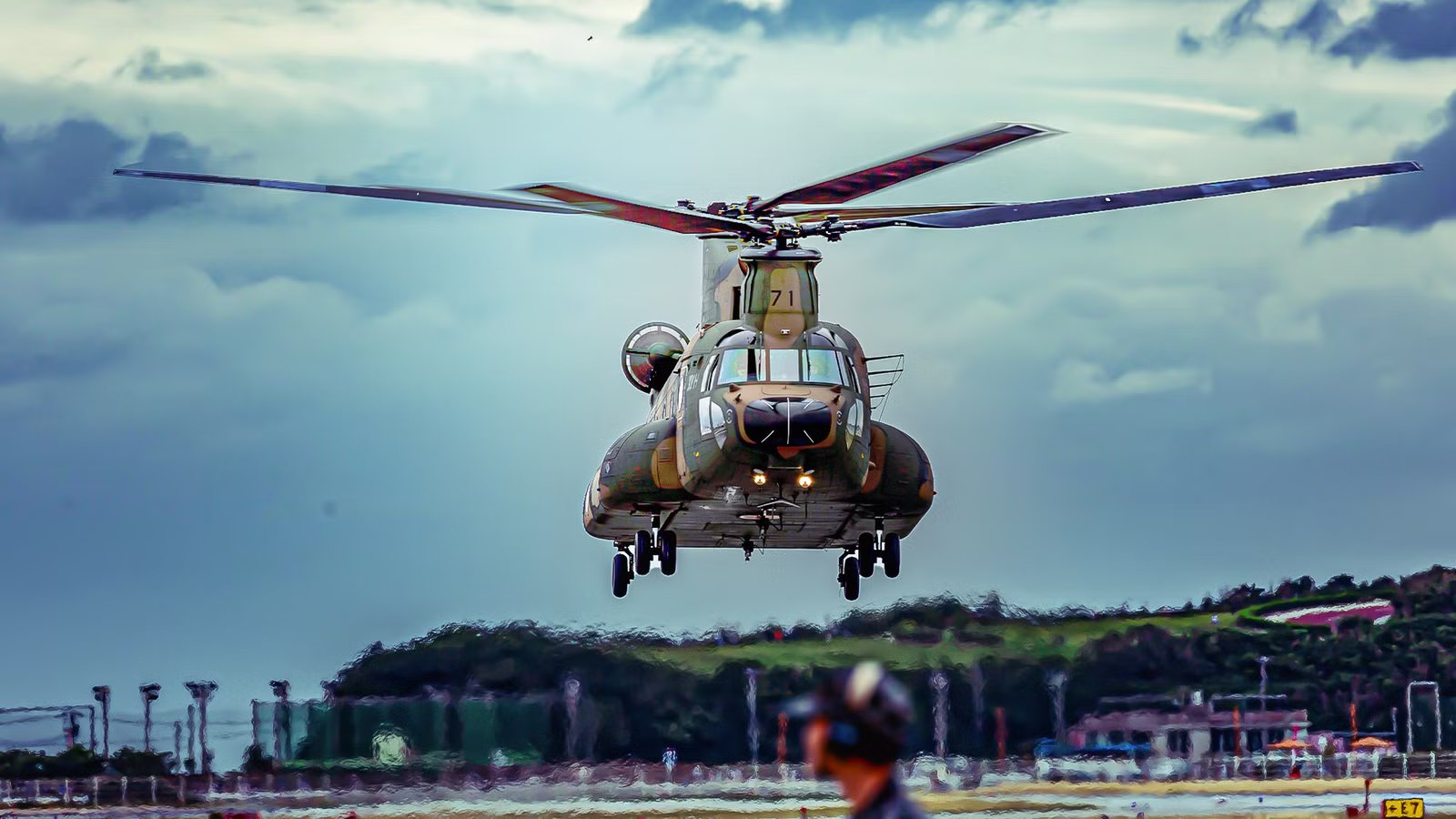
The  BoeingCH-47F Chinook has just completed more than 150 fully automated landings with an average error of less than five feet (1.5 meters), marking a significant step forward in military helicopter autonomy. Conducted during US Army flight tests in early 2026, the demonstration used Boeing’s A2X (Approach-to-X) software layered onto the helicopter’s Digital Automatic Flight Control System, allowing the aircraft to fly a complete approach and touchdown with no pilot input on the controls. For a platform that first entered service in 1962, the result is not just a technical milestone — it directly reflects how the US Army is reshaping aviation around reduced workload, increased precision, and future autonomous capability.
According to recent flight test data, reporting from outlets such as Army Times and Simple Flying, and Boeing’s own program disclosures, this analysis breaks down what has actually been demonstrated and why it matters now. Specifically, it examines three key areas: how the A2X system works within the Chinook’s flight control architecture, what the 150-test dataset proves about real-world performance, and how this capability fits into the US Army’s broader shift toward unmanned and reduced-crew aviation. That shift carries direct implications for US military operations, particularly in high-risk environments where landing precision and pilot workload are critical to mission success.
The Chinook At 64: A Platform Built To Keep Evolving

The Boeing CH-47 Chinook first flew on September 21, 1961, and entered US Army service the following year. In the six decades since, it has outlasted several programs specifically designed to replace it, and it continues to serve as the Army’s primary heavy-lift helicopter with no confirmed successor yet fielded. Its tandem-rotor layout, which eliminates the need for a tail rotor and allows the two rotors to share the lifting load, gives it a payload capacity and hover efficiency that no Western helicopter currently matches at scale.
The Chinook’s continued relevance in 2026 is highlighted by how Boeing invested heavily in keeping the platform competitive, most recently through the CH-47F Block II upgrade program, which introduces new rotor blades, redesigned fuel tanks for extended range, a reinforced airframe, and more powerful Honeywell T55-GA-714C turboshaft engines producing around 20% more power than the previous variant.
As Simple Flying has reported, Boeing received a $461 million order from the US Army for nine CH-47F Block II Chinooks in late 2025, bringing the total number of Block II aircraft under contract to 18 — a clear signal that the Army sees the platform remaining at the core of its heavy-lift capability well into the future. It is precisely because the Chinook is such a mature and trusted airframe that it serves as an ideal testbed for autonomous flight technology. The A2X program is, in that sense, a natural extension of decades of incremental capability development on a platform the Army is committed to flying well past 2060.
Supervised Autonomy: What A2X Actually Does

To understand why Boeing’s A2X milestone matters, it helps to look beyond the user interface and into the flight-control architecture enabling it. The CH-47F’s autonomous landing capability is built as an extension of the helicopter’s existing Digital Automatic Flight Control System (DAFCS), which is the flight computer responsible for stability augmentation, attitude hold, and coupled flight-path management.
The term “autonomous landing” can carry implications that go beyond what Boeing’s Approach-to-X system is actually designed to do, and it is worth being precise. A2X does not remove the pilot from the mission, but only from the control loop during the final approach and landing phase, one of the most physically and cognitively demanding segments of any rotary-wing flight, particularly in a tactical environment.
The workflow begins when the crew selects the landing zone, approach angle, and target airspeed using data coming from inertial navigation systems, radar altimeters, GPS positioning, airspeed sensors, and attitude references, with the system measuring deviations in:
- Lateral position
- Vertical glide path
- Forward velocity
- Sink rate
- Aircraft attitude
Those deviations are then translated into corrective cyclic, collective, and yaw control inputs through the DAFCS control laws: the A2X software generates a continuous trajectory solution, calculating the exact pitch, roll, yaw, and collective inputs required to maintain that path. Instead of the pilot manually coordinating cyclic and collective controls during descent, the flight computer updates those control inputs in real time based on aircraft state data.
Critically, the system does not lock the crew out. Pilot inputs can override or adjust the aircraft’s course and glide slope at any point, allowing crews to respond to a threat, an obstruction, or a sudden change in the landing area. Boeing describes this framework as “supervised autonomy,” and it is an accurate label: authority remains with the crew, but the machine handles the precise, repetitive work of managing the descent.
This design philosophy is central to understanding why the program exists. Boeing’s H-47 Human Factors Engineering lead, Deanna DiBernardi, framed the goal with precision:
“We built the interface and control laws around how pilots would naturally fly an approach.(…) Our goal is to reduce pilot workload so crews can maintain more eyes-out awareness in a tactical situation.”
In a contested landing zone, which can be a hillside in degraded weather, a confined urban rooftop, a forward operating base under threat, the difference between a pilot managing stick inputs and a pilot scanning for threats is not trivial. It can be the difference between a mission success and a catastrophic loss of situational awareness at the worst possible moment. Boeing’s software is designed to return cognitive bandwidth to the crew exactly when they need it most.
Why The F-4 Phantom Won’t Be Retired Anytime Soon
A Cold War icon defies expectations, remaining relevant in the 21st century. Discover the secrets behind the F-4 Phantom’s enduring legacy.
The Numbers: What 150 Approaches Actually Prove

Flight test milestones are most meaningful when the underlying data support the headline. In the case of A2X, the data is difficult to dismiss. Since the software’s first integration into the US Army CH-47F in January 2026, the program has accumulated a substantial and varied test record. The key figures are as follows:
- Over 150 automated approaches have been completed since testing began in January 2026.
- An average final position error of less than five feet (1.5 meters), consistently maintained across the full test series
- Approach profiles cover a range from a 100-foot (30-meter) hover down to full ground contact, with all four wheels touching down on the landing surface.
- No pilot interaction is required on the controls during the automated segment, with pilot override capability retained when needed.
The sub-five-foot positional accuracy figure deserves particular attention. In standard aviation contexts, a five-foot landing deviation is almost inconsequential. In the tactical environments the Chinook routinely operates in, such as confined mountain zones, improvised forward landing areas, shipboard operations, or austere desert strips, that distance represents the margin between a successful insertion and a rotor blade striking an obstacle.
The fact that A2X maintains that accuracy repeatably, across more than 150 attempts and a range of approach profiles, is what transforms this from an interesting demonstration into a potentially deployable capability. Boeing’s next steps involve refining the software through continued flight testing, making targeted adjustments, and preparing a final configuration for the Army to begin integrating across its fleet.
Seeing Through The Dust: The Degraded Visual Environment Problem

Boeing’s A2X addresses the pilot workload challenge, but there is a related and equally serious problem that has long plagued rotary-wing operations: the degraded visual environment, or DVE. Brownout — the phenomenon where rotor wash lifts dust, sand, or snow into a dense cloud around the aircraft during low-altitude operations — has been the cause of numerous helicopter accidents in combat zones, including in Iraq and Afghanistan. In a brownout condition, a pilot can lose all visual references within seconds of beginning a descent, making even a routine landing potentially fatal.
This is the gap that systems like Sierra Nevada Corporation’s Degraded Visual Environment Pilotage System, or DVEPS, are designed to fill. DVEPS takes a sensor fusion approach, combining LIDAR, millimeter-wave radar, and forward-looking infrared (FLIR) data into a coherent synthetic 3D picture of the terrain that remains legible to the crew regardless of what is happening outside the windows. According to reporting by Military Aerospace and Electronics, Sierra Nevada secured a contract valued at $471.6 million with the US Special Operations Command to supply DVEPS capability to special operations aviation platforms.
While A2X and DVEPS come from different development threads and are not formally integrated, they address complementary dimensions of the same operational challenge. A2X handles the control inputs; DVEPS handles the perception problem. Together, the two technologies represent a layered approach to making the terminal phase of helicopter flight safer and more effective under adverse conditions. For Army and special operations crews who regularly operate in environments where dust, darkness, and enemy activity converge, the combination is a genuine operational requirement being answered with real hardware and tested software.

How Many Chinooks Were Built?
From the Vietnam War to today, over 1,200 Boeing CH-47 Chinooks have been built – still the world’s most trusted heavy-lift helicopter.
The Army’s Broader Autonomy Push: The Chinook Is Not Alone

The Chinook’s autonomous landing demonstration arrives at a moment when the US Army is simultaneously pursuing a wide-ranging review of how it structures and staffs its aviation enterprise. According to Army Times, the service is targeting the elimination of roughly 6,000 pilot and aviation crew positions as part of a broader force restructuring effort. That figure is directly connected to the service’s push toward optionally manned and increasingly autonomous aircraft— the logic being that platforms capable of operating without a crew on board, or with reduced crew, require fewer trained aviators to sustain.
The Chinook is currently the second Army helicopter to demonstrate autonomous landing capability in recent months. The Army also received its first optionally piloted UH-60 Black Hawk for flight testing in March 2026, a development that represents a parallel track toward reduced-crew aviation within the service’s medium-lift fleet. As Simple Flying has explored in depth, the Army has been pursuing autonomous helicopter technology across multiple platforms, with unmanned and optionally piloted variants of the Black Hawk family at the center of several ongoing programs. The Chinook’s supervised autonomy demonstration fits squarely within that trajectory, as a deliberate step in the Army’s roadmap toward what it describes as “optimally crewed” aviation capability.
The implications for special operations and medical evacuation missions are particularly significant. These are the scenarios where crew workload is at its most intense, where landing zones are most likely to be confined or degraded, and where the penalty for distraction or error is highest.
A Chinook crew executing a forward surgical team insertion at night into a dust-obscured mountain landing zone, under potential threat, has very little cognitive margin to spare. Returning some of that margin to tactical awareness, which is the role A2X is specifically designed to serve, it addresses a real and documented operational gap.
What Comes Next For The Autonomous Chinook

Boeing has been clear that the A2X program is not finished. The company’s next phase involves continued flight testing to refine the software, address any edge cases identified in the first 150-plus approaches, and produce a final version ready for Army integration. That integration process will itself take time — transitioning a flight control software package from test configuration to fleet-wide fielding requires qualification, training pipeline development, and maintenance documentation updates across a fleet that numbers in the hundreds of aircraft.
The Army’s desired timeline is one of urgency, but military aviation certification is, by necessity, a measured process.
The broader question is what A2X ultimately enables at the operational level. Boeing and the Army are careful to frame supervised autonomy as a crew-assistance tool rather than a step toward fully unmanned Chinook operations, and that framing is almost certainly accurate in the near term.
The supervised autonomy model, where humans define the mission parameters and retain authority while the aircraft manages the precise execution, is a more palatable and more immediately practical form of autonomy than full unmanned operation. It allows the Army to capture the workload and accuracy benefits without requiring the doctrinal, legal, and operational framework shifts that a fully unmanned heavy-lift helicopter would demand.
It is worth placing this milestone in the context of Boeing’s wider military aviation portfolio. As previously covered by Simple Flying, Boeing’s military programs are navigating a demanding period of modernization commitments, with the defense division expected to deliver on multiple fronts simultaneously.
The A2X program, by contrast, represents a relatively clean story: a focused software development effort on a mature, trusted platform, delivering measurable and repeatable results on an accelerated timeline. For a manufacturer facing scrutiny across several programs, the Chinook autonomy demonstration is the kind of milestone that speaks for itself — 150 landings, five feet of error, zero pilot input, and a 64-year-old helicopter still finding new ways to prove its worth.