dailynewsnblog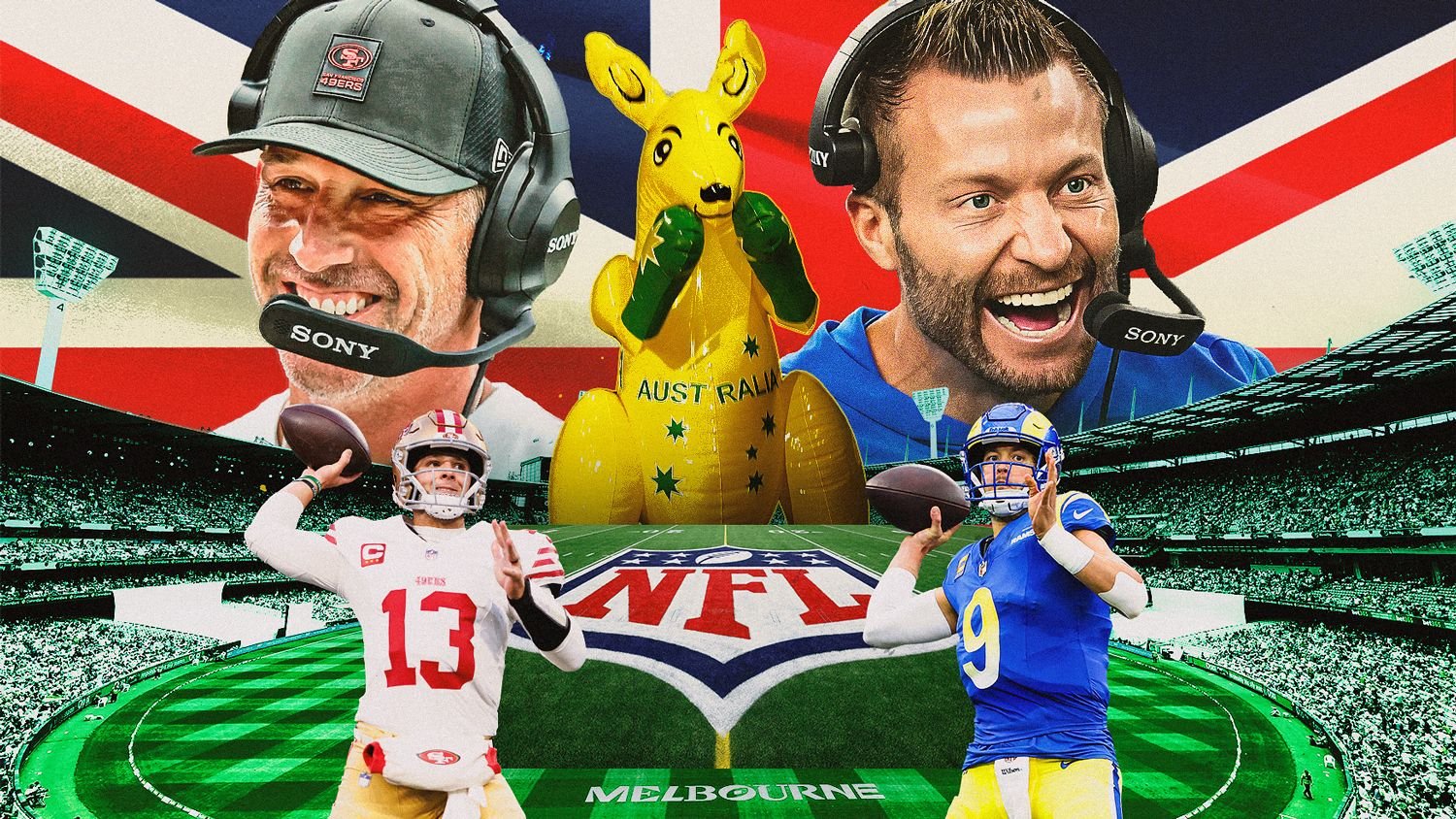
Sarah Barshop
Close
Sarah Barshop
ESPN Staff Writer
- Sarah Barshop covers the Los Angeles Rams for ESPN. She joined ESPN in 2016 to cover the Green Bay Packers for ESPN Milwaukee. She then moved to Houston to cover the Texans. She came to ESPN after working as a writer and editor for Sports Illustrated.
Nick Wagoner
CloseNick Wagoner
ESPN Staff Writer
- Nick Wagoner is an NFL reporter at ESPN. Nick has covered the San Francisco 49ers since 2016, having previously covered the St. Louis Rams for 12 years, including three years (2013 to 2015) at ESPN. In over a decade with the company, Nick has led ESPN’s coverage of the Niners’ 2019 and 2023 Super Bowl run, Colin Kaepernick’s protest, the Rams making Michael Sam the first openly gay player drafted to the NFL, Sam’s subsequent pursuit of a roster spot and the team’s relocation and stadium saga.


Multiple Authors
MELBOURNE, Australia — By the time San Francisco 49ers coach Kyle Shanahan had a chance to publicly discuss playing the Los Angeles Rams in Australia, 53 days had passed since the NFL announced the matchup.
Speaking at league meetings on March 31, a reporter had barely finished the question when Shanahan made his feelings clear. Though the 46-year-old coach said he understands it’s “cool” for the league to expand globally, he doesn’t see any “pro” for a team to take a 16-hour flight across the international dateline.
The next day, Shanahan told PFT Live that he knew “for a fact” the Rams had pushed to play San Francisco to prevent 49ers fans from taking over SoFi Stadium in Los Angeles. That theory gained steam in the Bay Area and had the backing of Green Bay Packers coach Matt LaFleur, but it was ultimately not the reason the Rams and Niners are set to meet at Melbourne Cricket Ground (MCG) on Thursday (8:35 p.m. ET, Netflix).
“We did not select the Niners at all,” said Kevin Demoff, the Rams’ team president. “I know they would love to think of themselves highly enough to say that, but that was not the case at all.”
In reality, the Melbourne opener is the culmination of the NFL’s four-year journey to deliver a marquee matchup that can ensure its first foray into the region will leave fans in this part of the world yearning for more. The record-setting travel (roughly 8,000 miles) also requires the toughest test yet of compromise between the league’s global ambition and the comfort of its teams.
For the Rams, it’s a trip to the Eastern Hemisphere more than a decade in the making. In 2016, they looked into playing a regular-season game in China. As the NFL closed in on plans for a game in Australia in 2024, the Rams immediately volunteered to host it. Doing so quickly allowed Los Angeles to be designated as the home team when the announcement was made, which no team had really ever done, Demoff said.
The league then turned its attention to the Niners — Australia’s most popular team by total fans, according to league data — in an effort to create a blockbuster debut. It’s a strategic pairing designed to unlock a massive new sports market while satisfying the league’s ever-growing list of deep-pocketed broadcast partners.
“We knew that we had an amazing opportunity in Week 1 on Friday morning in Australia to create what feels like a major event, which I know is a priority for Netflix and a focus overall,” said Matt Shapiro, the NFL’s senior vice president of global events and market strategy. “It really does feel like we are creating a global moment, a global stage between the Rams, the 49ers, Netflix and one of the most iconic stadiums in the world.”
WHILE THE NFL is constantly collecting statistics on how people consume its games globally, the league does not have specific benchmarks in place that trigger any new country getting a game.
It’s why Charlotte Offord, the NFL’s general manager of Australia and New Zealand, had no expectations on when the first contest Down Under would take place after helping open the Australian league office in 2022. At the time, the league had noticed sizable growth in the fanbase despite minimal investments in the market.
According to NFL data, Australians who identified as NFL fans grew from 5.7 million to 8.8 million between 2022 and 2025, a 54% jump that included more than 1.3 million people declaring themselves NFL fans in the past year. The league also has initiatives through the NFL Academy, which opened in 2024, and an active NFL flag football program in all 16 Australian states and territories.
“What I learned through the journey of that was this market is sports mad,” Offord said. “There’s two markets in the world that I think are sports mad: Australians and Americans.”
With that in mind, the NFL solicited bids from Australian cities to host. Sydney (where an exhibition was played between the Broncos and Chargers in 1999), Perth and Melbourne provided submissions. But Melbourne stood out for two primary reasons: its walkability and the MCG, which is the largest stadium in the Southern Hemisphere with a capacity of more than 100,000 fans.
The decision to pick the Rams as the home team was easier, Offord said.
Australia is one of the Rams’ seven chosen markets (along with China, Japan, South Korea, New Zealand and the United Arab Emirates) in the league’s Global Markets Program. The GMP is a league initiative that began in January 2022, granting teams international marketing rights outside of the United States. Teams choose the markets and must invest resources in growing their brands and the game to maintain those rights. Despite their popularity in Australia, the 49ers’ three GMP countries are Mexico, United Kingdom and UAE.
The Rams have made 15 visits to Australia since the GMP launched, sending current and former players, cheerleaders and team mascot Rampage Down Under. Their first visit came after winning Super Bowl LVI, when they brought the Lombardi Trophy to the country.
Los Angeles had initially hoped to wait until Week 1 of the 2028 season to give up a home game for an international contest, roughly two months after the end of the LA 2028 Olympics, Demoff said, but the team felt there was the “unique opportunity” once the league put Australia on the table for 2026. Having Demoff and the Rams on board allowed the NFL to move quickly to put the other pieces in place.
“We definitely wanted to do it with a club who was going to be that pioneer with us,” Shapiro said. “The Rams have certainly been an incredibly progressive and pioneering club on the international front and their willingness to take this journey with us was a critical piece of it overall.”
The Rams had not given up a home game to play internationally since the $5.5 billion SoFi Stadium opened in September 2020, so they knew the assignment was coming. In December 2023, the NFL voted that each team has to “host” an international game every four years.
While the Rams did not choose to protect any teams on their home schedule, Demoff acknowledged that they originally wanted to play their game against the Kansas City Chiefs at SoFi Stadium. But after Chiefs quarterback Patrick Mahomes tore his ACL in mid-December, Demoff said the Rams asked the NFL to play Kansas City in Week 1. The league said no.
Instead, the league eliminated the Rams’ East Coast opponents for travel purposes. The Seattle Seahawks were not an option because they won the Super Bowl and the right to host the opener. That left the 49ers, Dallas Cowboys and Arizona Cardinals as the only teams under consideration, Demoff said.
And while the Cardinals, who have won 19 games over the past four seasons and don’t rank among the 10 most popular teams in Australia, would have made sense geographically, they offered neither the global brand nor the competitive verve of the Cowboys and 49ers.
Ultimately, the league opted for the prime NFC West matchup by sending the 49ers to Melbourne while the Cowboys became the designated home team in Rio de Janeiro, Brazil, in Week 3 against the Ravens. It will be Dallas’ first international game as the home team and the NFL debut in Rio de Janeiro.
THE GAME IN Melbourne is not the 49ers’ only international trip in 2026. With Estadio Azteca fresh off renovations in advance of this summer’s men’s FIFA World Cup, the Niners lobbied hard to return, according to 49ers CEO Al Guido.
San Francisco was overdue to give up a home game after not hosting one since 2010. The last time the Niners played an international game was as the visitors in Mexico City in 2022.
As the Niners submitted their requests, the league broached the idea of sending them to Melbourne as the Rams’ opponent.
Guido, who says the Niners aspire to be the “globe’s team,” indicated the decisions for both international games were made independently but also acknowledged that San Francisco ultimately didn’t have much say on going to Australia.
“It wasn’t like a quid pro quo thing,” Guido said. “You can request where you want to play internationally. It doesn’t mean you’ll get it. … The Mexico City game was something because even though it’s an international match, it’s North America. For us, it gave us a chance to play two international games. … It was a little of like, ‘You’re already in Mexico City. They would like you to play as their visiting team.’ And we didn’t have a choice in the matter, to be clear.”
ONCE THE TEAMS were set for the first regular-season game of a multiyear agreement to play in Australia, the league began working through the many logistics of hosting in a new and distant place. The first decision was choosing when the game would happen. Although Week 1 always made the most sense because of travel time, Offord and Shapiro said that other weeks were considered.
There was also some debate about whether to put the game on Thursday or Friday because of the league’s preference to let the defending champion play the first game of the season. The NFL ultimately landed on a Thursday night kickoff in the United States — a Friday morning kickoff in Melbourne — with the Seahawks opening the season a day earlier than normal on a Wednesday.
The 49ers took advantage of the open week before the game, landing in Melbourne seven days before kickoff. They held four practices at AAMI Park, a short walk from MCG. On Friday night, a handful of Niners players attended the Australian Football League game at MCG. And the team held events throughout the week for kids at their training facility, schools, hospitals and other venues around town. Wide receiver Deebo Samuel Sr. even spent time shooting baskets with kids at a park near the team’s hotel.
The Rams organization was also involved locally in the past week, hosting youth flag football clinics, having marketing activations such as a floating football field on the Southbank Riverwalk, and programming events with former players. But in an effort to stay in as close to a rhythm and routine as possible, the current players and staff left Los Angeles on Tuesday night, landed on Thursday morning in Melbourne — approximately 29 hours before kickoff — and practiced at Marvel Stadium the day before the game.
The disparate approaches offered a stark reminder that the league’s business efforts don’t always align with the competitive needs of each football operation.
“There are all kinds of things we do in this league that are for the good of the league,” Demoff said. “And I think playing international games and understanding that that’s part of the league and the fact that everybody has to play them, it’s not a competitive disadvantage.”
Along with the unique challenges for the teams, the league also had much to think about. The early kickoff presented difficulties for the fan experience, with the league having to consider every angle up to and including ensuring MCG had enough breakfast concessions for fans entering the stadium compound as early as 7 a.m. AEST (Australian Eastern Standard Time).
Beyond that, there was plenty of other work to do to make the stadium ready for an NFL game. While the MCG is big enough to host professional sports teams in Australian rules football, soccer and cricket, that doesn’t mean all the spaces are optimized for NFL contests.
According to Jon Barker, the NFL’s global head of major event productions and operations, the planning and execution began about 16 months ago with the hardest work coming over the past three weeks. Following initial site visits to determine facility needs, the league embarked on all the necessary changes to the MCG.
On the exterior, that included building a hardened perimeter and campus with various shops and fan-centric activities, as well as implementing accompanying road closures and public transportation tweaks. Inside the stadium, Barker’s team expanded locker rooms and coaching booths, and added ribbon boards, field LEDs and other necessary technology for the game and halftime performance by the Jonas Brothers. Even the decision to select this particular music trio came with careful consideration.
“Somebody might say, ‘Well, why wouldn’t you just use an Australian artist?'” Barker said. “I understand the question, but the idea here is to bring something unique and something different that you may not get in your home market. … I want the fanbase in Australia to feel proud that this is their game, but I also want to give the fanbase in Australia something that they’ve never experienced before.”
THERE’S NO DOUBT that part of the calculus for playing in Australia is an experiment to see whether games that require flights nearly double the distance to London, the league’s most common international destination, are sustainable.
“This is a great test case for playing in Asia, certainly probably in the Middle East or some of those farther markets [or] Africa,” Demoff said, pointing out the fact that the longest flight before this trip was 10 or 11 hours. “… Once you’re flying 15 hours, you start to understand the rhythms and how it works. Whether this means you can play in Tokyo or Seoul or Beijing or Singapore or Auckland. For us, any of those places we have rights, it’s very exciting.”
From the league’s perspective, Australia could serve as a gateway to markets it has yet to explore. Fans from more than 33 countries, many of which are in Asia, have purchased tickets for this 49ers-Rams matchup, according to NFL data. But before the league can think beyond Australia, it knows it needs to work through the bumps along the way to proof of concept.
“This is new,” said Peter O’Reilly, the NFL’s executive vice president of club business, international and league events. “You learn things every year. This is further than we’ve gone for a regular-season game. But we feel really confident in the plan and the work we’ve done over many, many months working with the teams and our partners on the ground there in Melbourne.”
The NFL’s current collective bargaining agreement, which was ratified in 2020 and runs through March 2031, doesn’t include much language or many guidelines around international travel. Though in May, the NFL voted to no longer allow teams to block games from being moved out of North America.
The league will play a record nine international games in 2026 and has the ability to play up to 11, including a yearly contest at Wembley Stadium involving the Jacksonville Jaguars based on the current agreement with the NFLPA. NFL commissioner Roger Goodell has said he would like the league to play as many as 16, meaning each team would play overseas every year. For that to happen, the league and NFLPA would have to reach an additional agreement.
As the sport continues to grow globally, the guardrails around what the league is asking its players and teams to do once a season will likely be a part of any conversations around any new CBA negotiations.
“I’ve said this to Roger [Goodell], we need to be thoughtful as we expand the international program,” Guido said. “What does that mean for our schedule? What does that mean for roster sizes? Do we start to think about additional bye weeks? All of that needs to be taken into account in the future.”
One challenge is how to host international games that require longer flights later in the season. The league is testing that with the Cowboys hosting the Baltimore Ravens in Rio de Janeiro, Brazil, in Week 3. Both teams play on Sundays before and after the game. When the NFL played games in São Paulo, Brazil, in 2024 and 2025, both games were held the opening week of the season.
“I think truly for the league to grow, can this become a game that gets played later in the year?” Demoff said. “… There are only so many games you can play Week 1. I don’t ever foresee a world in which the majority of the Week 1 calendar for kickoff week is played abroad.”
Gerrit Meier, the league’s managing director and head of international, told Reuters in September that the NFL believes its next 50 million fans will come from international markets. The road to that number comes with an inherent understanding that coaches and players will voice their concerns with the toll it might take on the team, but the pros should ultimately outweigh the cons for the league.
“To do that is going to come with a little bit of pain on the football side,” Guido said. “I think the balancing act that ‘business’ and/or football always have to do … is making sure that the [game] is never watered down to where we’re actually diminishing the product.”