dailynewsnblog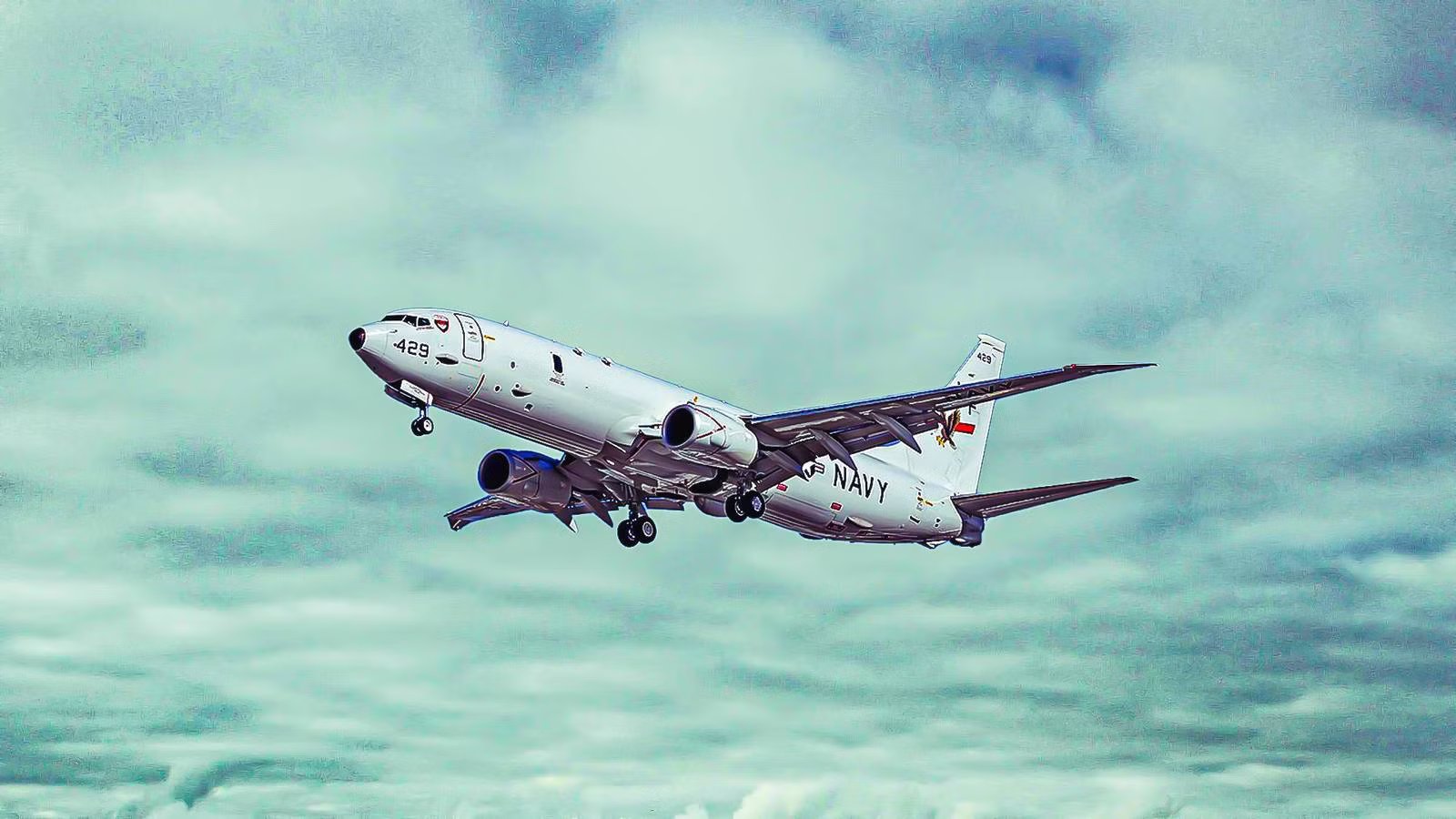
The  Boeing P-8A Poseidon spends its working life doing something very different from the aircraft most people associate with fuel economy. It flies hundreds or even thousands of miles out over the ocean, searches for ships and submarines, spends hours on station, operates sophisticated sensors, and can carry weapons for use against targets it may never actually encounter. All of that requires a substantial amount of fuel, but just how much does the Poseidon consume for every mile it flies?
To find out, the calculation needs to be put alongside the way a P-8A really flies. That means looking at how much fuel reaches the aircraft’s 4,660-mile (7,500 km) theoretical range, what happens during the hours it spends on patrol, how its altitude and speed change while searching for contacts, and how much of the aircraft’s weight comes from the sensors, weapons, and mission equipment it carries. The P-8A’s ability to refuel in flight adds another part to the equation, as does the very different mission it performs compared with the Lockheed P-3 Orion it replaced. The result is a closer look at what a Poseidon’s fuel is actually being spent on once it leaves the runway.
So What’s The Actual Miles-Per-Gallon Number?

According to the Royal Australian Air Force‘s P-8A Poseidon specifications, the aircraft carries almost 74,957 lb (34,000 kg) of internal fuel and has a range of about 4,660 miles (7,500 km). To turn that fuel mass into gallons, the FAA‘s Weight & Balance Handbook gives a standard Jet A/A-1 density of 6.68 lb per US gallon at 59°F (15°C). That puts the Poseidon’s full internal fuel load at approximately 11,220 gallons (42,470 liters).
Dividing the quoted range by that theoretical fuel volume gives the familiar figure: 4,660 miles (7,500 km) divided by 11,220 gallons (42,470 liters) equals about 0.42 miles per gallon (0.18 kilometers per liter). Expressed another way, the aircraft would consume approximately 2.4 gallons for every mile flown (5.7 liters per kilometer). It is an interesting number, but it is not a real-world fuel economy figure in the way the mpg figure on a car is.
The calculation assumes that the P-8A takes off with its full fuel load, flies essentially one continuous trip toward its maximum range, and lands after using almost all of that fuel. A maritime patrol sortie normally looks nothing like that. The aircraft entered service with the US Navy in 2013, replacing the P-3 Orion, a turboprop design that had been patrolling the same oceans since 1962, and the entire point of the swap was to change how the mission was flown. The difference is important because Poseidon’s mission is built around time and coverage, not only distance.
The Flight Profile Changes Everything

According to the US Navy’s P-8 Poseidon mission profile, a typical patrol can involve flying out to a station, remaining on task for four hours at a 1,200-nautical-mile radius (2,222 km), then returning to base. On station, a Poseidon is not cruising at one constant, efficient altitude either. That mission profile shapes nothing like the straight-line range-divided-by-fuel math implies.
Antisubmarine warfare makes this particularly important. That time on station can mean holding a wide search pattern at altitude while sonobuoys listen for a contact, then descending rapidly and circling tightly the moment something worth investigating shows up on a sensor display.
A P-8A may initially remain at altitude while its sensors and sonobuoys cover a large area. If a contact develops, the crew can change speed, heading and altitude while narrowing the search. The aircraft can descend toward the surface when required, maneuver around a developing contact, and then climb again.
That is one reason the aircraft’s altitude profile cannot be reduced to a single cruise figure. Simple Flying has previously examined why the P-8 Poseidon normally operates at high altitude despite being capable of flying as low as 200 feet above the waves. The P-8’s radar, communications and acoustic systems generally benefit from operating higher, while its structure and mission equipment allow it to descend when circumstances require it.
Crews trained on the older P-3 Orion often flew low for long stretches because that older airframe’s magnetic anomaly detector needed proximity to the water to work; the Poseidon’s sensor suite generally trades that low-altitude requirement for the reach of a modern radar and acoustic processing system, which is precisely why the aircraft spends most of its patrol time climbing back up rather than skimming the wave tops. Every one of those altitude and speed changes burns fuel differently than a smooth, single-altitude cruise, which is exactly what the spec-sheet range figure assumes. That means the aircraft has greater freedom to choose an altitude appropriate to the tactical situation, but that is just half of the story. The other half is what the airplane is carrying while it does all that maneuvering.
The Poseidon’s Weight Comes From What It Hunts With

The P-8A is built on the Boeing 737-800 airframe, but calling it a 737 with military equipment attached misses how much of its useful capability is concentrated in that additional equipment. According to NAVAIR’s official P-8A Poseidon program page, it carries the sensors, weapons, and mission systems needed to conduct anti-submarine warfare, anti-surface warfare, intelligence, surveillance, and reconnaissance work, none of which exists on the commercial aircraft it is derived from.
Its payload is fundamentally different from that of the commercial aircraft from which its airframe was derived. As our analysis into the militarized 737 detailed, the aircraft can carry up to 129 A-size sonobuoys, AGM-84 Harpoon anti-ship missiles, and Mk-54 lightweight torpedoes. It is also equipped with the Raytheon AN/APY-10 maritime, littoral and overland surveillance radar, which includes synthetic-aperture and inverse-synthetic-aperture imaging capabilities. Alongside the radar, the P-8 carries an integrated acoustic sensor and processing system that receives and processes data from its sonobuoys, allowing the crew to build and maintain an underwater tactical picture.
There is another important difference from the 737-800: the P-8A can receive fuel from an air tanker mid-mission, stretching its time on station well past what its internal fuel tanks alone would allow.
Despite all of that added hardware, the jet still shares roughly 86% of its parts commonality with the commercial 737 Next Generation family it is built alongside, which is exactly why Boeing has been able to keep production running well past 169 delivered airframes with fewer than 30 left on order across all customers. None of that hardware shows up in a range-divided-by-fuel calculation, yet it is the entire reason the aircraft exists. Which raises the real question: if fuel burn per mile is not what defines this airplane, what does?
The Real Benchmark: Radius Of Action, Not Miles Per Gallon

For a maritime patrol aircraft, the number that matters is how far it can fly, how long it can stay once it gets there, and how quickly it can respond, not how many miles it squeezes from a gallon of Jet A. That is precisely how the Navy’s own mission profile frames the P-8A: a 1,200-nautical-mile (2,222 km) radius with four hours available on station, extendable further with aerial refueling.
A budget officer comparing two patrol aircraft on fuel burn alone would be measuring the wrong variable entirely, in much the same way that judging a fire engine on its miles per gallon misses the point of a vehicle built to arrive fast and pump water, not to commute efficiently.
Set beside the Lockheed P-3 Orion it replaced, that shift in priorities becomes clear. The turboprop-powered Orion was designed for long, slow, fuel-sipping patrols without any aerial refueling option at all, relying on four propeller engines to stretch every gallon across a Cold War-era mission built around waiting, not reacting.
The jet-powered Poseidon trades some of that raw range for speed getting to the search area and for a sensor suite that needs power and altitude to perform, and makes up the endurance difference by simply taking on more gas mid-flight when the mission demands it, something the propeller-driven design it replaced was never equipped to do. In other words, the aircraft’s fuel system is part of its mission architecture. The relevant question is how much useful patrol work can be done before the aircraft has to return home.
Why The Fuel Burn Is Acceptable To The Current P-8 Operators

Singapore is the latest example. As reported by Simple Flying, the Republic of Singapore Air Force is set to become the first Southeast Asian operator of the P-8A, replacing aging Fokker 50 maritime patrol turboprops to strengthen surveillance across some of the world’s busiest shipping lanes. A decision driven by sensor performance, endurance, and interoperability with US and Australian P-8A fleets, that cannot be reconducted just to a fuel-per-mile figure.
Germany, Canada, the UK, Norway, and New Zealand have made the same calculation in recent years, each replacing older turboprop patrol aircraft with a jet that burns noticeably more fuel per mile but delivers a sensor suite, weapons load, and refueling-extended endurance that the older airframes simply could not match. Germany’s Navy provides a useful example of how the mission has changed. Its P-8As are now being used over the Baltic Sea, where maritime surveillance involves a geographically constrained and strategically important environment. In such a mission, the ability to rapidly reach a designated area and process information from multiple sensors counts more than minimizing the fuel consumption.
All this gives the 0.42-mpg calculation a much narrower meaning. It describes a mathematical relationship between the aircraft’s quoted range and its fuel load, not how efficiently a P-8 performs its actual job.
What Does 0.42 MPG Really Tell Us?

The 0.42-mpg figure is a legitimate calculation, but it is also a good example of how easily a specification can lose its meaning when taken out of context. The P-8A’s quoted range and fuel capacity produce a neat number, but neither tells us how a typical patrol is actually flown.
A Poseidon does not spend its mission trying to maximize the distance covered by every gallon. Its fuel has to support the transit to the patrol area, the time spent there, changes in altitude and speed, sensor operations, and the return flight, with reserves still available. Aerial refueling can then extend the mission when the situation requires it.
So 0.42 mpg is best understood as a piece of aircraft arithmetic rather than a measure of Poseidon’s real-world efficiency. It is an interesting number to calculate, but a rather poor way of describing what the aircraft was designed to accomplish.