dailynewsnblog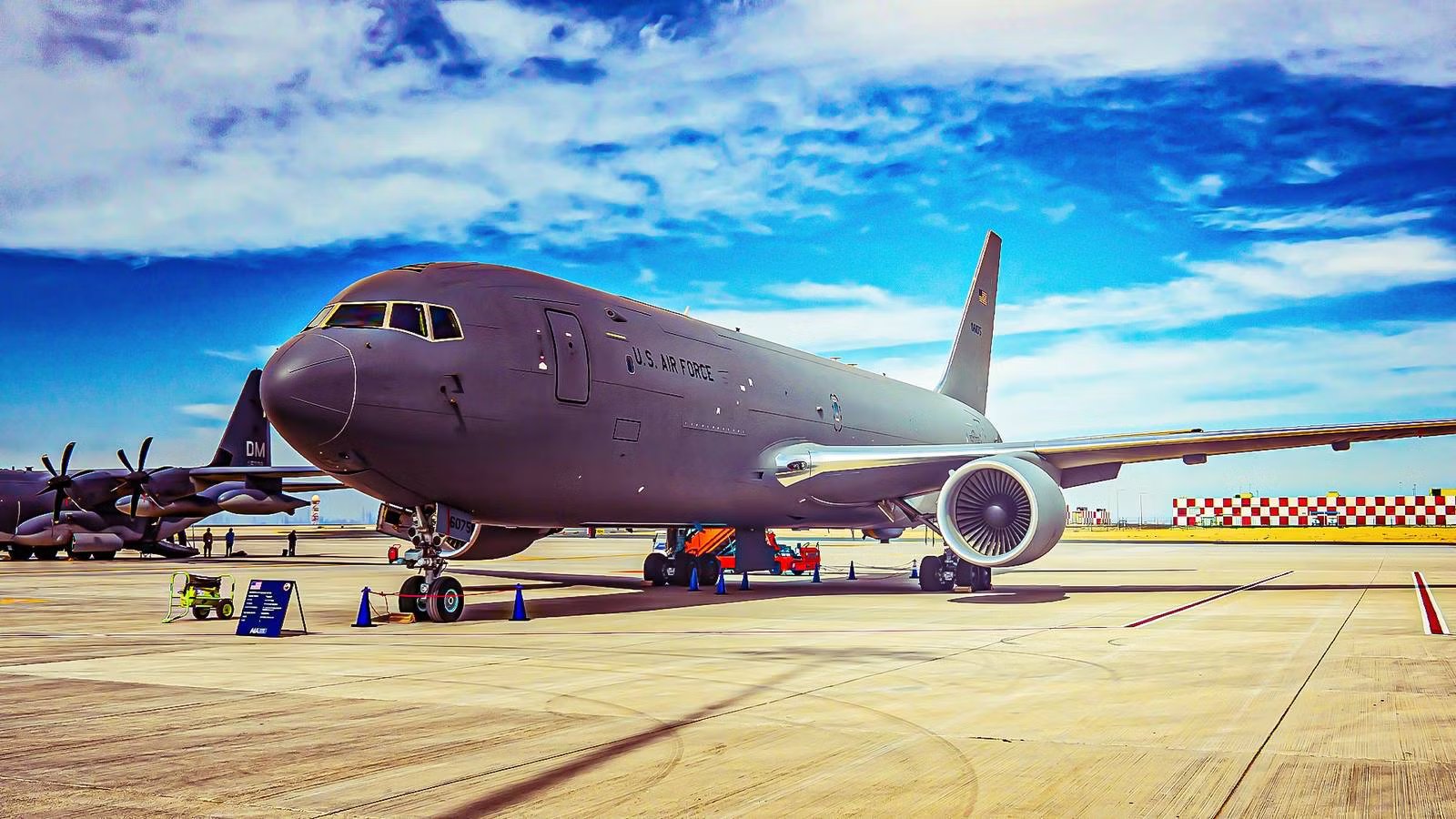
A  BoeingKC-46 Pegasus can burn through more than four gallons of jet fuel for every mile it flies, at least if the aircraft is judged by the same crude miles-per-gallon calculation used for a car. That sounds less like the efficiency of a modern military aircraft and more like a problem waiting to be solved. But rather than treating the Pegasus’s enormous fuel appetite as the central problem, the United States Air Force is expanding the fleet around it. The contradiction raises a more interesting question than the headline number itself: what exactly is the Air Force getting for all that fuel?
The answer depends on what happens between takeoff and landing. Boeing built the KC-46 for a task in which fuel is simultaneously something the aircraft burns and something it delivers, while Air Mobility Command measures its usefulness in terms that have little resemblance to miles per gallon. That puts the Pegasus’s engines, fuel tanks, refueling systems, aging Boeing KC-135 fleet, and expanding production program in the same equation, but which of those numbers actually determines whether the aircraft is doing its job efficiently?
So What’s The Actual Miles-Per-Gallon Number?

According to Air Mobility Command’s KC-46A Pegasus fact sheet, the air tanker‘s maximum range is 6,385 nautical miles (11,830 km), and its maximum fuel capacity is listed at 212,299 lb (96,297 kg). Converting that weight into a volume takes one more figure: the FAA‘s Weight & Balance Handbook gives Jet A/A-1 a standard density of roughly 6.68 lb per US gallon at 59°F (15°C), which puts the KC-46’s full tank at approximately 31,800 gallons (120,380 liters).
Dividing those two spec-sheet numbers against each other, the result is 0.23 miles per gallon, or 0.09 km per liter. Flipping the fraction, it sounds even worse: about 4.3 gallons consumed for every single mile the aircraft covers, gone before the jet passes the next highway-style mile marker in the sky.
It is a perfectly valid piece of arithmetic using published figures from Boeing and the Air Force. The problem is what those figures represent. Maximum range is not necessarily achieved with maximum fuel, and maximum fuel capacity does not mean that every sortie takes off with all 212,299 lb onboard. The amount of fuel a crew actually carries and how much of the available range it can use is influenced by several factors, such as the aircraft weight, payload, reserves, weather, and mission.
Why That Number Barely Means Anything In The Air

Boeing
The difference becomes obvious once you consider the Pegasus as an operational aircraft rather than a set of specification-sheet numbers. A real sortie can involve a climb to its operating altitude, cruise to a refueling track, time spent waiting for receiver aircraft, multiple contacts, routing changes, and a reserve that cannot simply be counted as useful range. The aircraft’s own weight also changes with cargo, passengers, and fuel. A KC-46 supporting fighters over the Pacific can therefore have a completely different fuel profile from one repositioning between bases, even though both flights use the same two Pratt & Whitney PW4062 engines.
Then comes the part of the mission that makes the KC-46 fundamentally different from an ordinary aircraft: some of the fuel it carries is supposed to leave the airplane before the airplane lands. A Pegasus that departs with full tanks and returns three hours later with only a third of its initial fuel has not necessarily burned the missing two-thirds through its Pratt & Whitney PW4062 engines. Some of that fuel may have gone into Lockheed MartinF-16s and F-35s or Northrop GrummanB-2 Spirit Bombers along the way. Reading a fuel gauge before and after a mission and assuming the difference all went through the tanker’s own engines would substantially exaggerate what the KC-46 actually consumes just to move itself through the air, a distinction the 5 Fast Facts On The USAF KC-46A Pegasus Tanker lays out well when it comes to how the aircraft’s onboard fuel actually gets used.
The result is an unusual accounting problem. For most aircraft, the fuel load exists to enable the aircraft to perform its primary mission. For the KC-46, part of that same load is the mission itself. That means the useful question is how much of the fuel it carries can ultimately be made available to another aircraft while the Pegasus still has enough remaining to complete its own flight.
The Reason The KC-46’s Fuel Is Also Its Cargo

The KC-46’s fuel capacity is inseparable from its refueling equipment. Boeing lists 212,299 lb (96,297 kg) of total fuel capacity, while the aircraft can transfer that fuel through either its fly-by-wire boom or its hose-and-drogue systems. As Boeing’s own KC-46 Pegasus specifications make clear, there is no separate tank holding the fuel that will eventually be delivered to receivers; the same overall fuel supply has to support the tanker itself and the aircraft it is sent to refuel, which is why the Pegasus’s fuel load cannot be treated like the fuel tank of a conventional transport aircraft.
The Pegasus moves that shared supply through two very different systems. Its fly-by-wire refueling boom can transfer fuel at up to 1,200 gallons per minute (4,542 liters per minute), while its centerline and wing-mounted drogue systems, better suited to US Navy, US Marine Corps, and allied aircraft equipped with refueling probes rather than boom receptacles, top out at around 400 gallons per minute (1,514 liters per minute).
The transfer rates also show why a tanker needs a different way to measure performance. Fuel that leaves the KC-46 through the boom or drogue has already accomplished something useful, even though it no longer appears in the aircraft’s tanks at landing. A meaningful efficiency measure therefore has to account for both sides of the equation: what the tanker carries to the refueling area and what it can actually deliver once it gets there.
What Efficiency Really Looks Like For A Tanker

Boeing’s own comparison point for the KC-46 is closer to the operational question. The company says the Pegasus can deliver more fuel at all ranges than the KC-135 Stratotanker it is replacing. That shifts the focus from the amount of fuel required to move the tanker itself toward the amount of fuel the tanker can make available to other aircraft at a given distance, a point the US Air Force’s own KC-46A fact sheet reinforces when describing how onboard fuel is split between the boom, the centerline drogue, and the wing refueling pods.
Stack the KC-46A against the wider tanker fleet, and the picture gets clearer. The Boeing KC-135R carries around 198,000 lb (89,800 kg) of fuel, the retired KC-10 Extender carried roughly 356,000 lb (161,480 kg), and the Airbus A330 MRTT, the aircraft the KC-46 out-competed in the drawn-out KC-X selection process — holds about 245,000 lb (111,130 kg), as detailed by Simple Flying in the size comparison of the KC-767 and KC-135. The KC-46A’s 212,299 lb sits between the KC-135R and the larger McDonnell DouglasKC-10 and A330 MRTT capacities, but those figures describe potential rather than completed missions. The operational question is what each aircraft can put on station, transfer to receivers, and still retain for the trip home.
Aircraft | Fuel Capacity, lb (kg) |
KC-135R Stratotanker | ~198,000 (89,800) |
KC-46A Pegasus | ~212,299 (96,297) |
Airbus A330 MRTT | ~245,000 (111,130) |
KC-10 Extender (retired) | ~356,000 (161,480) |
That reframing explains why the Air Force keeps deciding it needs more KC-46s, even while the jet’s per-mile fuel burn remains, on paper, the worst-looking number in its logbook.
Why The Air Force Is Buying More KC-46s

The program that began in 2011 with a planned buy of 179 aircraft, has grown steadily to 188, then to 263 KC-46As under the current Tanker Production Extension Program, as Simple Flying reported, driven largely by a KC-135 fleet that now averages more than 60 years old and a demand for aerial refueling that shows no sign of slowing.
The case for a larger fleet instead rests on what the aircraft can do as part of the wider refueling network. Air Mobility Command has said the KC-46A delivers more fuel at all ranges and from shorter runways than the KC-135 it succeeds, while using less ramp space than competing tankers. Those characteristics affect where the tanker can operate and how efficiently the Air Force can distribute its refueling capacity across bases and missions.
There is still an important qualification. The KC-46 has to turn its theoretical capacity into fuel actually delivered to other aircraft, and its Remote Vision System remains part of that equation. The camera system used by boom operators has been undergoing the RVS 2.0 upgrade, with fielding currently expected in 2028.
The Number That Actually Matters

A KC-46 can be assigned a miles-per-gallon figure, but that number describes only one part of what happens to its fuel. The Pegasus is simultaneously transporting itself, carrying a large fuel reserve and, during the mission that defines it, converting part of that reserve into endurance for other aircraft. Reducing all three functions to a single MPG number strips away the distinction that matters most.
That is why the more revealing measurement sits somewhere between fuel burn and fuel offload. A tanker has to reach the refueling area, remain there long enough to support its receivers, transfer the required amount of fuel, and retain enough to complete its own mission. Those demands make range, offload capability, transfer rate, and operational availability interconnected rather than interchangeable specifications.
The 0.23-mpg calculation is still worth keeping because it gives the reader an intuitive sense of the amount of energy involved in moving a KC-46 through the air. It just should not be mistaken for the number that explains why the Air Force considers the Pegasus useful. For an aircraft whose most important payload can disappear through a boom at 1,200 gallons per minute, the more interesting question is what remains available to the aircraft that needed the tanker in the first place.