dailynewsnblog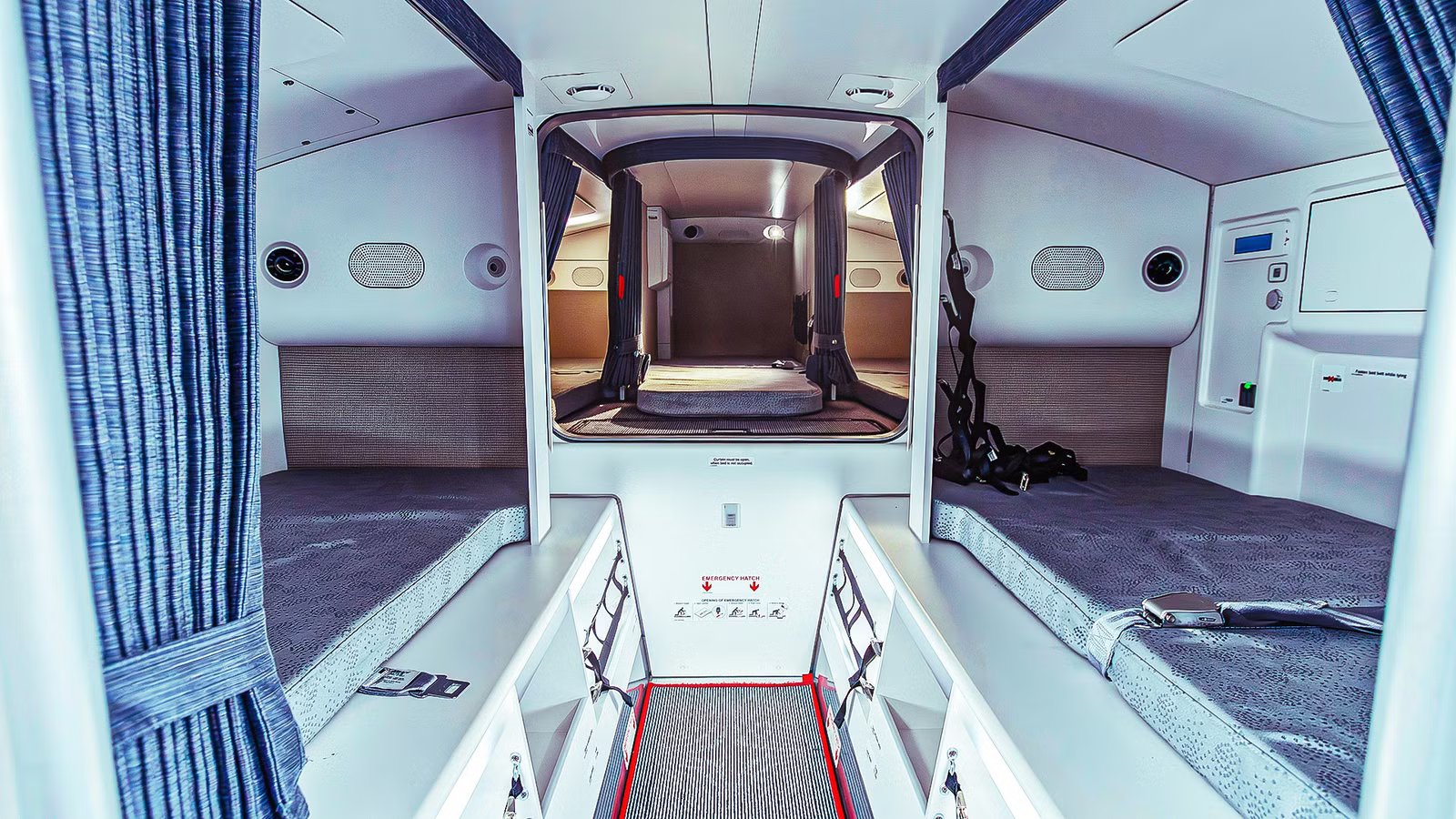
Boeing 787 Dreamliner routes from the US across the Pacific, such as to Tokyo, take over 11 hours. During this time, pilots are expected to perform a range of challenging duties: mapping, preflight checks, takeoff and climb, cruise, descent, approach, and more. All the time, they must remain in constant communication with other crew members and air traffic control as they travel through different airspaces.
The required duties and flight time are simply too much for a single crew of two pilots to operate safely or effectively. Instead, a third pilot is necessary for flights up to 13 hours in the FAA’s Part 117 rules, according to Pilot Institute. The crew must expand to four members for flights up to 17 hours. The additional crew members allow each pilot to get some much-needed rest.
Pilots Rest During Long-Haul Flying

The way that pilots organize their sleep while flying at 38,000 feet (11,600 m) cruising altitude depends on the size of the augmented crew, decisions made by the augmenting first officer (responsible for organizing rest), and their relative seniority. That’s not a case of the most junior pilots having to deal with the least desirable parts of long-haul aviation, but ensuring the right crew members are in the cockpits at the right time.
The crew rest plan usually comes into effect when the aircraft flies through 18,000 feet (5,500 m) and ends around 45 minutes before landing. That is because takeoff and landing are usually when all pilots are in the cockpits to help with these exceptionally busy parts of long-haul flying.
During a flight of approximately 10 hours, around nine hours of the flight time is usable for rest. As a result, each pilot will get three hours for rest, minus the few minutes needed for changeover and any briefings. That provides the pilots with an uninterrupted 2.5 hours of rest.
The Rules Around Where Pilots Sleep On Long-Haul Flights

The FAA also has rules on what must be provided to pilots so that their rest periods are effective. CNN reports that Class One bunks must be “in a location where intrusive noise, odors and vibration have minimum effect on sleep.” They also have to be temperature-controlled and include the ability for crew members to adjust lighting. Oxygen masks and other features ensure that resting pilots can remain safe if there is an emergency.
The bunks are defined as a “surface that allows for a flat sleeping position.” They need to measure at least 78 inches (198 cm) by 30 inches (76 cm). This amount of space could cause problems for larger pilots. A further 35 cubic feet (one cubic meter) of space is needed around them, with an additional 65 cubic feet (1.84 cubic meters) around them. This additional space needs to be reserved for changing, as well as comfortably entering and exiting the space.
Susannah Carr, a flight attendant with United Airlines, describes to CNN what using bunks like these is like in comparison to the premium classes: “In some ways yes, in some ways no,” says Carr. “The bunks can be wider than first class and for me personally, depending on the aircraft, I get more legroom. But it’s a bunk, so you don’t necessarily have the full headspace of being in the cabin.”
Why Rest Is So Important When Flying Across The Pacific

Rest is essential to stave off fatigue, which causes pilots’ physical and mental performance to worsen. A BBC report on pilot fatigue shows how serious the problem is: “80% [of accidents] are a result of human error, with pilot fatigue accounting for 15-20% of human error in fatal accidents. A survey by the British Airline Pilots’ Association (Balpa) of 500 of its members showed 43% had involuntarily fallen asleep in the cockpit, and of those, 31% said that when they woke up the other pilot was also asleep.”
There are a number of notable accidents over the last two decades that have been firmly connected to pilot sleep and fatigue. An example is AEU804, a JetX subcharter flight from Antalya, Turkey to Keflavík International Airport (KEF), Iceland in 2007. The flight made an unscheduled fuel stop in Edinburgh. Pilots during the 17 hours and 20 minutes of operation rested in the cockpit rather than a dedicated rest area. When landing at KEF, the aircraft skidded off the taxiway. Thankfully, none of the passengers or crew were injured.
The table below shows details of JetX’s short-lived fleet of four aircraft. It uses information from Planespotters.net:
Registration | Aircraft Type | Delivery Date | Exit Date |
|---|---|---|---|
OE-LNK | Boeing 737-800 | September 2006 | May 2007 |
TF-JXA | McDonnell Douglas MD-82 | August 2006 | December 2007 |
TF-JXB | McDonnell Douglas MD-82 | February 2007 | December 2007 |
TF-JXC | McDonnell Douglas MD-83 | October 2007 | April 2008 |
“The flight crew was likely fatigued, and this had a degrading effect on their performance,” reads the Aircraft Investigation Board report. It suggests that the unscheduled stop in Edinburgh extended each pilot’s flight duty hours and increased the risk of fatigue-related errors.
Project Sunrise Is Causing New Problems For Crew Rest

Qantas Project Sunrise flights, which will travel from Australia to New York and London nonstop, will have a flight time pushing up to 22 hours. Sleep is one of the many areas that these flights are revolutionizing. To prepare for Project Sunrise, Qantas operated a number of test flights during the pandemic.
It used the opportunities of not having to meet passenger demand to run trips between Australia and Europe. Pilots were tested throughout to gather data on their alertness, sleep patterns, hydration, meal patterns and more. The result was an optimization of pilot nutrition and circadian rhythm management and a better understanding of the physiological demands of remaining in the air for almost a full day.
Sleep during Project Sunrise services will be even more well-structured than in previous ultra-long-haul operations. Pilots and crew members will also have access to upgraded rest areas. That’s because sleep will be even more essential to ensure Project Sunrise flights can operate safely, along with the need for Qantas to keep in line with the requirements of Australian and international aviation regulators.
Getting Enough Rest On The Ground

Shutterstock | Simple Flying
Flying safely isn’t just about ensuring that long-haul pilots have opportunities to rest mid-flight. They also need to arrive at work properly rested. FAA regulations impose several limits on pilots, according to Pilot Institute. These rules are housed in Part 117. There are rolling cumulative limits, meaning that pilots can’t go over 100 hours of flight time in any 672 consecutive hours.
They also can’t fly for more than 1,000 hours during any consecutive 365 calendar days. Other limits are present during flight duty periods, including 60 flight duty period hours in any 168 consecutive hours. A limit of 190 flight duty period hours in any 672 consecutive hours also applies.
Part 117 regulations zoom in even further by mandating rest periods. Before any flight duty period, all pilots need to have had at least ten consecutive rest hours. During this time, pilots must have a minimum uninterrupted sleep opportunity of eight hours. Each week, pilots must therefore have at least 30 hours when they are completely free from any duty.
The final rest requirement for all pilots is a personal assessment. They must confirm that they are fit for duty before entering any flight duty period. Both a pilot and the airline have the ability to refuse an assignment based on the pilot’s fatigue.
The Restrictions Applying To Other Sectors Of The Aviation Industry

Commercial pilots have by far the strictest rest requirements both during and outside flying hours. This is because they are responsible for most people’s lives during their work. Charter and fractional pilots have the next strictest limits, which are governed by the FAA’s Part 135 and Part 91K limits. Part 135 specifies that single-pilot crews cannot fly over eight hours at a time, while two-pilot crews have a ten-hour limit in a 24-hour period. These rules don’t have a need to affirm fitness for duty.
Part 91K applies to fractional ownership programs. This is an arrangement where multiple people or businesses purchase an aircraft to split costs, each receiving a certain amount of flight hours per year. Pilots working these planes have a cap of 500 flight hours a quarter, 800 flight hours across two consecutive quarters, and 1,400 per year. Single-pilot crews are limited to eight hours of flight time, which extends to ten hours for crews with two pilots. Further extensions are in place for crews of three and four pilots where rest is possible.
Meanwhile, cargo and private pilots have minimal limits, as specified by Part 91. It is the pilot’s responsibility to make a judgment if they can fly safely and they don’t have the protection of the limits imposed on commercial pilots.