dailynewsnblog
If you have ever stepped off an airplane and thought, “That was actually a great flight,” despite being crammed into the exact same 17-inch-wide seat you complained about the last time you flew, you have experienced the undeniable power of inflight service. A passenger’s overall perception of a flight is heavily influenced by the quality of inflight service, which can somehow override — or at least help to forget about — the physical limitations of a cramped seat. While airlines invest heavily in the physical “hard product” like seat ergonomics and cabin layout, putting most of their effort into the premium economy cabin and upwards, it is the “soft product” (crew hospitality, food, cabin ambiance…) that psychologically determines whether a trip is remembered as great or miserable.
Not so long ago, flying was a highly luxurious experience where extravagant service was the main attraction — with caviar, seafood, free tobacco, and complimentary food and drinks with most flag carriers — but modern aviation has brought new priorities and shifted toward a highly efficient, mass-transit model. However, because most major airlines now operate the exact same aircraft ( Airbus,  Boeing and Embraer) and seat designs, exceptional inflight service and the human element have become the ultimate battleground for differentiating brands and winning customer loyalty, and, unfortunately, Europe and America are quickly falling behind Asia and the Middle East.
The Evolution & Psychology Of The Inflight Meal

Food is undeniably the cornerstone of the inflight service experience, acting as a crucial distraction that breaks up the monotony of a long-haul flight — this is one of the main reasons why they keep feeding you meals and snacks even in economy class when you thought that the flight was almost over. If we pay close attention, the meal service is the only time during the journey where the passenger is completely engaged and cared for in a tangible way. It is a highly anticipated ritual that helps travelers mark the passage of time across multiple time zones. However, delivering a hot, edible, and visually appealing meal to 300 people simultaneously at 35,000 feet is an operational miracle that requires months of planning and highly specialized catering facilities on the ground, as well as a dedicated crew that not only serves everyone as fast as possible, but that can do wonders by delivering your meal with a warm smile.
In the golden age of flying, galleys were larger, and crews had the time and space to prepare complex dishes. Today, the reality of high-density seating means that modern aircraft galleys are incredibly compact, acting as high-tech reheating stations rather than actual kitchens. Airlines partner with large catering companies like Do & Co or LSG Sky Chefs to prepare meals on the ground, blast-chill them, and load them into tightly packed, standardized carts. The challenge is immense, as the dry cabin air and low pressure completely dull our taste buds, meaning catering chefs have to aggressively over-season dishes with salt and spices just to make them taste normal to a passenger in the air.
This is why the quality of the meal service can completely shift your perception of the flight. When an airline nails the food—perhaps by offering a culturally authentic dish or simply serving a warm, freshly baked bread roll instead of a cold, plastic-wrapped hockey puck—it instantly elevates the perceived value of your ticket. Conversely, a sloppy, lukewarm meal immediately makes the passenger feel undervalued and hyper-aware of the physical constraints of their seat. For airlines, investing a few extra dollars per passenger into the catering budget is often the most cost-effective way to boost overall satisfaction scores and distract from the fact that everyone is sharing a single armrest.
The Human Element: Crew Interaction & Empathy

While the food is very important, the cabin crew is the absolute heartbeat of the inflight experience. Technically, a flight attendant’s primary legal role is to ensure passenger safety and manage emergency evacuations, a fact that is often overshadowed by their visible hospitality duties. However, from a passenger’s perspective, the flight attendants are the face of the airline brand. The subtle interpersonal dynamics between the crew and the passengers can defuse tension, create comfort, and turn a stressful travel day into a surprisingly pleasant journey.
Catch what other flight trackers miss
Emergency squawks, holds, NOTAMs — live signals, no signup.
Open tracker
Catch what other flight trackers miss
Emergency squawks, holds, NOTAMs — live signals, no signup.
Open tracker
The soft skills required to be an excellent flight attendant are staggering. They must constantly read the room, identify nervous flyers who need reassurance, manage disruptive passengers with diplomacy, and provide efficient service without appearing rushed. A great crew anticipates needs rather than just reacting to them; it is the difference between a flight attendant simply handing you a cup of water and one who notices you are coughing and proactively brings you a warm cup of tea with lemon. This level of emotional intelligence is impossible to automate and forms the core reason why some airlines—particularly those based in regions with a deep cultural emphasis on hospitality, such as the Middle East or Asia—consistently win global awards.
Airlines understand this dynamic, which is why crew training goes far beyond safety drills to include intense service psychology. However, it is also important to recognize the physical toll this takes on the crew. A flight attendant managing a busy, 300-seat Economy cabin on a 14-hour flight is walking miles on a tilted floor in a pressurized tube. When airlines cut crew staffing to the bare legal minimums, the service inevitably suffers, not because the crew doesn’t care, but because they are physically overextended. Therefore, a good service experience is often a direct reflection of an airline’s willingness to adequately staff and support its frontline workers.
Flyers Are Saying Virgin Atlantic’s Cabin Crew Service Stands Out: Here’s Why
Virgin Atlantic cabin crew deliver excellent service across all classes and combine consistency with a strong personality
Cabin Environment & The “Invisible” Service

As someone passionate about cabin design, I always argue that “service” is not just about what is handed to you; it is also about the environment that is passively curated around you. The physical atmosphere of the aircraft cabin — the lighting, the temperature, the cleanliness of the lavatories, and even the ambient noise — acts as a form of invisible service. If the cabin is freezing cold, overly bright during a night flight, or smells heavily of jet fuel, no amount of free champagne is going to make you feel comfortable.
Modern aircraft have given airlines incredible tools to manage this invisible service. Take the Boeing 787 Dreamliner or the Airbus A350, for example. These next-generation jets are built with composite materials that allow for higher cabin humidity and lower cabin altitude pressure, meaning you land feeling significantly less dehydrated and fatigued. Furthermore, they feature advanced LED mood lighting systems that crews use to simulate sunsets and sunrises, gently guiding your circadian rhythm across time zones. When a crew skillfully uses these environmental tools, the flight feels natural and restful; when they abruptly flip on the harsh fluorescent lights at 3:00 AM for breakfast, it feels like an interrogation.
Cleanliness is another massive component of this environmental service. Upon boarding, a pristine cabin immediately sets a tone of professionalism and care. Throughout the flight, the frequency with which the crew cleans and restocks the lavatories directly indicates their commitment to passenger comfort. These sensory details might seem minor, but they constantly feed into our subconscious evaluation of the journey, proving that good service is just as much about preventing discomfort as it is about providing amenities.
Tech-Driven Service: The Rise Of Personalization

If you want to see where inflight service is heading right now, you have to look at the intersection of hospitality and big data. We are moving away from a one-size-fits-all approach and entering an era of hyper-personalized service, driven entirely by technology. Airlines know more about their passengers today than ever before, and they are using that data to empower their cabin crews to deliver a customized experience that makes you feel recognized, even in a cabin of 300 strangers.
Ten years ago, a flight attendant relied on a printed paper manifest that simply showed who was sitting where. Today, crews are equipped with company-issued tablets loaded with sophisticated Customer Relationship Management (CRM) software. Before you even board, the crew can see if you are a frequent flyer, if you missed a connection the day before, if it is your birthday, or if you prefer a strict vegan meal. This allows a flight attendant to walk down the aisle and say, “Welcome back, Mr. Nunez, I see you had a rough delay yesterday in Frankfurt. Let me offer you a complimentary drink to make up for it”. That level of personalization is incredibly powerful for building brand loyalty.
Service Aspect | Legacy Approach (past) | Tech-driven Approach (present) |
|---|---|---|
Passenger Info | Printed paper manifest | Real-time CRM on crew tablets |
Ordering Food | Waiting for the aisle trolley | Ordering on-demand via IFE screen or BYOD app |
Service Recovery | Apologies and paper vouchers | Instant digital miles/vouchers issued during the flight |
Preferences | Asking passengers for meal choice | Preloading known dietary habits |
Furthermore, personalization extends directly to the passenger’s own devices. We are seeing a huge rise in “Bring Your Own Device” (BYOD) portals, where you can connect your smartphone to the aircraft’s internal WiFi to order snacks, drinks, or extra blankets directly to your seat without ever ringing the call bell. This gives the passenger total control over their experience and allows the crew to manage requests efficiently from the galley, rather than constantly walking the aisles to see what people need.
The “Service Recovery” Scenario: When Things Go Wrong

No matter how well an airline plans, things in commercial aviation — like in any other life situation — inevitably can go wrong at some point. Weather causes massive delays, catering trucks get stuck in traffic, and inflight entertainment screens randomly reboot or shut down indefinitely. In the airline industry, how a company handles these failures is known as “service recovery,” and it is arguably the most critical test of its inflight service model. A passenger might forget a perfectly normal flight, but they will absolutely remember how the crew treated them when everything went wrong.
Service recovery is an exercise in empathy and empowerment. The best airlines give their flight attendants the authority and the tools to fix problems on the spot. If a passenger’s pre-ordered meal wasn’t loaded onto the plane, a great crew member won’t just shrug and offer a bag of pretzels; they might piece together a meal from Business Class, offer a sincere apology, and use their tablet to instantly deposit 5,000 frequent flyer miles into the passenger’s account as an apology. This immediate action validates the passenger’s frustration and often turns a highly negative situation into a story of exceptional customer care that inevitably boosts customer loyalty and brand differentiation.
The psychology behind this is fascinating. Studies in the hospitality sector show that a customer who experiences a problem that is brilliantly resolved is often more loyal to the brand afterward than a customer who never experienced a problem at all. This is called the “service recovery paradox”. Airlines that understand this train their crews not to be defensive, but to lean into the problem, acting as an advocate for the passenger. It proves that good service isn’t about being perfect; it’s about being profoundly human when the system fails.
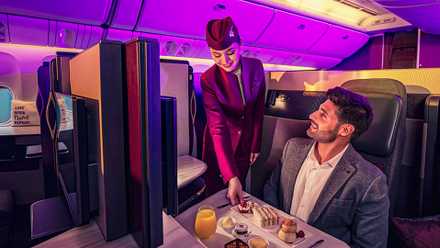
The Subtle Signs That Give 1st Time Business Class Passengers Away, According To Cabin Crew
Passengers may have a lot to hide if they plan to blend in on their first business class journey
The True Value of Service & The Future Ahead

When we step back and look at the entire aircraft cabin ecosystem, it becomes crystal clear that inflight service is the ultimate differentiator. As hard products continue to homogenize — with almost every airline eventually offering decent WiFi, similar seat pitches in Economy and sliding doors with flat beds in Business Class — the only thing airlines can and will truly compete with is how their passengers feel. Service is the magic that softens the harsh edges of air travel; it is the warm smile that makes a turbulent flight feel safe, and the thoughtfully presented meal that makes a cramped space feel cozy.
Reflecting on the present day, we find ourselves at a unique crossroads in aviation. We are flying in the most technologically advanced, fuel-efficient, and safest aircraft in human history, yet the collective patience of the traveling public has never seemed shorter. We demand lower fares while simultaneously expecting premium treatment. The airlines that are currently thriving are the ones that have figured out how to bridge this gap, using smart technology to streamline the logistics while fiercely protecting the warmth and empathy of human interaction. They understand that while a comfortable seat gets your body from A to B, the service and treatment are what transport your state of mind.
As we look toward the future, the integration of technology into the cabin will only accelerate. We will likely see AI predicting passenger needs, biometric boarding seamlessly integrating with onboard preferences, and perhaps even robotic elements assisting the galleys to speed up meal delivery. But this constant push toward automation raises a critical question for the next decade of cabin design and airline management: In our relentless pursuit of a perfectly frictionless, digitally optimized flight, how do we ensure we never lose the human touch that makes the miracle of flying feel truly special?