dailynewsnblog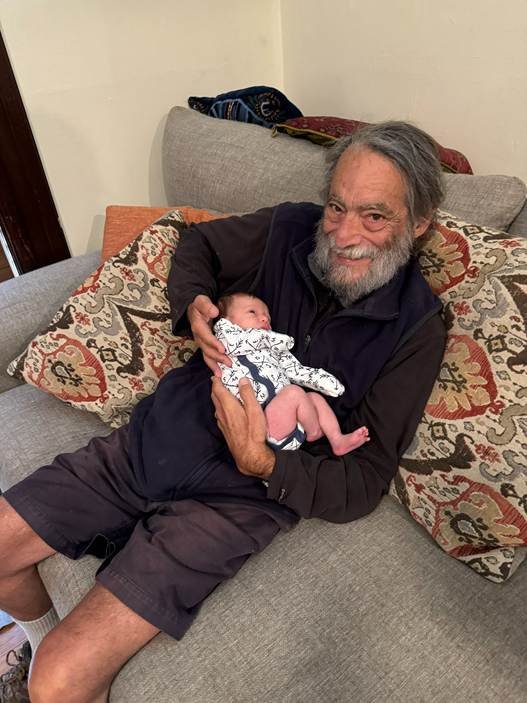

Stephen Bray and granddaughter Naomi
A close friend of mine, Stephen Bray, passed away almost a year ago. His wife, Diane, invited Jean and I and a number of Steve’s friends to come to a gathering at her house this week to gather our memories, reminiscences, and appreciations. That has prompted me to reflect on my relationship with Steve.
We first met outside the old Temple Beth Hatfiloh building on 8th and Jefferson in Olympia’s downtown. Our sons, Aaron and Zac, were in the same Sunday school class at TBH, and we were waiting around to pick them up when school was over. This was probably 1992 or 3.
I recognized Steve from his picture in The Olympian, where he was writing a semi- regular column about baseball in the paper’s sports section. We struck up a polite conversation which included talk of baseball in general and the Mariners in particular. But when the kids were ready to roll, we parted quickly and amiably.
The next time we found ourselves in the same situation, I asked Steve whether he would be interested in hearing the most perfect baseball story of all time. How could he respond to that question with other than a skeptical “sure.”
And here is the story.
In 1969 major league baseball first came to Seattle with the expansion Seattle Pilots. As all expansion teams, they were a pretty ragtag bunch, filled with players rejected by other squads, and unripe initiates. The Pilots played at a partially remodeled old minor league ballpark called Sick’s Seattle Stadium. It was still in the process of going from 15,000 minor league seating capacity to 21,000 when the season started in April. The outfield bleacher seats – relevant to this story – were installed immediately adjacent to the field, separated by a simple chain link fence replete with entry and exit gates to the stands.
On Sunday, June 1, the Pilots were playing the Detroit Tigers in a day game. My dad told me that he would drive me to the stadium and then take off to the office to get some work done. He would in turn pick me up when the game was over. It was a beautiful, warm, late Spring day and I brought my big softball glove. Dad dropped me off in plenty of time to find my seat during the pregame warm up period. I was 14 years old and had never played an inning of baseball and only a bit of pick-up softball at school.
The Tigers were a formidable team that year. They had run away with the American League pennant in 1968, cruised to a World Series Championship, and still possessed all the talent that got them there the year before. Sluggers Al Kaline, Norm Cash and Willie Horton led a powerful offence. Pitchers Denny McLain and Mickey Lolich were Cy Young and World Series MVP winners. The Pilot fans were lucky to get an intimate view of the champs, never mind their own lowly team.
When I got to my left field bleacher seat, the Tigers were hitting batting practice. I sat by myself, with most seats still empty prior to the start of the game. Willie Horton was at the plate, slamming ball after ball in the warmup. Suddenly, with a smooth and powerful swing, Horton sent the ball sailing out to the left field stands where I was sitting. I stood up. The tiny ball was rapidly coming my way. It was terrifying. It was coming right to me. I stuck out my right gloved hand. Straight in front of me. I didn’t move an inch to my left. Not an inch to my right. And the ball, that hard, small, spinning ball, flew directly into my outstretch glove. And… it hit the glove straight on, and before I knew how to close on it, the ball ricocheted away, bouncing from seat to seat down the stands. I watched, embarrassed and powerless, as other kids scampered for the ball and captured it.
Meanwhile, on the field, different batters were taking batting practice and fielders were taking fielding practice. About 5 minutes passed. Willie Horton by this time was in his usual left outfield position shagging balls. A high fly ball was sent his way. But this time, after catching it, he turned around and started walking to the bleachers. He was walking in my direction. And then I saw him start to motion with his hand for someone to come forward. “Who me?” I gestured. His response was affirmative and he kept walking over to a gate in the chain link fence. He waved me to come down.
I walked down to the gate, Willie Horton opened it and said to me, “stick out your mitt.” I did so. Then he slapped the ball into my mitt and said, “you’ll get it next time, kid.”
And with that, he closed the gate, turned around, and walked back out to the field.
The 1969 Seattle Pilots season was both the first and last for the team. Ownership failure and league failure to control its miscreants led the Pilots to leave Seattle and become the Milwaukee Brewers the very next year. Seattle fans – including the state’s attorney general – sued Major League Baseball and the suit was settled eight years later when Major League Baseball returned to Seattle with another expansion team, this time the Mariners. And who should be selected in the expansion draft that first year? Why Willie Horton of course.
…And that was the story that I told Steve years later outside of Temple Beth Hatfiloh while waiting for our two sons who, by the way, quickly became far better baseball players than I ever was.
Stephen and I had parenting in common, and appreciation for baseball. But over the years, we shared so much more. Stephen was everything anyone could ask for in a friend. Caring but not intrusive. Wise. Humorous and witty. He initiated contact as much or more than I did. We were close, knew and remembered details about each of our lives, and supported each other during difficult times. I miss him terribly.
Most significantly, Steve almost died of cancer at a very young age. Recovery from that, a kind of rebirth, must change one’s perspective on what is important and vital in life. And for Steve to live an extra 50 plus years after such an averted death sentence was a gift to him and so many around him.
When I heard last year that he was in the hospital and that this time, recovery was not in the cards, I penned a last message to Steve. I believe Diane said that she had the chance to read it to him before he passed, but it wasn’t clear that he was able to take it in. Nevertheless, I will end this blog entry with the final message to my dear friend:
Dear Stephen,
When I told you the story of how Willie Horton asked me to open my mitt, slapped a ball into the open glove, and told me “you’ll get it next time,” I knew it would resonate with Stephen Bray, the baseball writer for The Olympian. And 40 plus years later, our friendship has proven that out.
When one nearly dies and then lives another 50 plus years, a certain foundation of equanimity is a valued companion. And death, with its inevitability, a leveling agent. Yet, its imminence for you is still crushing to those who love you. And I love you.
You have been, for me, the greatest of friends. Genuinely interested in my life. Openly sharing about yours. A source of wise counsel. And so often, a joy to be around.
Being a good friend to others isn’t the only attribute of a life well-lived. But it’s a pretty good sign.
Goodbye dear friend. Know that you gave and received love. That you will be missed by many. That you will be missed deeply by me.
love,
Daniel