dailynewsnblog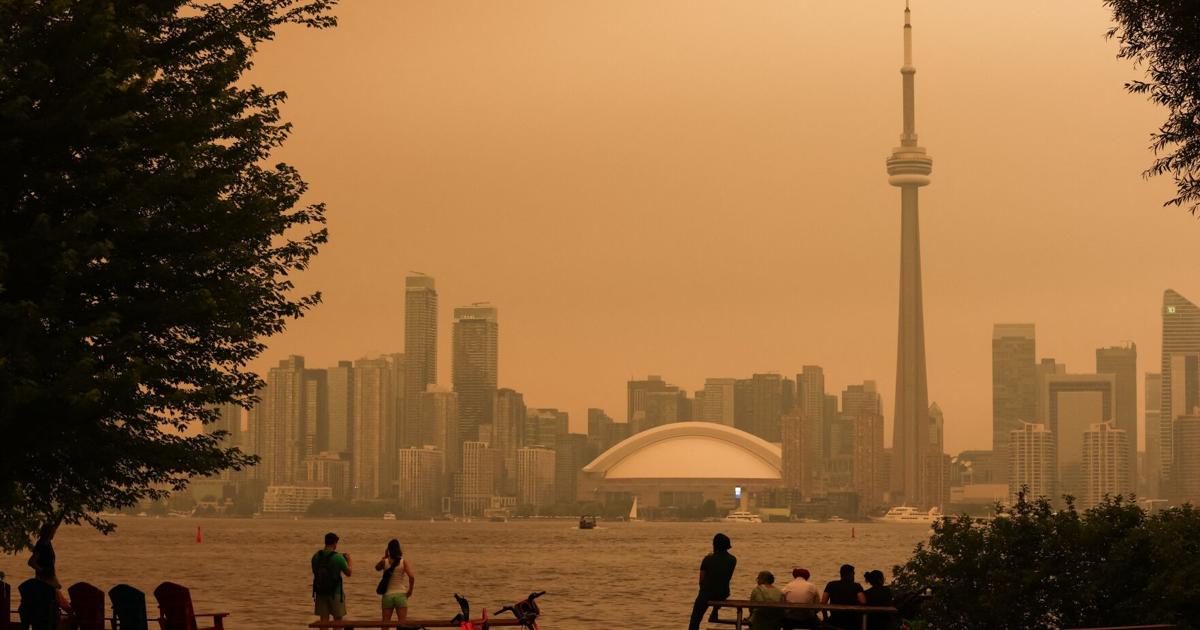
The smoke is here to stay.
That is to say, the smoke may be gone from the skies of Toronto — a week after it blanketed the city with eye-watering, cough-inducing soot, briefly giving us the worst air quality in the world — but it will be back.
Even if global carbon emissions were cut dramatically, so long as any greenhouse gases are being put into the atmosphere, climate scientists say the world will continue to get hotter.
And as the temperature rises, the forests dry out and the wildfires will get bigger, stronger and more frequent.
“It’s not going to get better. It’s going to get worse,” said Edward Struzik, a fellow with the Institute for Energy and Environmental Policy at Queen’s University and the author of “Dark Days at Noon: the Future of Fire.”
“These fires aren’t going away. Toronto is going to get smoke every summer.”
More forest has burned this year in Ontario than ever before recorded, and it’s not even August. As the biggest wildfire in the province’s history continues to burn north of Thunder Bay (at 315,000 hectares, it’s more than 50 per cent bigger than the largest forest fire on record), thousands of people have been evacuated from 13 remote communities, some of which have burned to the ground.
Politicians in Canada and the U.S. have been making calls for quick fixes, including no less a figure than U.S. President Donald Trump, who has threatened tariffs in retaliation for the smoke.
But the quick fixes being suggested — more waterbombers, firebreaks and “raking” the forest — would have little immediate effect, experts say.
The best solution would have been to dramatically cut emissions years ago. The harsh scientific reality is there’s nothing we can do to stop wildfire smoke from blanketing cities for a few days every summer — and it’s going to continue for decades to come.
We’re all going to need to buy air purifiers and masks and get used to it.
But that’s not to say there’s nothing we can do. Here are the key things Canada must do to prepare.
Why Canadians can’t fight fires the American way
The U.S. reaction has become as predictable as the fires themselves. When smoke blows south over the border, members of Congress, state governors and the president start complaining that Canada is somehow dropping the ball on forest fires.

Computer models have failed to predict a series of “impossible” blazes — which means more places once thought of as safe need to start confronting
Computer models have failed to predict a series of “impossible” blazes — which means more places once thought of as safe need to start confronting
If we imitated the American approach — by actively managing forests by thinning trees, removing low-hanging limbs and getting rid of dead wood on the forest floor — then there wouldn’t be so many fires, and the fires that did ignite wouldn’t grow so big. Or so the U.S. thinking goes.
This is nothing more than political rhetoric that misapplies American solutions to a Canadian problem with fundamentally different characteristics, says Zeke Hausfather, a climate scientist at Berkeley Earth, an independent non-profit research organization.
“The idea that we can thin our way through the boreal forest boggles the mind,” he said. “There aren’t enough people in Canada to do that.”
The boreal forest in Canada is an enormous and largely roadless expanse bigger than the entire European Union. In comparison, America’s much smaller forests are criss-crossed by roads, making firefighter access much quicker and easier.
“Western U.S. forests have evolved for frequent low-level fires that burn out the undergrowth — usually every five to 30 years,” he said. “Historically, before fire suppression, fires would burn through, and they wouldn’t actually kill the trees. They’d just kill smaller trees and clear out the brush.”
“The boreal forest is a fundamentally different beast,” he said. “It’s an ecosystem designed to burn.”
With smaller, more densely packed trees, the boreal is wetter and colder and doesn’t burn anywhere near as often — every 100 to 200 years on average, Hausfather said. But when fire does erupt, it’s often much more intense, burning up into the canopy and levelling everything in its path.
In these “stand replacement” fires, he said, “the forest burns down, and new trees grow up to replace them.”
Clearing out the dead wood on the ground wouldn’t prevent, or even slow, the canopy fires that sweep the boreal, said Hausfather.
While that means U.S.-style forest-management techniques won’t prevent smoke from filling the skies of distant cities, they could be used in a more focused way, he said.
Mechanical thinning and controlled burns (as well as building codes that require the use of fire-resistant materials) are the unsexy work that could make a real difference for First Nations in Ontario’s north.
Former forest firefighter Jen Beverly, a professor of environmental science at the University of Alberta, cautions that even this limited use of “fuel management” techniques is far-fetched.
Targeting a five-kilometre radius of forest around vulnerable communities across Canada would still require thinning 25 million hectares, according to a recent research paper she co-authored. That’s an area 37 times greater than the annual commercial logging harvest nationwide.
It would take 37 years to thin those forests, she said. “And by the end, you’d have to go back and clear the areas you did in the first year.”
If you scaled back your efforts to the FireSmart practices of limbing trees in close proximity to communities, it would still require treating three million hectares of forest, which would cost an estimated $21 billion.
“And you’re barely scratching the surface of the problem,” she said. “You’re just looking at the most flammable fuels causing the most extreme exposure.”

The Canadian Interagency Forest Fire Centre’s coordination centre has been deploying wildfire fighters around the country for more than 40 years.
CIFFC
Canada’s firefighting mission control
In the west end of Winnipeg, in a concrete building housing a Leon’s and a Hakim Optical, there’s a small office that operates like a mini NASA mission control.
With maps on large monitors lining the walls and a 24-hour duty officer answering a phone that won’t stop ringing, the Canadian Interagency Forest Fire Centre’s co-ordination centre has been deploying wildfire fighters around the country for more than 40 years.
As the nation’s premiers gather in Charlottetown, calls for an increased federal role in firefighting have proliferated, led by Ontario Premier Doug Ford. But it’s unclear what Ottawa could do that the CIFFC isn’t already doing.
Like so many things in Canada, forest fires are a provincial concern. Each province and territory runs its own wildfire fighting force, with its own waterbombers and helicopters, pumps and hoses. Because traditionally the fire season started in the west and moved east as the summer wore on, the CIFFC was able to co-ordinate the sharing of firefighting resources between provinces. Idle Fire Rangers in Ontario shipped out to help with spring fires in British Columbia. Then in August, Albertan firefighters would come east to Quebec.
The CIFFC has international agreements and has brought in wildfire fighters from the U.S., Mexico and Australia to pitch in, but the need for more surge resources has become so acute that this spring, the federal government leased 10 firefighting aircraft — four water bombers and six helicopters — to put on standby, ready to backstop any province that had maxed out its resources. They’ve already been deployed 22 times, according to a report in the Parliament-focused Hill Times newspaper.

The FireRanger program is understaffed and over budget, increasing the risk that each new blaze may break containment and threaten lives.
The FireRanger program is understaffed and over budget, increasing the risk that each new blaze may break containment and threaten lives.
“We are doing everything we can. We are working with everybody across the country to make sure that at the end of the day, provinces and territories have what they need, when they need it,” said CIFFC spokesperson Awa Cissé.
The non-profit organization already coordinates the federal fleet and would welcome expanding its role to manage more deployable firefighting resources — a suggestion that’s been floated in the meeting of premiers in Charlottetown this week.
Creating a pool of federal firefighting resources to dole out to provinces in need creates more problems than it solves, says David Martell, a professor emeritus at U of T’s Institute of Forestry and Conservation and one of the country’s foremost experts on fighting wildfire.
“The provinces know how to share stuff. They do it all the time. They’ve been doing it since 1970, and they do it very well,” he said.
If Ottawa has the money for a federal fleet of waterbombers, “that’s nice to know,” he added. ”My advice would be: take that money and give it to the provinces and let them buy them.”
Why Toronto ‘can’t be surprised’ by the next smoke event
Wildfires are something the vast majority of people don’t think about until the smoke rolls over the cities. Then, it becomes a crisis.
“There’s a kind of knee-jerk reaction that takes place,” said Struzik, the Queen’s fellow and author. “The provinces will ramp up their budget for forest firefighting … But a really long-term, comprehensive strategy really hasn’t taken hold yet.”
This means creating evacuation plans for vulnerable communities so they’re not scrambling as the flames approach, he said. It also means prepping for the next smoke event in big cities.
He noted New York City puts out public alerts that if you can’t afford a mask, you can go to your local fire station or library to pick one up, while outreach workers patrol, offering homeless people masks, transportation and shelter.
Much like heat waves and extreme cold snaps, Toronto and other cities are going to have to start preparing for smoke like a regular weather event, Struzik said.
“Every year we act like it’s something new and unexpected,” he said. “We can’t be surprised by these massive fires anymore.”