dailynewsnblog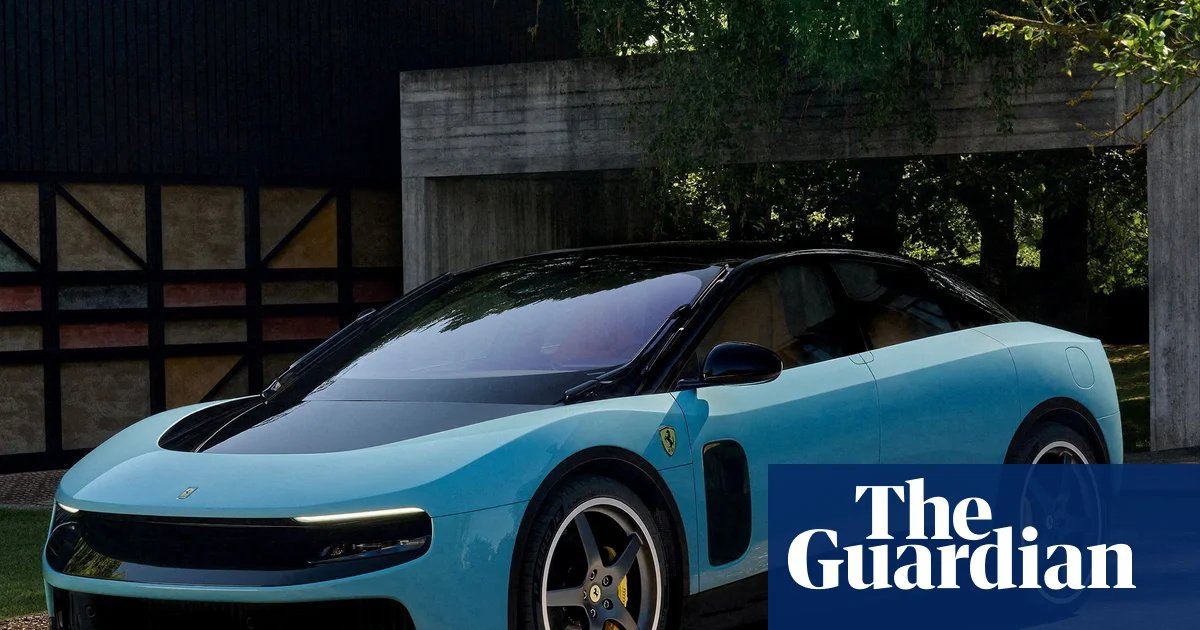
For passionate enthusiasts, Ferraris are not merely cars but works of art. The emotion stirred by their classic red curves is, they say, akin to standing before a Michelangelo sculpture, while the sound of the engine revving evokes a sensation comparable to listening to the music of Giuseppe Verdi or Giacomo Puccini.
Which is why the sight of the Italian carmaker’s first fully electric car, the Luce EV, unveiled this week, left many fans aghast.
“I don’t dispute the fact that it’s electric – that’s a generational step that needs to be taken,” said Fabio Barone, the president of the Italy-based Passione Rossa Ferrari owners’ club. “But the design was a total shock – it has shaken the very foundations of our legendary Ferrari.”
Barone, who bought his first Ferrari at 27 and has since notched up several world records for speed, is far from alone in his reaction. Across the manufacturer’s devoted fanbase, the five-seater blue Luce, which in Italian means light, drew widespread scepticism. Internet commenters said it resembled a Nissan or even the Fiat Multipla, a 1990s people carrier crowned the world’s ugliest car. The more disparaging memes compared it to a vacuum cleaner or a rubber clog.
Matteo Salvini, Italy’s deputy prime minister and transport minister, wondered what the carmaker’s founder, Enzo Ferrari, would make of it, while the former Ferrari CEO Luca Cordero di Montezemolo went one further by suggesting the Luce ought to be stripped of its prancing horse logo.
“I agree with him – the horse needs to be removed,” said Barone, adding that his main gripe was its lack of sound. “How can you have a Ferrari without any vroom?”
Efficient electric car motors are whisper-quiet compared with the roar of Ferrari’s usual V12 petrol engines. So Ferrari has felt compelled to add some sound back in. The company claims that sound is authentic because it is picked up by sensors beside the axles and amplified like an electric guitar.
Whether its efforts convince fans that it is a true Ferrari remains to be seen. The initial financial market reaction suggested investors had a clear view: Ferrari stock plunged 8.4% in Milan trading on Tuesday and US-listed shares fell 5.3%. On Thursday the share price staged something of a recovery, regaining 3.5%.
The rebound came after Ferrari’s chief executive, Benedetto Vigna, said the car was garnering interest from potential buyers. During an event in Modena, Vigna dismissed the critics, telling reporters that people were writing to say they liked the Luce and were placing orders. “This morning, three people wrote to me saying ‘I’m buying it because I like it’,” Vigna said, adding that the company had received compliments for the “courage and determination” shown in “defining what the car of the future should be”.
Vigna had previously said Ferrari was looking for buyers outside its traditional fans. John Elkann, the American-Italian scion of the Agnelli family of industrialists, drafted in the former Apple design boss Jony Ive and his collaborator Marc Newson to spearhead the new car – suggesting it wanted appeal beyond petrolheads.
Investment bank analysts who attended the glitzy launch event in Rome with Ferrari’s superwealthy customers were also more circumspect. Zuzanna Pusz, of the Swiss bank UBS, said there would be “stable underlying loyalty despite muted enthusiasm for the model”.
Michael Filatov, of the German bank Berenberg, said customers’ “sentiment shifted after the car was seen in person”, and particularly after seeing the extremely well-appointed interior. But more importantly, the backlash “may not matter for the investment case” for Ferrari. Most analysts suggest it will produce fewer than 1,000 of the cars, so “Ferrari only needs to capture a small number of open-minded wealthy buyers”, Filatov said.
Elkann also presented Luce to Pope Leo, a car enthusiast himself, and the Italian president, Sergio Mattarella, as part of its high-profile launch.
Barone’s club counts 70 members across Italy, who regularly gather with their Ferraris, often organising fundraising events. He claims they were the ones who first brought Ferrari to the Vatican, when their cars received a blessing from Pope John Paul II in St Peter’s Square in the 1990s.
Barone owns a Ferrari F8 Tributo, one of only 1,000 or so made, decked out with a personal number plate. When he’s not taking it for a spin in the Italian countryside or racing it around an autodrome, his Ferrari is usually locked away in a garage in the south of Rome. For everyday use, he drives a humble Fiat.
Barone, who was taught to drive by his father when he was eight, developed a passion for Ferraris at an early age. “I used to spend my mornings looking through the windows of the Ferrari dealership in Rome until one day a salesman let me drive one,” he said. Barone was by that time a teenager. “I still remember the smell of the leather seats,” he said.
Alex Tedino, a member of the Ferrari owners’ group, had a similar experience, making it difficult to accept the Luce because, he believes, it betrays the very essence of the brand’s aesthetics.
“You can’t compare a Ferrari to other cars,” Tedino said. “For us, they are great works of art and have always generated emotions – like looking at a Michelangelo, while the sound of the engine is like listening to Verdi or Puccini.”
The opposite reaction was triggered when he first saw the Luce. “It did nothing for me,” he said.
While Tedino is in favour of Ferrari making electric cars, he said that unless the classic look was maintained, the company should perhaps create a different brand altogether. “It needs to be something visually beautiful, like all the other Ferraris,” he said.