dailynewsnblog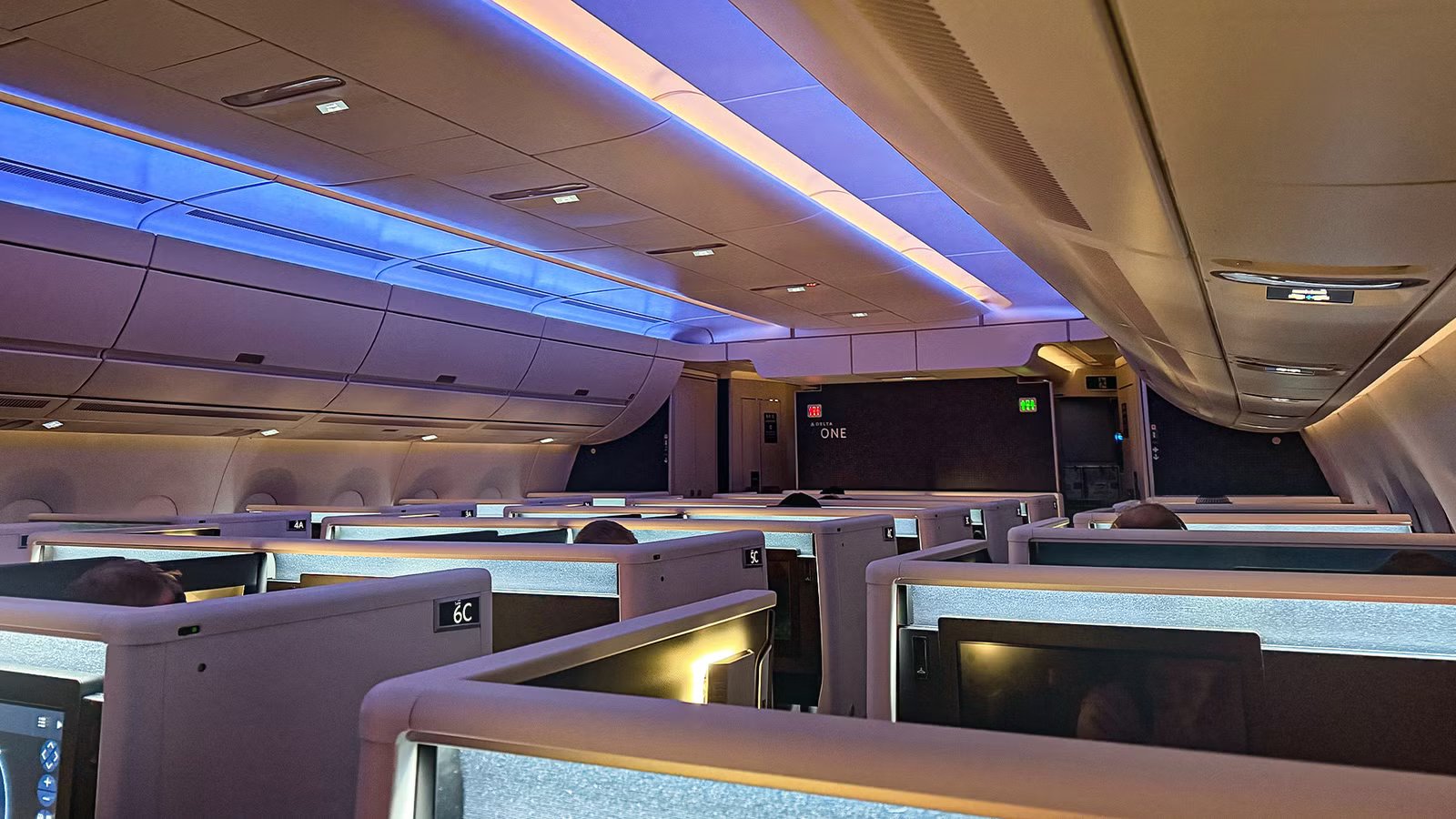
Modern aircraft cabins have evolved into meticulously engineered spaces where advanced lighting systems play a crucial role in passenger well-being. Far beyond basic illumination, these sophisticated lights are now used to regulate biological rhythms, enhance mood, and communicate brand identity, profoundly shaping the physiological and emotional inflight experience.
The evolution of next-generation aircraft has introduced highly customizable, multicolored LED cabin lighting. In a competitive market, airlines leverage this technology as a crucial “soft product” to stand out from rivals and significantly reduce the physical stress and toll of long-haul travel for their passengers.
The Biological Blueprint: Circadian Rhythms And Jet Lag

The main objective of advanced cabin lighting — apart from making cabins look “cooler” and more sophisticated — is the regulation of the human circadian rhythm (our internal 24-hour clock that controls sleep-wake cycles). When flying through several time zones, our internal clock can lose its footing, leading to exhaustion and cognitive slowness — also known as jet lag. The modern LED (Light Emmitting Diode) systems are designed and programmed to imitate the natural evolution of sunlight, delicately shifting color and temperatures to deceive our brains into adapting to the destination’s time zone before landing. Melatonin (the hormone responsible for sleep) production can be suppressed or stimulated with lighting, and airlines use this illusion to effectively force hundreds of passengers through a collective biological transition.
The complex, technical execution of this illusion involves managing the passengers’ exposure to the increasingly famous “blue light”. When boarding the aircraft and during meal services, the lighting tends to be crisp and cool (high Kelvin), promoting alertness and awareness and helping cabin crew perform their duties effectively. However, during the flight’s resting period, the lighting system tends to gradually replace the blue wavelengths with warm amber and soft pinks. This change is not only for aesthetics; it also has a physiological requirement. Research shows that exposure to high-intensity blue light at the wrong time, even for a brief period, can set back sleep for several hours, worsening the recovery needed by passengers after a long-haul journey.
Going further than sleep, the psychological effect of color temperature has a massive impact. An aircraft cabin enveloped in warm hues (similar to a sunset) during a meal service, for example, can help create a sense of intimacy and calm, reducing the ambient stress that passengers often associate with travel. On the other hand, a sequence that simulates a sunrise, in which the cabin progressively transitions from deep indigo to soft gold over a long period of time (30 to 60 minutes), helps to gently wake up the passengers. This technique prevents shocking the biological system, which can be caused when bright overhead lights are abruptly activated. It has been proven that this often triggers cortisol spikes and makes passengers feel more irritable upon arrival.
The Psychology Of Color: Branding And Mood Enhancement

Airlines use light as a tool to define the mood of the journey, reinforce their brand identity, and manage the psychological effect of travel on passengers. If you were to step onto a Virgin Atlantic flight, their iconic “mood violet” and deep pinks immediately portray a trendy, lounge-like atmosphere which aligns with the brand’s rebellious spirit. On the other hand, an airline like  Emirates is seen to employ gold and warm white tones, creating a sense of luxury and traditional hospitality. Lighting isn’t only about looking nice; it’s also extremely important as color theory deeply influences the passenger experience, behavior and perception of cabin space.
A clear example of this is that blue light is associated with cleanliness and efficiency, which explains its frequent use by dozens of airlines during boarding, as it makes the cabin feel spacious and modern. Green tones (used less frequently) can evoke feelings of nature and relaxation and, interestingly, help lower flyers’ anxiety. The transition between these scenarios is controlled from a Flight Attendant Panel (FAP), allowing the crew to select from several pre-programmed lighting profiles designed for specific phases of the flight, including “Boarding,” “Cruise,” “Meal Service,” and “Sleep.”
|
Light Color |
Intended Psychological Effect |
Typical Phase Of Flight |
|
Cool Blue & White |
Alertness, cleanliness, spaciousness |
Boarding, inspections and cabin cleaning |
|
Warm Amber & Gold |
Relaxation, comfort, intimacy |
Meal service and before sleep |
|
Orange & Soft Rose |
Gentle waking, natural transition |
Before landing |
|
Deep Purple & Indigo |
Calm, luxury, sleep induction |
Overnight cruise |
|
Green & Turquoise |
Nature, freshness, reduced anxiety |
Boarding in tropical places (not very common) |
The integration of these colors is also often used to define different “zones” within the aircraft cabin. Multi-class configurations — where airlines fly an aircraft with business, premium economy, and economy class cabins — are extremely common, and lighting can be used to indirectly differentiate the business class cabin from the economy class cabin without installing heavy, physical barriers. A softer, more subtle lighting palette in premium cabins supports the feeling of luxury and privacy. Meanwhile, the lighting settings in Economy Class are normally optimized to ensure the dense seating arrangement has less of a claustrophobic feeling by attracting attention to the ceiling architecture and available space there.
Will Aircraft Ceilings Of The Future Be Illuminated?
Engineering The Atmosphere: LED vs. Fluorescent Systems

The transition from fluorescent lighting to LED technology in aviation is probably one of the most significant upgrades in hardware for cabin interiors over the last 20 years. When fluorescent bulbs flickered (limited by their “on/off” positions), they could cause headaches and eyestrain. Most importantly, the bulbs were heavy, easily broken, and consumed large amounts of power. LEDs, by comparison, are solid-state electronics which are surprisingly weight-efficient and extremely durable (lasting up to 50,000 hours in operation). Their extended lifespan is a significant benefit for airline maintenance budgets, but, as we have seen in this article, the true winner is the passenger.
LEDs allow “stepless dimming,” meaning light levels can transition so smoothly and gradually that humans barely perceive the change. This has become essential for creating a peaceful environment. If a cabin were to suddenly go from dark to light, it would disrupt the rest and comfort of every passenger. When working with LEDs, this transition can take 20 minutes, mimicking a natural dawn or dusk. This technical and flexible feature, in turn, allows for “zonal lighting,” where different sections of the same cabin can have different lighting profiles. The best example of this would be needing to keep the galley bright for crew work and prep, while the seating area remains dark for resting passengers.
Going beyond the bulbs themselves, the “wash” of the light is critical. Modern commercial aircraft cabins have indirect lighting. This is achieved by pointing the LEDs towards the ceiling instead of directly at the passengers. This technique creates a soft, diffused glow, eliminating hard shadows and reducing glare on personal electronic devices. By pointing lighting towards the top of the cabin, designers can make the ceiling feel higher than it actually is, fighting the natural “tube” feeling in a narrow-body aircraft and creating a much-needed sense of vertical space.

While mood and biology have high-level benefits for airlines, lighting impacts some important functional roles that have a direct impact on passenger comfort and safety. The first and most obvious role of lighting that we all think about is task lighting, which you can find in individual reading lights that are commonly found in the Passenger Service Unit (PSU) or on the seat structure in Premium Classes. Reading lights started as focused, heat-emitting halogen bulbs and have evolved into precision-engineered LEDs, giving a clear beam of light directed at your seat, which doesn’t disturb your neighbor. This permits passengers to undergo different activities simultaneously, such as working or reading, while the person in the next seat can sleep in total darkness, a feature which is essential for harmony during long-haul travel.
The next functional role is emergency lighting. Floor-path marking systems (often photoluminescent or LED-powered) are designed and placed to easily and intuitively guide passengers towards the exits in smoke-filled environments. During normal flight scenarios, they are completely invisible and unnoticeable, but they are essential for the certification of the aircraft. We can now find new, modern systems that integrate “dynamic” emergency lighting. These have the feature of changing color or indicating with movement the direction to follow to the nearest exit, potentially saving critical time during an evacuation.
|
Functional Lighting Components |
Their Purpose |
|
Sidewall Wash |
Illuminates the walls to make the cabin feel wider |
|
Cross-Bin Lights |
Provides visibility when reaching into overhead compartments |
|
Glow Strips |
Floor-level lighting for nighttime navigation to the lavatory & emergency evacuation |
|
Attendant Call Lights |
Color-coded (Pink/Blue/Amber) to signal the crew from specific zones. |
In the galley, lighting is strategically optimized for high-intensity tasks, providing the brightness necessary for crew members to accurately read labels, monitor temperatures, and operate ovens. To maintain passenger comfort, modern aircraft utilize “light curtains” or physical partitions. These features effectively block this intense workspace light from entering the dimmed passenger cabin, allowing the crew to work effectively without waking travelers in the front and back rows.
The Economics Of Light: Why Airlines Invest Millions

Airlines invest millions in lighting upgrades primarily to improve fuel economy and elevate Net Promoter Scores (NPS). Modern LED setups are considerably lighter than bulky fluorescent tubes; by swapping out heavy copper wiring and ballasts for lightweight LED strips, carriers can achieve major fuel savings across their entire fleet. In the aviation world, reducing weight is a direct win for the financial bottom line.
Beyond the technical specs, the “return on emotion” is equally vital. Travelers who land feeling revitalized are much more likely to remain loyal to a carrier. Furthermore, in our social media-driven world, a sleek and vibrant cabin serves as a potent marketing asset. A high-quality photo of a passenger enjoying a drink in a modern, atmospheric cabin is infinitely more persuasive than a bleak image captured under the harsh, yellowing glare of dated fluorescent lights.
Additionally, lighting significantly impacts how passengers perceive the quality of their food. Research in gastrophysics (science that employs principles from physics and chemistry to attain a fundamental understanding of the worlds of gastronomy and cooking) indicates that ambient light color directly influences flavor perception; while cold, sterile white light can make meals appear uninviting, soft and directional tones enhance their appeal. By carefully managing cabin illumination, airlines are effectively “plating” the dining experience to compensate for the roughly 30% reduction in our sense of taste caused by high altitude, low humidity, and cabin pressure.
The Future Of Cabin Illumination: OLEDs And Personalization

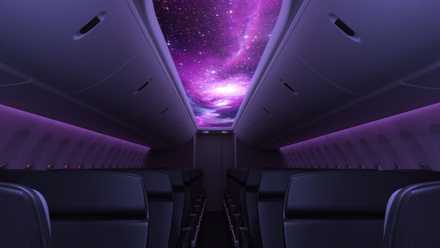
The future of aircraft lighting is shifting from broad “zonal” settings to “hyper-personalization.” Innovations like OLEDs (Organic Light Emitting Diodes) are already appearing in top-tier suites, where the walls and surfaces themselves emit light rather than relying on traditional bulbs. Leading companies like Collins Aerospace and Safran have already showcased the capability of creating concepts such as high-definition “virtual windows” — which are a great solution when used in very specific cases, such as for example, a central row suite on a widebody aircraft like Emirates does on their first class “Game-changer” seat flying on their Boeing 777s— and starry ceilings, all designed to eliminate the claustrophobic feeling of being trapped in a metal tube for a time that will soon reach almost 22 hours of continuous flight, for example, when Qantas starts flying their “Project Sunrise” flight from Sydney to London and New York.
We are also approaching an era of “smart lighting” that integrates with a passenger’s wearable tech. Soon, your seat could analyze your sleep data from a smartwatch to adjust your environment; for example, if you’re struggling to wake up, the seat’s “halo” light could automatically brighten and shift to a blue wavelength to naturally energize you. This represents a major step forward in combining travel convenience with personal health — even though it sounds a bit similar to an episode of Black Mirror…
Lastly, the rise of “spatial” lighting is transforming the aircraft cabin into a dynamic information display. Instead of traditional “Fasten Seatbelt” signs, floors can now glow red and walls can project directional patterns to guide movement. Furthermore, Schott AG is developing a projector system that displays row numbers, seatbelt compliance, and “do not disturb” preferences for meal services. By the 2030s, cabin lighting will evolve from a simple utility into a fully immersive tool for passenger well-being, communicating, restoring, and entertaining. For example, chronobiology-based mood lighting will actively reduce jet lag. While passengers currently view lighting primarily as an aesthetic customization, they will soon recognize these systems as essential features that maximize rest, boost productivity, and improve their overall journey the moment they leave the airport.