dailynewsnblog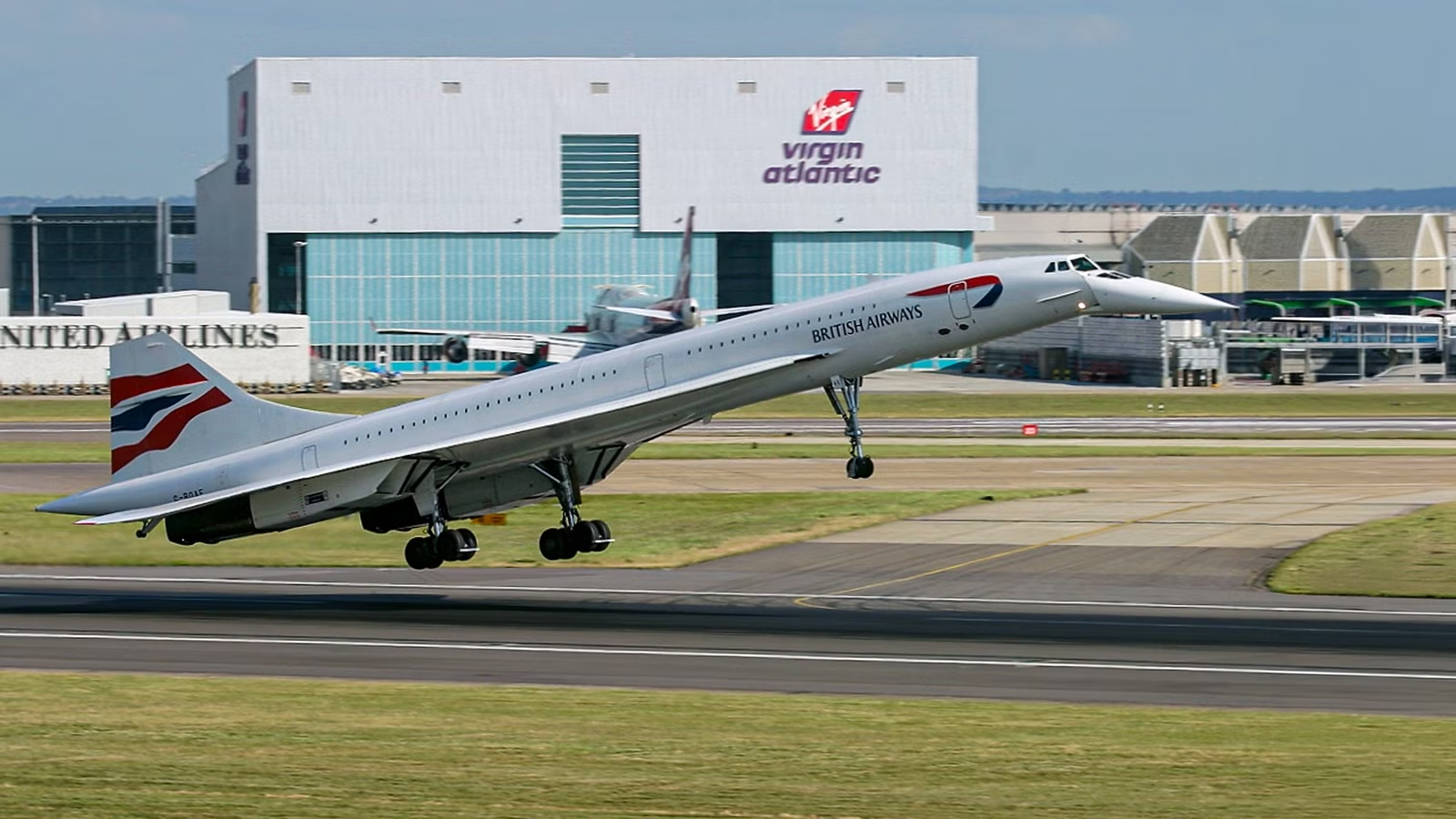
The Boeing 707 cut travel times by nearly half in the 1950s, while being capable and economical enough to entice airlines to commit to the change. Concorde was supposed to do the same thing in the 1970s, but the plane’s economics and lack of practicality resulted in one of the biggest failures in commercial aviation history. In the end, just 14 flew in regular commercial service: seven for British Airways, and seven for Air France, and these planes were bought at remarkably low prices.
However, while the program never made money and Air France also lost money operating Concorde, the plane was profitable for British Airways. Despite most seats going out empty and the eye-watering ticket prices on Concorde flights, British Airways consistently earned a steady profit from its Concorde operations. What’s more, Concorde was an attempt at a new product strategy for the carrier that has become common today, albeit in a less obvious way.
British Airways’ Success With Concorde

Discussions about aircraft economics often center around operating costs, but what often goes overlooked is that revenue is just as important as cost. It’s estimated that Concorde may have cost as much as $29,000 per hour to operate, and despite being nearly as long as a Boeing 787-9, it could only fit about 100 passengers. Still,  British Airways earned a profit because all 100 of those seats were sold as first class tickets, earning the airline a massive amount of revenue per flight.
Because only 14 Concordes were ever used for commercial service, the experience of flying supersonic became a novelty, while its speed made the flights appealing to business travelers who could theoretically fly from London to New York and make it back home in time for dinner. British Airways positioned Concorde as an exclusive experience for the ultra-wealthy, while the plane’s speed and rarity made it a cultural icon. Few could afford it, but for those with the means, Concorde was the ultimate statement in luxury travel.
By the early 2000s, the aging and complex Concordes were becoming increasingly expensive to maintain, while the plane’s public image had been damaged by the tragic crash of Air France flight 4590 in 2000, tarnishing its previously pristine safety record. Air France retired Concorde in May 2003, while British Airways’ last commercial Concorde flight took off in October. In the plane’s final days, British Airways heavily discounted Concorde tickets, closer to business class prices, and the planes went out fully booked while British Airways earned even more revenue than before.
Airline Products And Concorde

At its core, all airlines have fundamentally sold one product: flights. Regardless of whether it’s a BOAC multi-leg journey on a Stratocruiser in the 50s, a Singapore Airlines Raffles Class ticket across the Pacific in the 90s, or a $20 Ryanair ticket on a one-hour segment today, the product is still a flight from point A to point B. While airlines had offered first class long before Concorde entered service, the experience was quite similar to economy, and only existed as a point of differentiation rather than being a truly separate product.
In the early days of commercial air travel, all seats were essentially first class, because the convenience and novelty of air travel was the luxury. As air travel became more accessible, first class developed as a means for competitors to differentiate themselves, but the experience of flying was like traveling on a bus or train, just in the sky. Even until the late 20th century, first class seats were simply larger economy seats with more recline and nicer food, while some airlines began introducing business class cabins that slotted in the middle.
What was unique about Concorde was that it offered a unique product in the form of luxury flights that were twice as fast as everything else. While British Airways offered first and business class on the rest of its fleet, it was basically the same as flying in economy, while Concorde slotted above everything else. This worked mainly because there were so few Concordes in service, which made it a scarce product that could successfully be positioned as a true luxury product. Today, however, airlines are segmenting customers again.
Flyers Are Saying Air Travel Is Becoming Unbearable: Here’s Why
A closer look at what is causing frustration among passengers today, and examining the nuances to see why flying is actually better now than ever.
Airline Product Segmentation Today

During Concorde operations, British Airways sold two different products: subsonic flights with different seating options that were fairly similar to one another, along with supersonic Concorde flights with luxury service. Concorde tickets weren’t sold on the basis of transporting passengers from point A to point B, but rather on their speed and novelty, with the planes themselves being the product, while subsonic jets sold a fundamentally different product. Today, airlines are following a similar approach, but the product isn’t the plane itself.
In 1988, a British Airways 747-200 featured first class recliner seats configured in pairs and located in the nose of the aircraft. There were also Club World seats, consisting of smaller recliners arranged seven-abreast on the main deck and four-abreast on the upper deck, along with economy. Today, a Boeing 777-300ER flown by the airline has economy seats, which are smaller than the old economy seats but with screens and chargers, along with premium economy, which strongly resembles the old Club World seats but is installed eight-abreast.
Club World, however, consists of individual suites with sliding doors, direct aisle access, and a lie-flat bed. First class, meanwhile, is essentially an upsized version of the Club Suites, while the dining and ground experience is significantly upgraded. Club World and first class passengers receive access to their own lounges on the ground. The line is more blurry than during the days of Concorde, but British Airways is essentially selling two products today, even though all of its planes fly at the same speed now.
Catch what other flight trackers miss
Emergency squawks, holds, NOTAMs — live signals, no signup.
Open tracker
Catch what other flight trackers miss
Emergency squawks, holds, NOTAMs — live signals, no signup.
Open tracker
Premium Seats Are A Different Product Today

The experience flying in Club World and first class is much different than flying in economy or premium economy, and British Airways’ first class isn’t known for being the most innovative product in the world. Emirates offers showers to first class passengers on its A380s, while the two-abreast suites on Etihad’s and Singapore Airlines’ A380s rival the size of a large New York City apartment. Etihad also offers a three-room suite on its A380s dubbed ‘The Residence‘, which includes a living room, bathroom with a shower, and a separate bedroom.
Whether it’s British Airways with its 777-300ERs or  Etihad Airways with its A380s, airlines around the world are now selling flights and luxury flights, even though the seats are all on the same aircraft. While carriers sell as many as four cabin classes, premium economy is essentially a more comfortable version of economy, while business and first class offer a differentiated experience at a higher price point. Economy and premium economy can be considered one product for standard transportation, while business and first class together are a separate, luxury product.
Cabin | Typical Configuration (Widebody) |
|---|---|
Economy | 2-3-2, 2-4-2, 3-3-3, 3-4-3 |
Premium Economy | 2-2-2, 2-3-2, 2-4-2 |
Business Class | 2-2-2, 1-2-1 |
First Class | 1-2-1, 1-1-1 |
An economy ticket gives you the basics, including a seat and some food, while the premium economy experience gives you an upgraded version of the same experience. A business class ticket, however, is bought for its comfort and privacy, while first class is an upgraded version of that experience. Because of how seats have evolved and the service that airlines now provide, the latter two cabins are much more distinguished from the standard product compared to before, creating a two-product hierarchy that every full-service carrier offers today.
The Key Differences Between Economy, Premium Economy, Business & First Class
Walk the aisle with a seat designer to decode the real differences between economy, premium, business, and first class. Is the upgrade worth it?
The Move Away From A Commodity Market

Traditionally, airline tickets have been treated as commodities, with most passengers prioritizing prices and then schedule, while business travelers would prioritize schedule, then price. There ultimately wasn’t much difference between airlines other than these factors, as well as where they flew to. By innovating more in premium cabins, however, airlines could differentiate themselves to a much larger degree, with different seat designs, amenities, and elaborate meal courses. Economy tickets are still largely commodities, but premium tickets are not.
 Delta Air Lines, however, attempted to differentiate itself across all cabins and has invested thoroughly in revitalizing its onboard products to create an airline that passengers are loyal to regardless of what cabin they travel in. Today, its customers are loyal to its premium brand, and the carrier often reports that it earns a revenue premium over rivals, meaning that passengers pay more to fly Delta even in economy. The actual differences between Delta’s onboard experience and that of other carriers are debatable, but customers perceive it as being better.
Airline | 2025 Earnings |
|---|---|
Delta Air Lines | $5 billion |
United Airlines | $3.35 billion |
American Airlines | $111 million |
The result is that Delta sells its own premium and standard products, but its products are viewed as being elevated compared to rivals like American Airlines. Through this differentiation, the airline has a premium brand image and is now the US’ most profitable carrier.  United Airlines has been successfully replicating this strategy, and through points of differentiation like onboard screens on domestic flights, the airline is positioning its products as fundamentally elevated compared to other airlines.