dailynewsnblog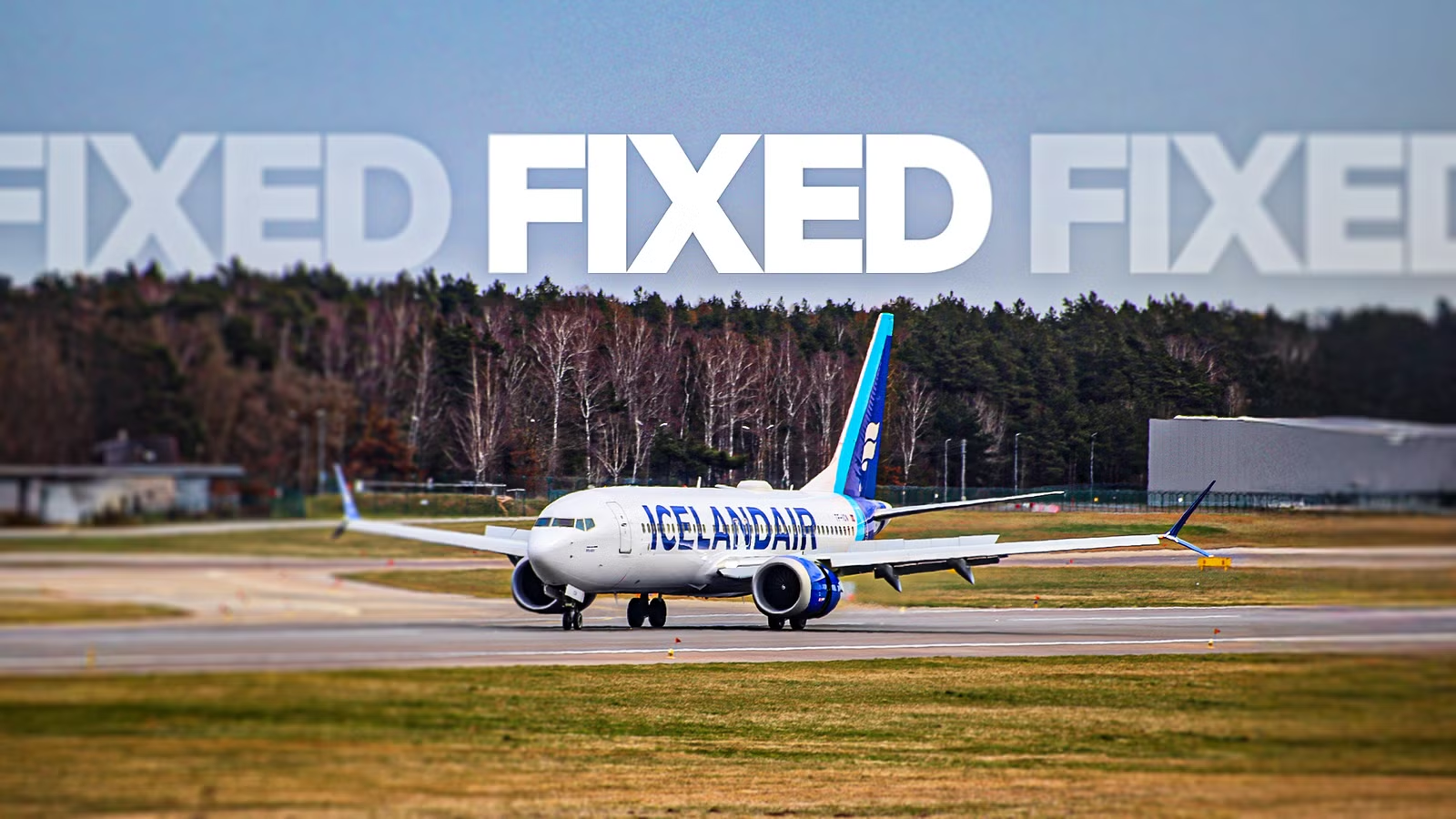
The Boeing 737 was launched in 1965, after Lufthansa became the launch customer of the 737 on February 19 of that year. Since then, the product line has evolved through 22 different variants, from the military-configured 737-T43A to the best-selling 737-800. Each of these variants offers a slightly different capacity and performance profile; some 737 aircraft, such as the 737-200, have had optional equipment permitting landings on soft-field runways.
The Boeing 737 MAX family is the latest and greatest edition of the Boeing 737 product line, consisting of the 737 MAX 7, MAX 8, MAX 9, and MAX 10. With the MAX 8 and MAX 9 already certified and flying, Boeing hopes to certify the MAX 7 this month, followed by the MAX 10 before year-end.
This aircraft family has had its fair share of challenges since its launch in 2017, including two notable fatal air disasters: Ethiopian Airlines Flight ET302 and Lion Air Flight 610. These disasters claimed the lives of all on board and occurred within a short period of just six months of one another, which prompted the worldwide grounding of the entire Boeing 737 MAX fleet from March 2019 to November 2020.
The Main Problem

The main issue for the 737 MAX aircraft was the software, specifically in a flight-control law called MCAS. According to Boeing, the Maneuvering Characteristics Augmentation System ( MCAS) provides consistent airplane handling characteristics in a very specific set of unusual flight conditions. MCAS now contains multiple enhanced protections:
- Measurements from two Angle of Attack (AOA) sensors will be compared.
- Each sensor will submit its own data to the airplane’s flight control computer.
- MCAS will only be activated if both sensors agree.
- MCAS will only be activated once.
- MCAS will never override the pilot’s ability to control the airplane using the control column alone.
The MCAS was the core of the Boeing 737 MAX struggles in the late 2010s. The MAX 9 would suffer from a structural concern related to its door plug assembly, a function of one of the passenger emergency exits. This led to a temporary fleet-wide grounding of the global MAX 9 fleet. However, the MAX 8 was unaffected. Alaska Airlines, the origin of the door plug fault, and United Airlines were two notable companies impacted by this particular grounding.
As far as MCAS is concerned, this was the main cause of both the Ethiopian and Lion Air crashes. As with any air disaster, much speculation pointed to a diverse array of variables involved in the two downed airliners, but as the investigations concluded, MCAS was the main variable involved in both.
What Does MCAS Do?

MCAS was installed on 737 MAX aircraft to align its operating characteristics and handling with traditional Boeing 737 NextGen (NG) aircraft, such as the Boeing 737-900. The MAX is equipped with CFM International LEAP engines, which are heavier and mounted further forward than engines equipped on previous NG aircraft. This caused a change in the aircraft’s aerodynamics. At high angles of attack, the engine nacelles generated extra lift ahead of the center of gravity, creating a pitch‑up tendency. MCAS was added specifically to counter this behavior.
One common misconception is that with heavier engines mounted forward, the center of gravity is simply moved forward, causing a nose-down tendency. But the large surface area of the engines (nacelles) act as an unusually large airfoil on each side, generating a large amount of lift on each side of the aircraft, thus increasing the angle of attack.
MCAS was added to automatically counter the tendency of the 737 MAX to increase its angle of attack aerodynamically thanks to its LEAP engines. It activated only at a high angle of attack, and applied nose-down stabilizer trim to counteract. MCAS was not a general stability system. It existed only because of the aerodynamic change introduced by the engines. Unfortunately, Boeing chose to feed MCAS from a single angle of attack sensor, not from both equipped on the 737 MAX, as there were two. When that designated sensor failed in both crashes, MCAS repeatedly applied nose‑down trim based on false high angle of attack readings, ultimately driving each aircraft into a dive.
The 20-Month Overhaul Of MCAS

Two fatal disasters with the same root cause prompted the global grounding of all Boeing 737 MAX aircraft in service and a halt to pending deliveries. The fix was directly aimed at MCAS and how the software behaves; the engineering of the software was changed, not the engineering of the airframe.
The summary of the changes, per the Federal Aviation Administration (FAA), describes all of the changes in depth. There are three main takeaways that addressed the fatal behavior of the MCAS:
- The software now allows only one nose‑down activation during any high‑angle‑of‑attack event, preventing the repeated trim cycles that previously could overpower the pilot’s control inputs
- It no longer resets when pilots use the electric trim switches; in turn, pilot counter‑trim cannot inadvertently re‑enable MCAS
- It now uses a dual‑sensor cross‑check, utilizing data inputs from both angle of attack sensors; it will disable itself entirely if the two angle‑of‑attack sensors are out of tolerance by more than 5.5 degrees
The United States Department of Transportation (DOT) has validated the same design architecture. The redesign compares both angle of attack sensors and only allows MCAS and the speed-trim system to activate if the two readings agree within 5.5 degrees, added cross-checking between the two flight-control computers, and capped how far MCAS can move the stabilizer. In a very general description, the added redundancy of participation from both angle of attack sensors is similar to that of flying with two working engines; this redesign was a safety engineering success.
Boeing’s Statements

According to Boeing, all of the aforementioned conclusions from the FAA and the DOT are valid and aligned with the manufacturer’s publications and press releases. Boeing was at the center of an unusually large amount of attention surrounding the crashes of the 737 MAX aircraft. As a result, Boeing underwent many changes in pursuit of changing and elevating the company’s safety culture.
“We have taken a number of actions to further enhance the safety culture of our company.”
Boeing has highlighted four main improvements taken in this pursuit. First, they have established an aerospace safety committee, which is described as “permanent” and comprised of the company’s board of directors. Second, they have created a Product & Services Safety organization, which will serve as a de facto safety engineering department. Third, Boeing has enacted a Design Requirements Program and enhanced their Continued Operational Safety Program, essentially acting as internal process reform. Lastly, Boeing has claimed to have “strengthened partnerships” with airline customers and 737 MAX flight training constituents. These two groups served as important voices throughout the investigation and review process of MCAS.
It’s worth noting that Boeing also underwent several personnel changes throughout the company. The company not only saw a new Chief Executive Officer, but also had an overhaul of its engineering team involved with aircraft development programs. Unfortunately for the Arlington, VA-based company, the 737 MAX crashes resulted in historical financial losses to the company’s balance sheet, resulting in a reduction in the workforce in several areas. According to Reuters, Boeing enacted a plan in 2024 to eliminate 17,000 positions company-wide.
FAA, Transport Canada, And EASA Results

Regulators ultimately reached a conclusion that reshaped the entire future of the 737 MAX: based on flight‑test data with MCAS switched off, the FAA, Transport Canada, and EASA determined that the aircraft could likely have met certification standards without MCAS at all. That finding reframed MCAS not as a structural necessity but as a handling‑quality aid. This is a system meant to make the MAX feel like earlier 737s, not to keep it physically stable or stall‑resistant.
While the MCAS system is not a primary nor a secondary flight control, one can potentially describe it as a “tertiary” augmentation system. While it is not as significant as ailerons, flaps, or even trim, MCAS sits in a category of convenience rather than necessity. One can argue that a yaw damper or speed trim are of similar importance to flight in general.
Luckily for Boeing, the MCAS reform did not involve any structural re-engineering to the 737 MAX. The fix was entirely related to software and how the aircraft’s fly-by-wire system interacts with the angle of attack sensors and its flight controls. A more expensive and time-consuming solution may have involved a new placement for the LEAP engines, or even engaging with an entirely new engine program. This may have risked being a detriment to the stellar operating efficiencies that are included in the marketing of the MAX family.
The Future Of The MAX Product Line

The future of the 737 MAX will always carry the weight of what happened. No amount of engineering refinement or regulatory reform can erase the loss of 346 lives, nor should it. Yet the MAX remains a central part of global fleets, including those of Ethiopian Airlines and lion air group the carriers most directly scarred by its failures. Its continued operation is not a dismissal of the past but a sign of how deeply aviation depends on this top-selling product line.
Looking ahead, the MAX is positioned to remain a workhorse of short and medium‑haul travel. Boeing’s redesign of MCAS, strengthened engineering governance, and expanded safety‑monitoring programs have created a fundamentally different environment than the one in which the aircraft was originally certified. Regulators now scrutinize software, sensor logic, and human‑factors integration with unprecedented intensity.
There is cautious optimism about seeing the MAX fly for the very airlines that suffered the worst losses. Ethiopian and Lion have kept the aircraft in their fleets. The MAX product, at its core, was designed with the utmost efficiency, range, and low operating costs. Given that the aircraft family has been flying in a post-MCAS reformed landscape relatively smoothly, the program is young and offers a solid product to airline customers worldwide.

![15-Hour Flights: Singapore Airlines’ 9 New Longest Nonstop Airbus A380 Routes [Map]](https://dailynewsnblog.com/wp-content/uploads/2026/07/shutterstock_2764064389_cropped.jpg)