dailynewsnblog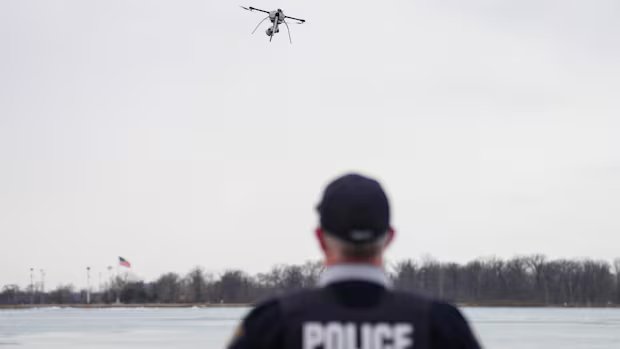

Listen to this article
Estimated 5 minutes
The audio version of this article is generated by AI-based technology. Mispronunciations can occur. We are working with our partners to continually review and improve the results.
High-tech surveillance cameras, police drones and AI analytics are changing how law enforcement responds to property crime at remote, hard-to-access industrial sites across Alberta.
This new approach was on display in Red Deer County on June 6, when a local gas plant was targeted for fuel theft twice in less than half a day.
The first break-in at the plant occurred just after 3 a.m.
However, the incident was resolved quickly after the suspects’ escape vehicle broke down, leading to immediate arrests, said Cpl. Mathew Howell, a public information officer with Alberta RCMP.
About 10 hours later, when a second crew targeted the same plant at 1:21 p.m., police relied on live surveillance footage from Zedcor — a private security company operating at the site — to track the suspects.
“We were able to identify the vehicle and locate it later that day, and essentially the vehicle was tracked all the way to Red Deer,” Howell said.
The live feed triggered a co-ordinated response involving a police drone and multiple RCMP detachments to intercept the vehicle and arrest the suspects.

A growing challenge
These two incidents also highlight a wider geographic challenge related to rural crime in Alberta.
According to a Statistics Canada report released last year, the rural crime rate in Alberta for 2023 was 54 per cent higher than in the province’s urban centres. A 2026 federal Senate report also highlighted a “troubling” surge in copper theft at critical infrastructure sites across the country.
Howell said isolated, rural industrial sites containing high-value equipment are frequent targets, but new technologies are helping police gather intelligence on these crimes more quickly.
“It’s one of the first things we look for whenever we don’t have a suspect in front of us right away,” Howell said, pointing to cameras with high-definition zoom lenses and licence plate readers.
“That has been something that’s very useful when it comes to investigations.”
Howell said Alberta RCMP have expanded their remotely piloted aircraft systems (RPAS) drone program to better assist with these rural calls. He said the drones can rapidly narrow down search areas with their infrared thermal sensors.
Howell noted that using drones often limits the need for high-speed ground pursuits of suspects, which carry inherent safety risks to the public on rural roads.
“We will keep seeing an uptick in these kinds of technologies, as long as we are always balancing public safety and the privacy of public information,” he said.

Proactive vs reactive security
James Leganchuk, president of North American operations for Zedcor Security Solutions, said his company was monitoring the Red Deer County gas plant during the June 6 thefts.
“We’re able to provide the video of an actual crime in progress and get an immediate RCMP response,” Leganchuk said.
He noted that the isolated locations of such sites make it difficult for officers to respond to traditional, unverified alarms.
Not too long ago, he said, industrial sites relied on physical guards or basic motion-sensor cameras, which frequently triggered false alarms from wildlife or weather.
“If they have a dedicated person, his phone’s going to go off all night,” Leganchuk said.
“They don’t even investigate until after the fact when you do find out that you were either vandalized or a theft happened. It’s very reactive.”

Now, he said his company uses “mobile surveillance towers” with advanced AI technology that can better identify humans and vehicles right away.
Leganchuk said demand for the technology at these industrial sites is growing, as he noted Zedcor’s fleet of mobile surveillance towers on sites across North America has expanded from 180 units in 2018 to roughly 5,000 this year.
Need for guardrails
Kelly Sundberg, a criminology professor at Mount Royal University, said the two Red Deer County incidents are prime examples of how such technologies can help police manage vast rural jurisdictions.
“The ability to monitor large open rural areas has increased significantly over the last years,” said Sundberg, who is also a former Canada Border Services Agency officer.
“In essence, what we’re doing is we’re maximizing the effectiveness of the police officers that we have.”
However, Sundberg is calling for more vigilance as surveillance technology continues to rapidly evolve and become more prominent.
“It’s important to ensure that we have very strict guardrails and safeguards in place to ensure that the use of this technology and artificial intelligence is used ethically and in the interests of Canadians,” he said.
Sundberg added that academic research institutions should be better utilized in a leadership role to act as quality control and an ethical safeguard.