dailynewsnblog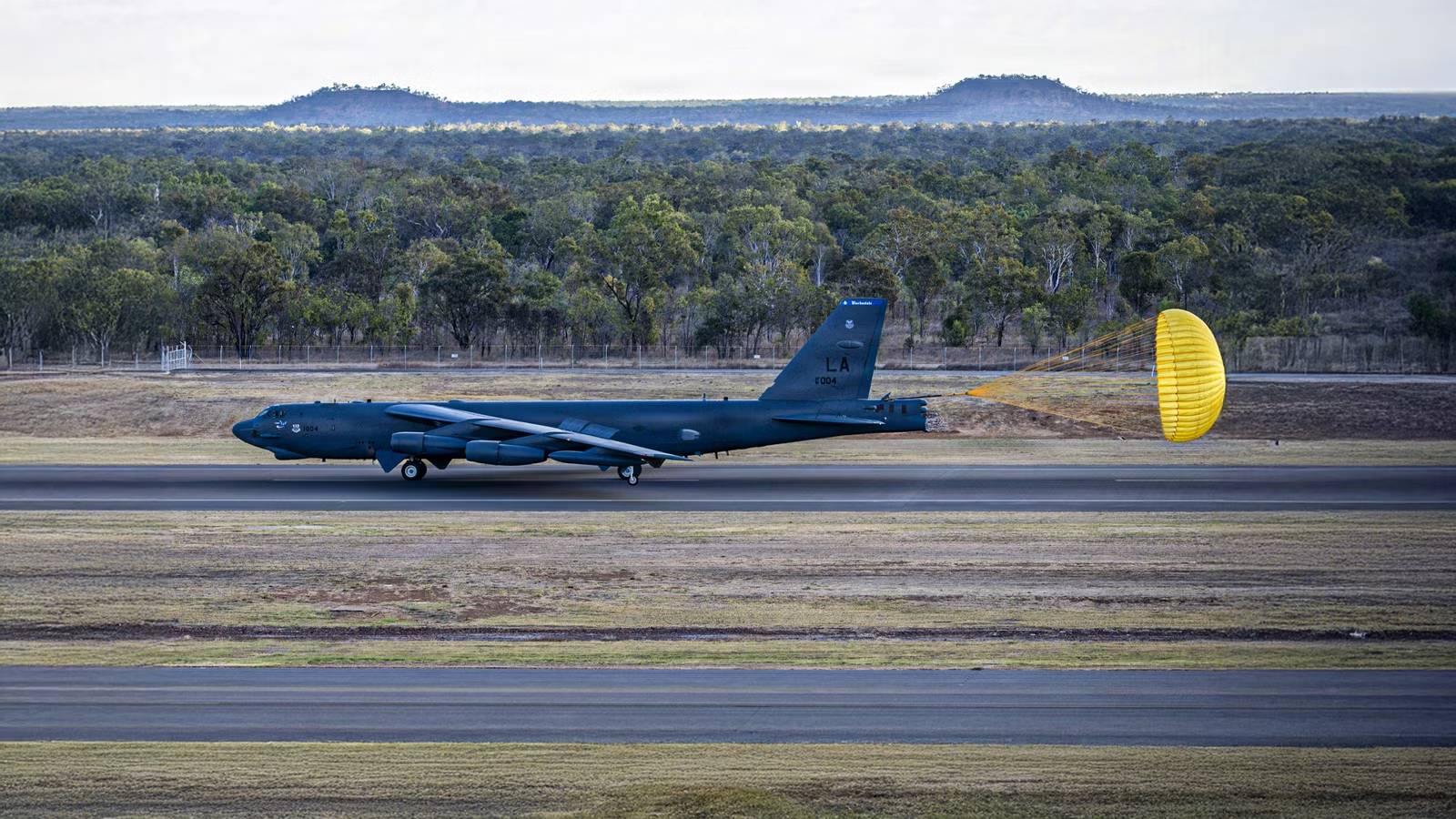
On September 1, US Air Force B-52H Stratofortress bombers landed at Royal Australian Air Force Base Tindal. The arrival looked like routine training at first glance. What it truly represents is that the newly expanded airfield is becoming the primary alternative to a long-standing bomber. The USAF can no longer solely rely on 21st century air warfare.
That island outpost is the sprawling complex of Andersen Air Force Base on Guam. The bomber task force from the 2nd Bomb Wing of Barksdale AFB is testing out the $1.1 billion-worth of construction that has been years in the making. Recent improvements have successfully turned the seasonal training strip into a fully-equipped site. According to Air & Space Forces Magazine, the base can now maintain, fuel, and relaunch the USAF’s colossal eight-engined warbird on a full-time basis.
The entire deployment is built to answer one big strategic dilemma: how to disperse US and allied air forces across the first and second island chains of the Western Pacific. Under the doctrine of Agile Combat Employment, the USAF’s ‘pivot to the Pacific’ is optimizing airfields across the vast expanse of the Pacific theater, as well as the fleet they host. The threat this new strategy is directed to deter? The People’s Republic of China.
A Base Rebuilt For Six Bombers

The massive scale of the construction at Tindal is what makes the latest deployment very different. The first phase of work was a $737 million runway and aviation fuel storage upgrade, according to Defence Connect. The second was a $437 million project to modernize the base’s aging power, water, and utility systems so they can handle much heavier troop concentrations. The centerpiece of the American-funded works is a dedicated parking ramp large enough to hold six B-52s.
The Department of Defense also separately budgeted more than $14 million for a squadron headquarters and maintenance building to support repeated employment rotations. Tindal was chosen as much for its location as it was for its existing infrastructure. The base was already home to Australia’s own Lockheed Martin F-35 Lightning II Stealth Fighters and Northrop Grumman Triton drones before American construction began.
That existing apparatus gave Tindal a strong foundation rather than starting from scratch. This upgrade package sits inside a much larger spending plan, with the Australian government committing roughly $8 billion to defense facilities across the Northern Territory.
The heavy investment transformed what had been a dual-use airfield into a full-fledged hub for joint air forces from across the region. The base’s expanded capabilities would also allow it to host Japanese self-defense forces, Singapore Air Force F-35s, Royal Navy Joint Strike Fighters, or aircraft from the US Navy and Marines in times of conflict. Just like Andersen AFB’s historic role.
The Missile That Made Guam A Liability

Andersen AFB has spent decades serving as the main forward hub for American air power in the Pacific precisely because it sat far enough from mainland China to be a secure staging position. However, in 2026, that assumption no longer holds true. China’s mobile, fast-launching DF-26 ballistic missile has a range of nearly 2,485 miles (4,000 km), which gives it the reach to strike Guam with a single salvo launched from the Chinese mainland.
Analysts nicknamed the weapon the “Guam Killer” because of the express intent that appears to have evidently motivated the People’s Liberation Army to construct them. The missile does not even need to destroy an actual aircraft to achieve its goal. Simply cratering a runway can stop planes from taking off during a critical operation to render it ineffective as a military airfield.
The missile can even steer itself to dodge defense systems late in its flight, shrinking the time a defender has to shoot it down. This reality changes how Pentagon planners view Guam, shifting it from a safe rear area into a heavily contested battle zone. In this environment, crowding bombers, fuel, and repair crews onto one single island becomes a massive vulnerability.
This danger is exactly why the military has poured extra funding into building multiple layers of missile defenses on Guam rather than giving up on the island entirely. However, strategy dictates that the USAF also disperse its forces across the theater to maximize resilience against any attack. That requires airfields to exist where essentially any airplane in the inventory can go without complication and then take off again just as easily.
From Continuous Presence To Unpredictable Rotations

The USAF had maintained a 16-year streak of permanent rotation from the Air Force Global Strike Command Fleet in Guam until 2020. That not only included the big ugly fat fellow, or BUFF, as the B-52 is known, but also the Northrop Grumman B-2 stealth flying wing and the Rockwell B-1 Lancer supersonic bomber. The USAF ended this strategy of continuous deterrence in order to begin reorganizing its bomber fleet as well as the network that supports it to adapt to evolving threats, especially in the Pacific.
In its place came a new strategy where bombers deploy overseas only in shorter, less predictable stints. Military leaders hold that the goal is to maintain a persistent presence while keeping adversaries guessing about day-to-day operations by using unpredictable operational plans. This has since become the foundation for what the Air Force now calls Bomber Task Force missions.
Guam did not disappear from the schedule. Bombers still land there regularly, and the Air Force has run a nearly identical rotation of task forces through Europe for years. This allowed the military to treat the Pacific version as an extension of a proven model rather than a brand-new invention. However, Guam is no longer the only forward option given the increasing threat from the PLA.
Six Bombers, Thousands Of Kilometers Of Buffer

Bomber Task Force 26-3 serves as the first real-world test of this new strategy. The Pentagon described the mission’s purpose in broad and sweeping terms. Official descriptions state that operating from Tindal proves the Air Force can launch, support, and rebuild decisive airpower across a growing network of allied bases. It is undeniable that the geography behind this setup is significant.
A B-52 bomber flying at normal cruise speeds would need about five hours to transit the 3,107 miles (5,000 km) distance to Chinese shores. Meanwhile, a flight toward Beijing would take closer to eight hours. Yet, the BUFF is unlikely to ever be dispatched on a combat sortie that requires penetrating the airspace of a near-peer adversary. The current iteration of the B-52 is already a powerful battlefield commander. With the upgrades coming in the B-52J series, it will not only be a flying supercomputer but also a kind of drone mothership.
Despite being nearly seven decades old, Why America’s Oldest Strategic Bombers Are More Valuable Than Ever thanks to its overengineered design that continues to prove a reliable and powerful platform even in the 21st century. It features a flying range of more than 8,699 miles (14,000 km) without refueling and can carry a massive payload of over 66,139 lb (30,000 kg). Once the full fleet of 76 airframes is upgraded, it will have longer range and higher payload as well as much more advanced sensors and data link capability.
Its arsenal already includes countless precision-guided bombs, long-range standoff missiles, anti-ship weapons, and naval mines. Upgrades will also give it the ability to carry Hypersonic missiles in the future. Each aircraft has the ability to strike targets on both land and sea using its organic weapons. Once it integrates with collaborative combat aircraft, magazine depth will exponentially increase. The loyal wingman drones act as a kind of ‘off board arsenal.’
All of those capabilities combine to allow the B-52 to strike dozens of targets simultaneously while flying hundreds of miles outside the threat range. Tindal acts not only as a redundant base to provide backup in the case of a massive strike against US and Allied facilities across the region, but also as a southern launch pad to complement Andersen’s strategic location in the northern end of the second island chain. This not only protects US forces, but also makes them more unpredictable.
Complaints Underscoring Tindal’s Strategic Importance

Perhaps providing the strongest endorsement of the validity of the strategy, the Chinese government has decried the construction at Tindal as a provocation from the moment the plans became public. The PRC has denounced the US strategy as drawing in third parties to a conflict that it has incited without justification. The Chinese Communist Party claims the American plans increase regional tensions and threaten to spark an arms race.
Yet, the base does not actually add any new bombers to the region. It simply gives the existing fleet on Guam a second backup to its primary safe harbor. Critics in the Australian parliament argue that this arrangement allows the government to claim it has full oversight while actually surrendering any real power to veto what weapons fly through Tindal.
The military infrastructure at Tindal was built so quickly that the political debate surrounding it is still struggling to catch up. That fact alone has blindsided some of the Australian public. Only time will tell if diplomacy and defense strategy will align with the USAF’s ideal defense posture. In the meantime, the base has already been built, and the negative reaction of the PRC has essentially given a powerful confirmation of effectiveness almost immediately.