Hiroshi Okuda, former Toyota chief credited for leading the Japanese automaker’s global climb, dies


TOKYO (AP) — Hiroshi Okuda, the former chief executive of Toyota, who led the Japanese automaker’s stellar rise in global markets, has died, the company said Wednesday. He was 93.

The date and cause of his death were not immediately available.

Okuda served as president then chairman of Toyota Motor Corp. from 1995 through 2006. In his 45-year career at Toyota, Okuda is especially remembered for having led the development of the gas-electric hybrid Prius in 1997, a model with the fuel-efficient technology that was ground-breaking at that time.

The Prius became a symbol of the auto industry ‘s push for green driving. Okuda was instrumental in helping drive Toyota’s reputation for fuel-efficiency at a time when gas prices were already surging, such as its bestseller Camry, as well as the hybrids.

Born in central Japan, the area where Toyota has its headquarters, Okuda graduated in 1955 from the prestigious Hitotsubashi University in Tokyo, with a degree in business.

Okuda, reputedly outspoken and always ready with a quick laugh, was unusual in not being from Toyota’s founding Toyoda family, as the leadership at the world’s top automaker tended to be.

The former chief executive was key in leading Toyota’s global expansion over his years at the helm, not only in sales, but also production, setting up manufacturing plants in the U.S. and Europe.

Okuda, a black belt in judo, was vocal about his concerns over the possible backlash that Toyota might face, as its growth meant the inevitable dethroning of the American so-called “Big Three,” General Motors, Ford and Chrysler, synonymous for U.S. manufacturing grandeur.

He liked to emphasize how the auto industry was global and connected, using the term “harmony” to drive home that message.

Toyota, as well as other Japanese automakers like Honda Motor Co. and Nissan Motor Co., were raking in huge profits, while the Americans were sinking into losses. That helped ring in the “Japan-bashing” sentiments starting in the 1980s.

As is still the case today, the cheap yen was also pointed to as giving Toyota and the other Japanese makers an unfair advantage. A cheap yen raises the value of overseas earnings for the Japanese, when translated into yen.

Okuda was adviser on Toyota’s board when Toyota added an American for the first time on its board, Jim Press, in 2007.

He was also a proponent of promoting younger management, when that was still relatively rare in Japanese corporate circles, although that usually meant empowering men in their 50s instead of their 60s.

“A company must change when things are going well. There’s no point in trying to change after things start going bad,” he told reporters in 2005.

That emphasis on staying nimble encapsulates Toyota’s basic principle of constantly improving, known as “kaizen,” which, along with just-in-time production, centering on the idea of avoiding huge inventory, is at the core of Toyota’s founding philosophies.

Respected in the business community here, Okuda served as head of major business lobbies, such as the Japan Business Federation known as Keidanren, the Japan Automobile Manufacturers Association, the Prime Minister’s Economic Strategy Council of Japan and the Japan Federation of Employers’ Associations.

Toyota did not immediately have details on surviving family. Funeral arrangements were being made by the family, and plans may be coming later on a more public formal ceremony, according to the company.

___

https://www.threads.com/@yurikageyama

Yuri Kageyama, The Associated Press

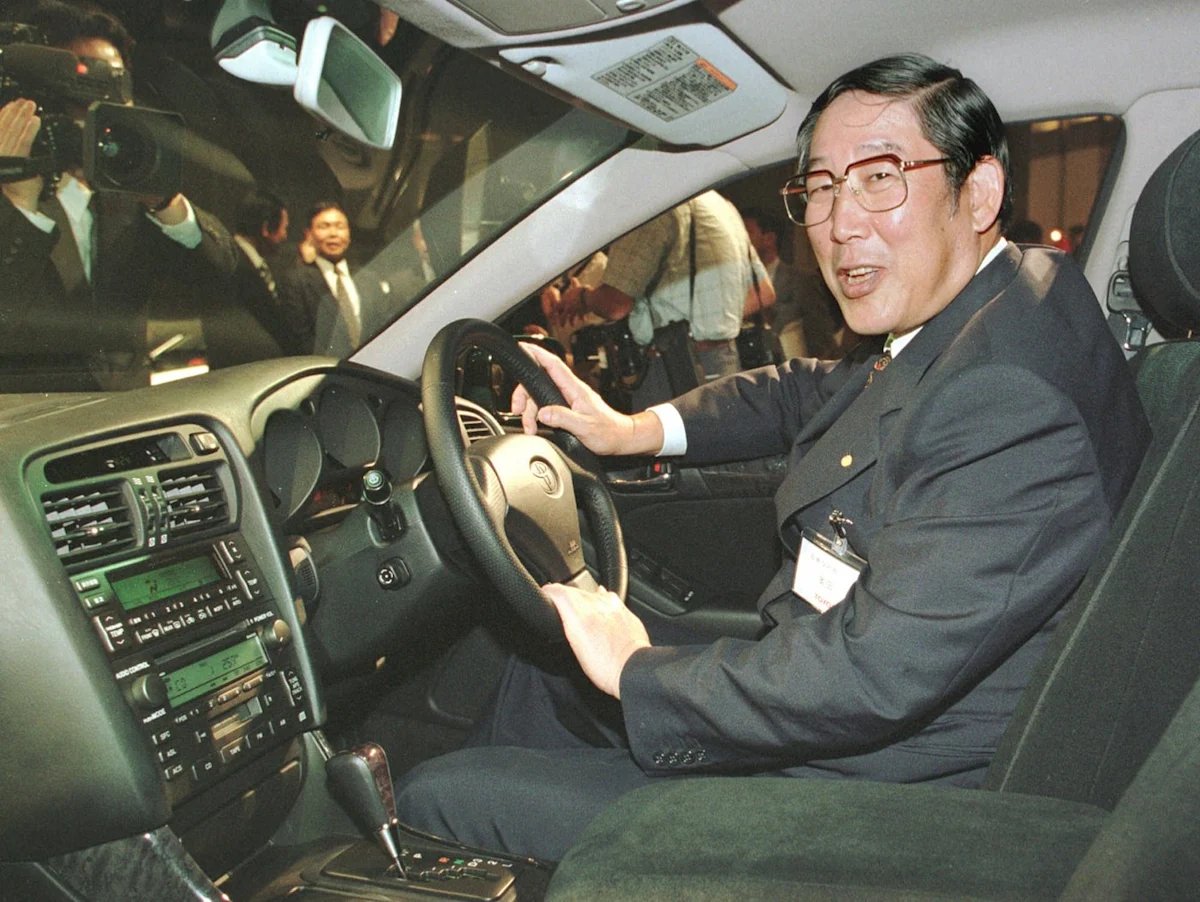
FILE – Hiroshi Okuda, then, president of Toyota Motor Corp., smiles as he sits at the steering wheel of the “Aristo,” Toyota’s remodeled sports sedan during a press conference at a Tokyo hotel, Aug. 27, 1997. (AP Photo/Shizuo Kambayashi, File) – The Associated Press
FILE – Hiroshi Okuda, then Toyota Motor Corp. chairman, speaks during a press conference at a Tokyo hotel on Nov. 1, 2004. (AP Photo/Shizuo Kambayashi, File) – The Associated Press
FILE – Outgoing chairman of the Japan’s foremost business lobby, the Nippon Keidanren, Hiroshi Okuda, left, leaves the podium following his one and the last speech as a chairman as newly named chairman Fujio Mitarai, Canon Corps Chief Executive Officer looks on during the annual meeting in Tokyo, May 24, 2006. (AP Photo/Junji Kurokawa, File) – The Associated Press


Source link

  • Related Posts

    Democratic Rep. John Larson loses his primary to opponent calling for generational change

    Democratic Rep. John Larson of Connecticut has lost his primary race to former Hartford Mayor Luke Bronin, NBC News projects, becoming the latest example of Democratic voters’ push to sweep…

    China Revives Free-Trade Zone Bond Market After 2023 Crackdown

    Shanghai Electric Group Co., an energy equipment maker backed by the municipality, began marketing so-called pearl bonds on Wednesday with initial price guidance set around 2.4%, according to a person…

    Leave a Reply

    Your email address will not be published. Required fields are marked *

    You Missed

    Arkansas high school football player finds venomous snake inside helmet during practice

    Arkansas high school football player finds venomous snake inside helmet during practice

    A Rescue Effort After Colombia’s Earthquake

    A Rescue Effort After Colombia’s Earthquake

    Downtown Regina scaffolding falls, sending 2 to hospital – Regina

    Downtown Regina scaffolding falls, sending 2 to hospital – Regina

    Saber denies replacing Rideshare Stimulator’s writers with ChatGPT

    Saber denies replacing Rideshare Stimulator’s writers with ChatGPT

    Democratic Rep. John Larson loses his primary to opponent calling for generational change

    Democratic Rep. John Larson loses his primary to opponent calling for generational change

    Paul Sullivan: White Sox Pope Hat Night makes believers out of everyone