dailynewsnblog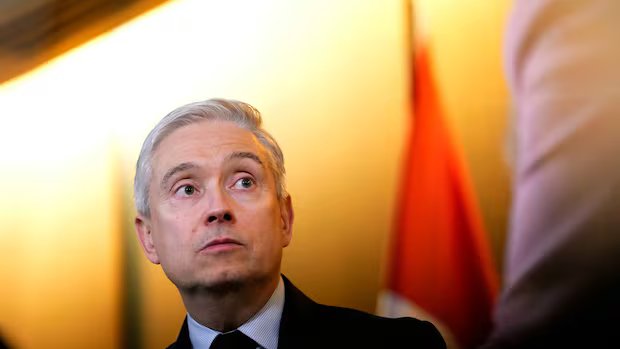

Listen to this article
Estimated 5 minutes
The audio version of this article is generated by AI-based technology. Mispronunciations can occur. We are working with our partners to continually review and improve the results.
Global energy markets continue to reel from the ongoing disruption in the Strait of Hormuz. The price of oil is sitting around $100 US a barrel, but Tuesday’s spring economic update used much lower prices to build the budget.
For this year, the economic update assumes the price of the main North American benchmark West Texas Intermediate (WTI) will be just $73 a barrel this year.
That underestimation means Ottawa has built in a multi-billion-dollar cushion for the next budget.
“I think there’s a lot of slack in the figures presented today, which means come the fall budget we are going to see much more room for this government to spend,” said Sahir Khan, executive vice-president of Institute of Fiscal Studies and Democracy in Ottawa.
The economic update is built on a series of economic assumptions that use private-sector forecasts for everything from economic growth to unemployment, inflation and oil prices.
Those private-sector forecasts were put together this March. Back then, the U.S. and Israel-Iran war was only getting started. The impact on global energy markets was still being measured.
Now, as much as 600 million barrels of oil have been taken off-line. For every day the Strait of Hormuz remains closed, an additional 15 million barrels of oil are stuck inside the Persian Gulf.
Even though the budget uses those lower oil prices as a building block, its authors say quite clearly that they expect the actual price per barrel will be higher.
“Current oil futures curves point to prices easing over the second half of 2026 and reaching about US$75 by year-end as crude oil exports through the Strait of Hormuz gradually resume. As a result, oil prices are still expected to average about US$80 for the year as a whole,” wrote the federal government in the budget.
By the time the budget was published, even that forecast was out of date.

The spring economic update tabled in the House of Commons on Tuesday proposed billions of dollars to address the country’s skilled trades worker gap, among other measures. Finance Minister François-Philippe Champagne sits down with Power & Politics to discuss the highlights of his party’s plan.
Right now, futures markets are projecting oil prices will remain between about $90 and $99 per barrel until the end of September. By the time the government starts working on its next budget, the futures contracts show WTI will still be trading above $80 a barrel.
Khan says the budget uses what he calls “conservative” assumptions in a handful of key measures.
Oil is the biggest. But he also points out that tax revenue tax is coming in at a faster pace than was expected in the fall.
“Those two things combined should provide a significant windfall for the federal government,” said Khan.
Randall Bartlett, deputy chief economist at Desjardins Group, says his office submitted their oil price forecast as part of that private-sector survey.
At the time, the bank was looking at WTI to average around $75 US this year and $65 US next year.
“But a lot has changed since. We’re now forecasting something closer to $87.50 US this year and $75 US next year,” he told CBC News.
Calculating what that increase will mean for federal revenues is always a tricky proposition. Bartlett says for every $1 US per barrel increase, Ottawa gets about $175 million.
But he warns that’s a rough estimate, and tracking how oil revenue works its way through the economy and into government coffers isn’t exactly straightforward.
There’s also a quirk of timing in which higher oil prices drive up economic growth in the short term, but in the long term the pain starts to hurt more than the gain.

CBC’s senior business correspondent Peter Armstrong explains why oil prices are so significant to federal revenues after Prime Minister Mark Carney’s government delivered its spring economic statement.
Even in oil-producing regions like Newfoundland and Labrador, Alberta and Saskatchewan, higher oil prices are good for corporate profit but hard on drivers, and tough on companies that use diesel to power their deliveries or heating oil to run their operations.
“For subsequent years, it’s not as precise as higher energy prices start to weigh more on consumption, offsetting the tailwind to investment,” said Bartlett.
Adam Chambers, Conservative critic for international trade, says governments underestimating how much revenue they will have to work with is common practice in Ottawa. He says the governments of Jean Chretien and Paul Martin were “famous” for it.
“They’re trying to set the bar very low for themselves so that they can jump over it very easily in the upcoming budget,” said Chambers.
He says his concern is that governments usually end up just spending that “new-found” revenue instead of using it to bring down the deficit.
Whatever they decide to do with it, the government is all but assured to have a multi-billion-dollar cushion to do something with when it sits down to work on the next federal budget in the fall.