dailynewsnblog
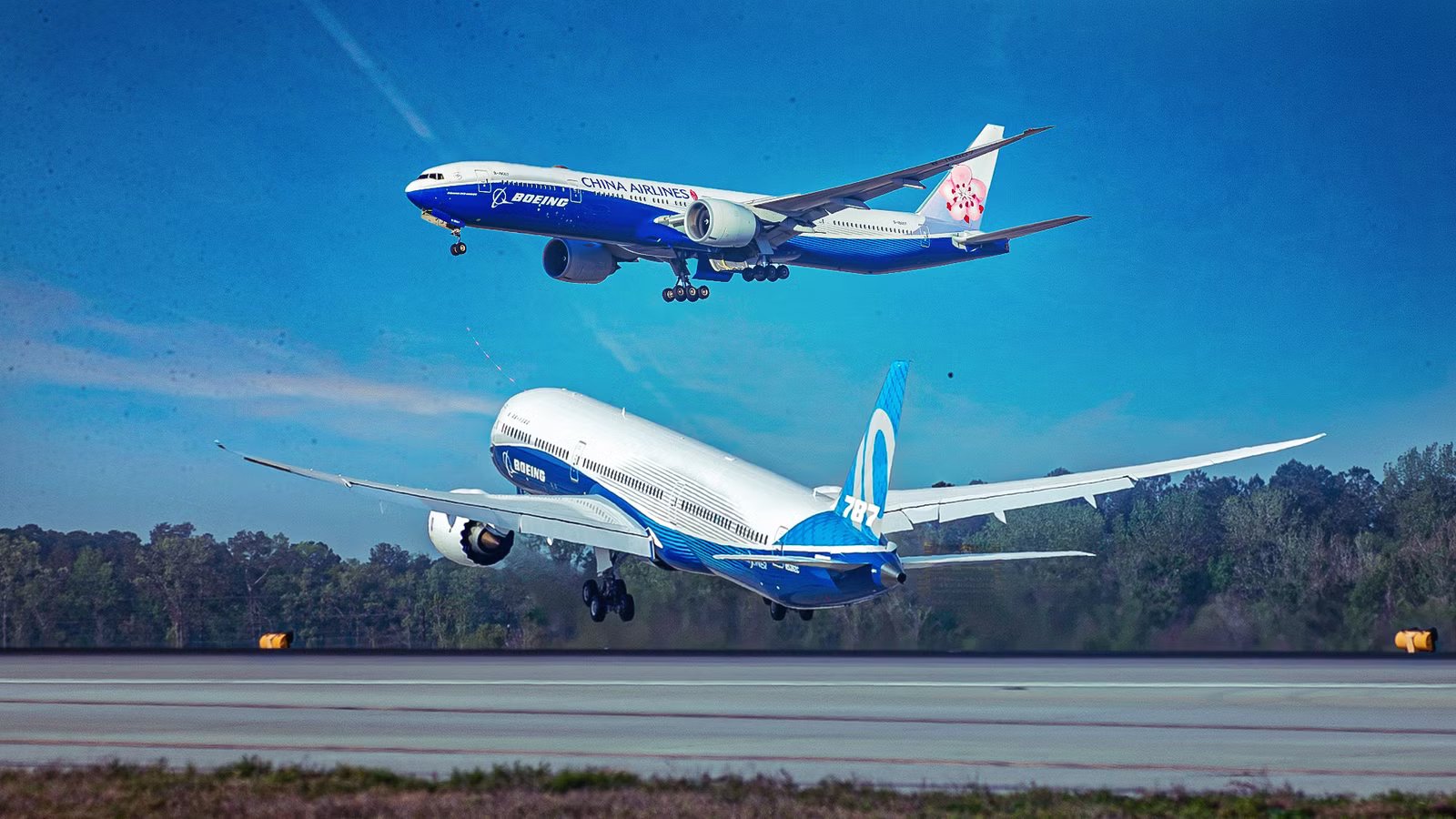
At first glance, the Boeing 777-300ER and the Boeing 787 might seem to serve a similar role. After all, both are twin-engine widebody aircraft built by Boeing, both are used on long-haul routes, and both are flown by major airlines around the world. However, upon closer inspection, it becomes clear that these two aircraft are designed for very different purposes.
The 777-300ER was developed to carry large numbers of passengers over long distances and to replace older four-engine aircraft such as the Boeing 747-400 and Airbus A340. The 787, by contrast, was designed to focus on efficiency, flexibility, and lower operating costs, particularly on long but lower-demand routes.
Differences in size, weight, passenger capacity, and power clearly show that these aircraft occupy different places in Boeing’s widebody lineup, and in this article, we will take a closer look at how, from almost every physical and operational perspective, the 777-300ER is significantly bigger than the 787.
Overall Size & Dimensions

One clear way to compare the size of the Boeing 777-300ER and the 787 is by looking at their basic dimensions. The 777-300ER measures approximately 242 ft long (73.9 m), which makes it longer than every variant of the 787, including the stretched 787-10. The 787-10 comes in at around 224 ft (68.3 m) in length, while the smallest variant, the 787-8, measures just 186 ft (56.7 m) long.
Wingspan further highlights the difference between the two aircraft, with the  Boeing 777-300ER having a wingspan of about 212 ft (64.8 m). The 787’s wingspan is approximately 197 ft (60.1 m), and although the 787’s wings are built using advanced composite materials and optimized aerodynamics, the wings of the 777 are simply larger to support its heavier structure.
In terms of height, the 777-300ER stands roughly 61 ft tall (18.5 m), compared to the 787’s height of around 56 ft (17 m). As such, when seen on the ramp or at the gate, the 777-300ER’s larger size is immediately apparent.
Passenger Capacity

One of the most important real-world indicators of aircraft size is passenger capacity, and this is an area where the Boeing 777-300ER clearly outpaces the 787. In a typical two-class configuration, the 777-300ER seats between 350 and 370 passengers, with some high-density layouts exceeding 400 seats.
Airlines that operate the aircraft on high-demand routes often configure it to maximize capacity, making it a true long-haul workhorse. For example,  Emirates, which is the world’s largest operator of the Boeing 777-300ER, has six different configurations across its 118-strong fleet, ranging from a total capacity of 324 to 421 passengers.
Aircraft | First Class | Business Class | Premium Economy | Economy Class | Total |
|---|---|---|---|---|---|
Boeing 777-300ER (v1) | 6 | 38 | 24 | 256 | 324 |
Boeing 777-300ER (v2) | 8 | 40 | 24 | 256 | 328 |
Boeing 777-300ER (v3) | 8 | 40 | 24 | 260 | 332 |
Boeing 777-300ER (v4) | 8 | 42 | – | 304 | 354 |
Boeing 777-300ER (v5) | 8 | 42 | – | 310 | 360 |
Boeing 777-300ER (v6) | – | 35 | – | 386 | 421 |
These different configurations, per aeroLOPA, are outlined in the table above. The Boeing 787 is notably smaller inside. The 787-8 typically seats around 230 to 250 passengers, while the 787-9 accommodates roughly 260 to 290. The largest variant, the 787-10, can seat between 300 and 330 passengers.
However, this is still well below the capacity of the 777-300ER. This difference reflects each aircraft’s purpose, as the 777-300ER is designed for major hub-to-hub routes with consistently high demand, while the 787 is optimized for thinner routes where filling a very large aircraft would be challenging.
Maximum Take-Off Weight & Engine Power

The Boeing 777-300ER has a maximum take-off weight of approximately 775,000 lbs (351 metric tonnes), which allows the aircraft to carry a full passenger load, significant cargo, and enough fuel to fly long-haul routes. By comparison, the Boeing 787-10 has a maximum take-off weight of around 560,000 lbs (254 metric tonnes), and the smaller 787-9 and 787-8 have even lower weight limits.
This means that in practical terms, the 777-300ER can lift well over 200,000 lbs (90 metric tonnes) more than the largest 787. This difference is reflected in the aircraft’s structure, as the 777-300ER features heavy-duty landing gear with six wheels on each main gear assembly, while the 787 uses a lighter four-wheel configuration. The stronger structure of the 777 is necessary to support its greater size and weight.
A larger aircraft also requires more power, and the Boeing 777-300ER is equipped accordingly. The aircraft is powered by General Electric GE90-115B engines, the most powerful jet engines ever used on a commercial aircraft. Each engine can produce up to 115,000 lbs of thrust and the fan diameter is so large that it exceeds the width of many narrowbody fuselages. The Boeing 787 uses either Rolls-Royce Trent 1000 or General Electric GEnx engines.
These engines are highly efficient but produce significantly less thrust, typically between 64,000 and 76,000 lbs of thrust, depending on the aircraft variant. This stark difference in engine power underscores how much larger and heavier the 777-300ER is, and that the aircraft requires immense thrust to get airborne, especially when operating long-haul flights from hot or high-altitude airports.
Cargo Capacity

In addition to carrying passengers, the Boeing 777-300ER offers substantially more cargo capacity than the 787, further reinforcing its status as a much larger aircraft. The 777-300ER’s wide fuselage and extended length allow for expansive underfloor cargo holds. These holds can accommodate a large number of standard containers, and the aircraft is capable of carrying significant freight even when fully booked with passengers.
This makes the 777-300ER particularly valuable on long-haul routes where cargo plays a major role in overall route profitability. The Boeing 787, while still a capable cargo carrier, offers less underfloor volume. Its smaller fuselage diameter and lower maximum takeoff weight limit the amount of freight that can be carried alongside passengers.
On some routes, airlines may need to prioritize passengers over cargo on the 787, whereas the 777-300ER can often do both without compromise. For airlines serving major global hubs with strong cargo demand, this additional capacity gives the 777-300ER a clear operational advantage and further highlights the size gap between the two aircraft.
Market Position

The final way to understand why the Boeing 777-300ER is bigger than the 787 is by examining how airlines deploy each aircraft. The 777-300ER serves as a high-capacity, long-haul flagship and is frequently used to replace older high-capacity aircraft such as the Boeing 747-400 and Airbus A340.
It operates on some of the world’s busiest long-distance routes, with airlines relying on it where demand is strong and consistent enough to justify a very large aircraft. The Boeing 787, by contrast, is designed to complement larger widebodies rather than replace them. Its smaller size allows airlines to serve long-haul routes with fewer passengers while maintaining strong fuel efficiency.
As such, it excels in opening new markets and connecting secondary cities. This difference is intentional, as Boeing never designed the 787 to compete directly with the 777-300ER. Instead, the two aircraft occupy different segments, with the 777-300ER clearly positioned at the larger end of the widebody spectrum.
The World’s Largest Operators Of Each Aircraft

By mid-2026, data from ch-aviation showed that Emirates had a total of 118 Boeing 777-300ERs in its fleet, making the carrier, based at  Dubai International Airport (DXB), by far the world’s largest operator of the aircraft. Emirates is followed by
 Qatar Airways and Air France, with a total of 57 and 43 777-300ERs in their fleets, respectively. The world’s largest commercial operators of the Boeing 777-300ER are outlined in the table below.
Ranking | Airline | Boeing 777-300ERs |
|---|---|---|
1 | Emirates | 118 |
2 | Qatar Airways | 57 |
3 | Air France | 43 |
4 | Cathay Pacific | 35 |
5 | Saudia | 35 |
6 | Turkish Airlines | 35 |
7 | EVA Air | 33 |
8 | Air China | 28 |
9 | Korean Air | 25 |
10 | Singapore Airlines | 22 |
When it comes to the Boeing 787, All Nippon Airways is the world’s largest operator, with a total of 91 aircraft spread across the three variants: 36 787-8s, 45 787-9s, and ten 787-10s.  United Airlines and
 American Airlines are the second and third-largest operators, with 88 and 70 in their fleets, respectively.
Newcomer  Riyadh Air is set to soon be one of the world’s largest operators of the Boeing 787, as the start-up carrier has a total of 40 787-9s on order, to operate from its hub at Riyadh King Khalid International Airport (RUH). It has already taken delivery of several Dreamliners, but several of these recently had to be flown out of Riyadh as the airport faced missile attacks.