dailynewsnblog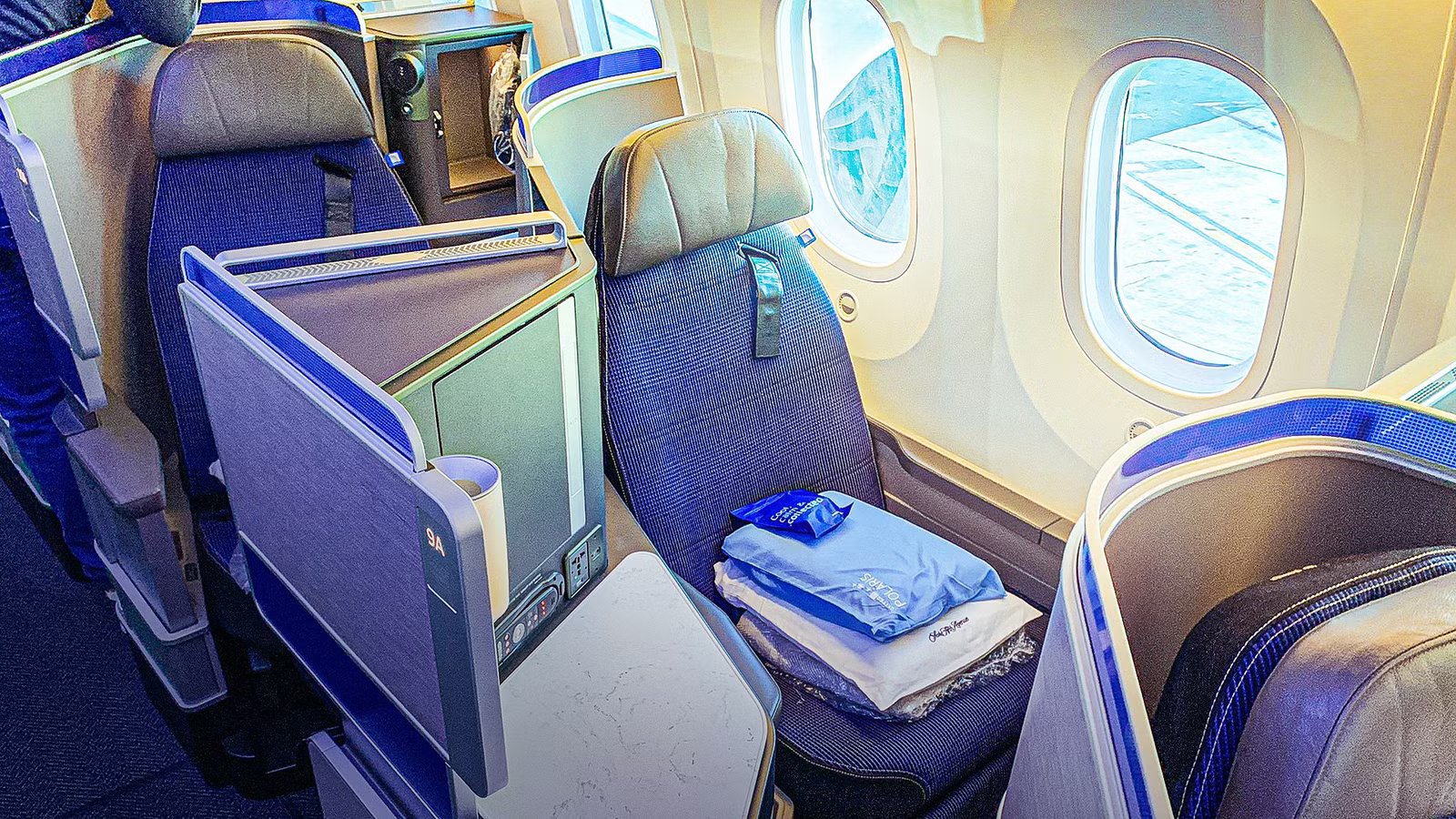
Uncovering the true cost of international business class has become increasingly complex as major carriers apply budget airline tactics to their most prestigious cabins. For anyone currently eyeing a  United Airlines Polaris suite on the Boeing 787 network, the baseline ticket price represents only a fraction of the total economic equation. This comprehensive guide details the real-world cash rates, tiered ticket classifications, and secondary upgrade costs that are presently defining the flagship widebody experience across prime transoceanic routes.
The ever-morphing commercial landscape follows a historic decision by the legacy carrier to fragment its premium cabin pricing model into distinct service tiers earlier this year. With the introduction of unbundled business class fares across its global network, United has decoupled the physical comfort of a long-haul lie-flat bed from the traditional luxury ground experience. Consequently, anyone planning a trip on the composite-fuselage twin-jet must evaluate what specific perks they are willing to sacrifice to secure the lowest corporate rate.
Be Prepared For The Worst

Selecting the lowest price displayed on a booking screen no longer guarantees the all-inclusive transoceanic journey that many have come to love. The emergence of the Base Polaris fare category means that passengers flying on the flagship Boeing 787 fleet face strict limitations before they even set foot in the terminal. The new entry-level corporate tier targets price-sensitive professionals who prioritize the physical comfort of a 78-inch (198.1 centimeter) horizontal surface over high-touch premium amenities, relocating the baseline value proposition for modern international premium travel.
While a traveler occupying a Base Polaris ticket still receives identical onboard catering, Saks Fifth Avenue bedding, and a Therabody amenity kit, the pre-flight environment is significantly compromised. The most dramatic trade-off involves the complete removal of United Polaris Lounge privileges, directing passengers instead to the regular, often crowded United Club facilities. This restriction strips away high-end sit-down dining, quiet daybeds, and private shower suites, resulting in a soft value deficit that sits between $150 and $300 per direction.
Additionally, logistical hurdles accumulate rapidly because advance seat selection requires an additional fee, potentially stranding late-booking premium travelers in less desirable middle sections or spaces adjacent to galley noise. The luggage allowance drops from two complimentary checked pieces to a single container, imposing a steep financial penalty on individuals who fail to pack efficiently for extended multi-week trips. Combined with a total ban on itinerary changes or refunds, the unbundled tier turns a standard long-haul luxury ticket into a rigid commitment with very little room for flexibility.
Under Corporate Control

Actual cash outlays required to sit in the forward cabin of a United Dreamliner vary wildly based on seasonal demand, route length, and your chosen tier of service. The carrier relies heavily on three distinct variants of the twin-engine aircraft, routing the 787-8, 787-9, and high-capacity 787-10 across core global networks. Looking into standard retail pricing reveals a clear premium on hub-to-hub trunk routes, where corporate accounts heavily dictate seat availability.
For example, booking a standard transoceanic hop from  Newark Liberty to
  London Heathrow outside of peak summer corridors shows a substantial spread across the newly configured ticket matrix. A baseline unbundled ticket can cost around $3,400 for a round-trip ticket, while stepping up to a Standard or Flexible asset pushes the cost past $4,600 to retain lounge access and change privileges. Transpacific journeys originating from West Coast gateways like
  San Francisco to
  Tokyo Narita demand a steeper investment, with prime mid-week summer departures easily reaching $6,500 for the lowest tier and topping $8,000 for full ticketing flexibility.
These stark capital requirements demonstrate how the legacy airline utilizes software to optimize yields while testing customer tolerance for ancillary add-ons. Passengers now need to weigh whether a sub-premium ground experience warrants a nominal upfront discount, given that a single unexpected schedule disruption could wipe out all initial savings under the zero-change rule on base tickets. Ultimately, the total price paid at checkout reflects the reality that personal scheduling stability is not as easy as it once was.
United Airlines To Introduce Base Fare Option To Polaris & Premium Plus
The carrier has big plans for its premium cabins.
Keep Some Miles In The Bank

For passengers who prefer to avoid full retail cash prices for a premium ticket, the MileagePlus upgrade system offers an alternate route into the front cabin of the Dreamliner. This secondary market relies on a dual-currency system where flyers combine a set allotment of loyalty miles with a fixed cash co-pay to bypass high retail prices. However, successfully executing an upgrade request on a high-demand widebody route depends heavily on how the airline clears its standby waitlists.
The financial layout of a mileage upgrade award is tied to the fare code of the original economy ticket. Getting a seat on a transatlantic or transpacific Boeing 787 routing generally requires 30,000 miles, paired with a cash co-pay of $300 to $600 each way for discounted economy tickets. United often runs three distinct pricing tracks simultaneously for a single flight, allowing flyers to choose between fixed-mileage formulas, dynamic cash-only upgrade offers in the application dashboard, or day-of-departure price cuts at the check-in kiosk.
Original Ticket Class | Mileage Requirement | Cash Co-Pay Component | Waitlist Processing Priority |
Premium Plus (O, A, R) | 20,000 miles | $0 | Highest cabin upgrade priority |
Full Fare Economy (Y, B) | 20,000 miles | $0 | Cleared after premium economy |
Discount Economy (M, U, H, Q) | 20,000 miles | ~$300 | Mid-tier waitlist standing |
Deep Discount Economy (V, W, S, T, K, L) | 30,000 miles | ~$600 | Standard standby queue |
Careful timing is key, as the airline releases upgrade inventory based on real-time premium seat vacancies closer to the departure window. Elite status members holding Premier Platinum or 1K designations can utilize PlusPoints to skip the cash co-pay entirely, though they remain bound by the same underlying seat availability matrices. If a waitlisted upgrade fails to clear before the flight takes off, the airline automatically redeposits the deducted miles and refunds the cash co-pay within ten business days.
Pick The Odd Seats

The justification for allocating thousands of dollars or tens of thousands of miles toward a forward-cabin ticket rests on the engineering inside the carbon-fiber fuselage of the Boeing 787. Unlike older aircraft with tight configurations, the custom 1-2-1 walk-in layout engineered specifically for the Dreamliner ensures that every passenger has direct aisle access as standard. The spatial design eliminates the traditional friction of climbing over a sleeping neighbor, which is a critical asset on long transpacific legs that extend past ten hours for many travelers.
The metrics of the seat yield a comfortable environment, also offering a width of 22 inches (55.88 centimeters) that converts into a fully flat bed measuring 78 inches (198.12 centimeters) in length. United alternates rows between straight-facing suites flush with the aisle and angled pods that offer enhanced privacy away from foot traffic, providing a varied cabin geometry across the 787-8, 787-9, and 787-10 variants. Frequent flyers routinely target odd-numbered window rows because these specific pods place the structural console on the aisle side, creating a physical shield against passing service carts.
The suite itself remains highly uniform across the widebody sub-fleets, but the high-density layout of the largest 787-10 variant introduces more ambient noise due to its larger passenger capacity. Reviewing seat maps is the way to go to avoid row one or the final row of any cabin section, as proximity to galleys and lavatories can compromise the sleep experience via light pollution and crew preparation activities. Selecting a standard or flexible ticket makes it much easier to secure these prime architectural sweet spots months in advance, avoiding the unchosen random assignments typical of the base unbundled tier.
Simple Flying Quiz
What Aircraft Type Are You?
Five questions. One aircraft. Find out which plane best matches your personality.
Question 1 of 5
How do you prefer to travel?
Question 2 of 5
What’s your ideal weekend away?
Question 3 of 5
How do you handle a busy schedule?
Question 4 of 5
What matters most to you on a long trip?
Question 5 of 5
How do others describe you?
Your Result
The Explorer
Cessna 172
You value freedom, simplicity, and the joy of the journey itself. You’re happiest when you’re in control, taking life at your own pace and discovering the world one small airfield at a time. No crowds, no queues — just sky.
Your Result
The Workhorse
Boeing 737
Reliable, efficient, and always in demand. You get the job done without fuss, keeping things moving for everyone around you. You’re the backbone of any operation — proven, dependable, and trusted the world over.
Your Result
The Icon
Airbus A380
You think big. More space, more comfort, more presence — you believe in doing things properly and on a grand scale. When you walk into a room, people notice. You’re built for the long haul, and you do it in style.
Your Result
The Pioneer
Concorde
Speed, ambition, and a refusal to accept limits define you. Every second counts, and you’d rather break the sound barrier than wait in line. You were ahead of your time — bold, brilliant, and utterly unforgettable.
Are The Competitors Leading?

When cross-referencing transpacific cash fares from California to Tokyo, for example, United frequently aligns its Base Polaris pricing with regular business class offerings from prominent Asian airlines. Creating a parallel layout forces flyers to choose between the expansive corporate network of a domestic carrier and the premium, all-inclusive touchpoints of international joint venture partners.
Major competitors operating on identical routes generally include lounge entry and advanced seat assignments within their base premium ticket structures, giving them a soft-product edge over United’s stripped-down entry tier. For instance, booking a regular long-haul business ticket on a partner airline often grants access to full-scale dining lounges that rival United’s high-end ground installations. Going through the effort to work out the extra cash required to step up from a Base Polaris fare to a Standard Polaris fare simply to regain lounge entry, the financial advantage of the domestic carrier often evaporates entirely.
It is an example of a segmented commercial framework that United is explicitly counting on. The focus here is on its massive hub network and corporate contract dominance to retain passenger loyalty despite the unbundling strategy. For solo travelers who prioritize high-end ground hospitality before a long flight, looking to international alliance partners might yield superior overall value for the same capital outlay. However, for tight travel budgets, the base tier provides a streamlined path to a lie-flat bed without paying for ancillary ground luxuries.
A Justified Decision

The evolution of premium pricing through the remainder of the year will be heavily dictated by shifting corporate travel policies and international fuel variables. As businesses tighten internal spending parameters, demand for unbundled corporate fares is projected to outpace traditional flexible luxury tickets across major industrial sectors. It ultimately validates United’s decision to break up its cabin pricing, allowing the carrier to protect its volume metrics while maximizing yield from remaining premium customers.
Persistent widebody delivery delays from aerospace manufacturers mean that the existing Boeing 787 fleet must work harder to sustain expanding international route networks. Fleet stagnation globally has created an artificial ceiling on premium seat supply, keeping baseline cash fares high even as individual perks are removed from lower ticket tiers. Those who know how to work around this can exploit this environment by looking for seasonal award availability on days when corporate travel naturally subsides, turning loyalty points into a strong shield against high cash retail pricing.
The success of the unbundled Polaris experiment has already encouraged other legacy carriers to implement similar basic business class models on competitive long-haul corridors. The days of all-inclusive luxury travel are giving way to data-driven customization, meaning for the modern flyer, mastering the nuances of fare codes, co-pays, and lounge eligibility matrices is the only way to ensure you get exactly what you pay for.