dailynewsnblog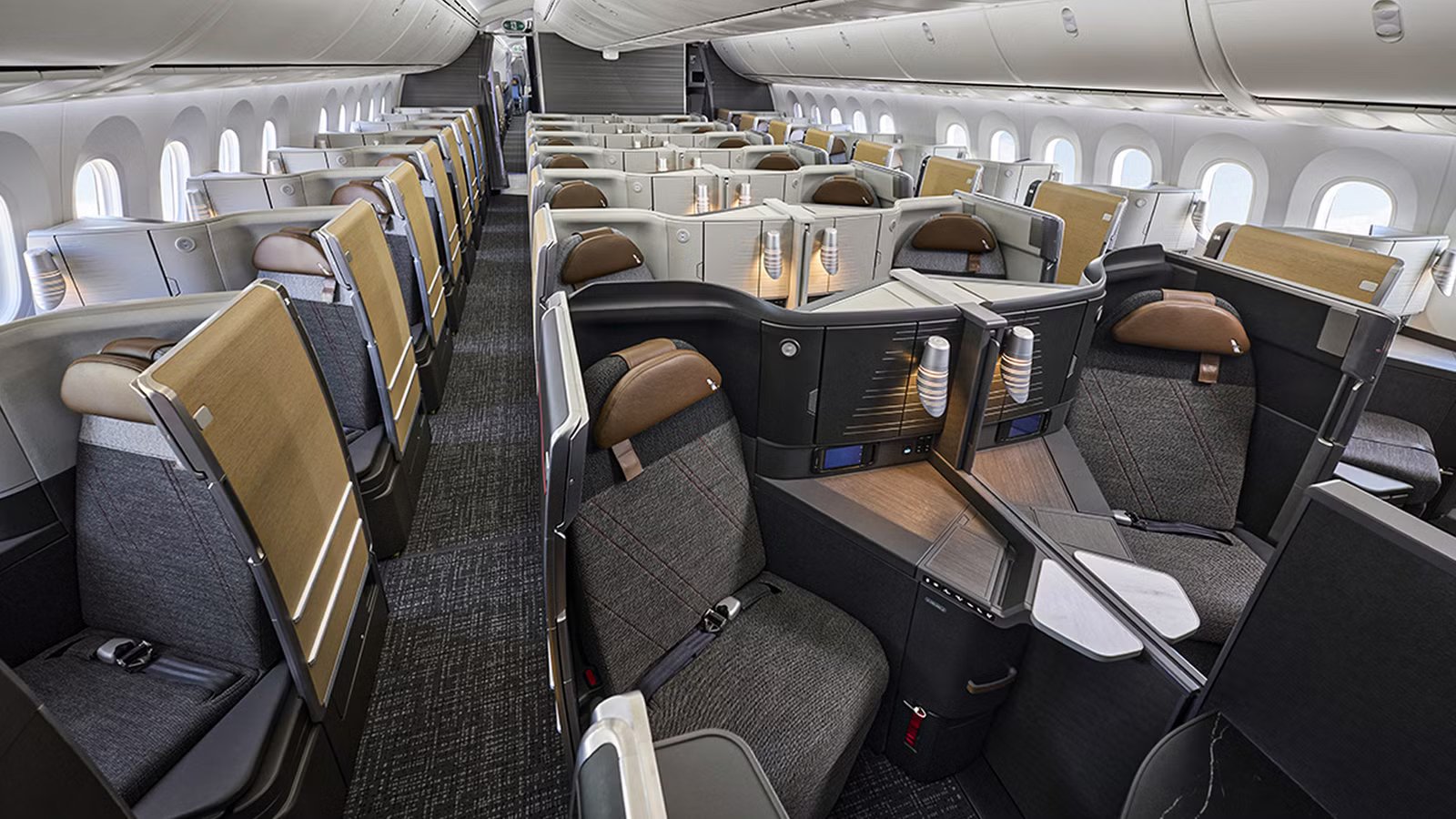
 American Airlines sells its ‘Flagship Business’ cabin as its main premium offering on all of its widebody airliners, as well as on the Airbus A321XLR and the soon-to-be phased-out Airbus A321 Transcon subfleet. It offers a remarkably consistent product on its widebodies, as it uses various reverse herringbone seat models on all types.
On the Boeing 787, American uses three different models, with select 787s also featuring its latest ‘Flagship Suites’ product. The Boeing 787 is the backbone of American’s long-haul operations. The Fort Worth-based carrier has 70 examples, split between 37 787-8s and 33 787-9s, with another 19 787-9s on the way.
These planes are based out of every American Airlines hub city except for Washington, Charlotte, and Phoenix. The 787-8s are mainly used as low-gauge aircraft, as they are American’s smallest widebody, while its standard 787-9s are configured much more densely. Meanwhile, its most recent 787-9s have featured a new premium-heavy layout.
Flagship Business Cash Prices To Europe

While American selectively deploys the Boeing 787 out of New York-JFK, Miami, Los Angeles, and Dallas/Fort Worth, the Dreamliner is most commonly used on transatlantic flights out of Philadelphia and Chicago-O’Hare, which do not have Boeing 777 bases. One-way Flagship Business fares can vary drastically depending on the date, dipping to as low as $2,200 but also climbing to over $11,000.
In addition, there can be significant variances in price depending on whether a ticket originates in Europe or the US, with prices generally being higher for US-originating tickets. Philadelphia is American’s primary transatlantic hub, with the 787-8 variant serving most European destinations. This includes popular cities such as Athens, Dublin, and Milan, along with most secondary destinations. This includes Prague, Copenhagen, Nice, Budapest, Naples, Amsterdam, Zurich, Barcelona, and Madrid.
Meanwhile, the larger 787-9 is used to serve Paris, Rome, Venice, Lisbon, London-Heathrow, and Edinburgh. From Chicago-O’Hare, meanwhile, the 787-9 serves London-Heathrow and Rome, while the 787-8 flies to Barcelona, Madrid, Naples, Dublin, Amsterdam, Paris, and Athens.
The only European route that American Airlines serves from Miami with the 787 is to Milan, using the 787-8. From Los Angeles, American uses the 787-9 to serve London-Heathrow, while from Dallas/Fort Worth, American deploys the 787-8 to Frankfurt and deploys the 787-9 to London-Heathrow. In addition, the 787-9 is used to serve Rome and London-Heathrow from New York-JFK, while the 787-8 is used to connect New York-JFK with Barcelona.
American’s Services To Asia

On routes to Asia, American Airlines typically charges between $3,100 and over $8,500 for Flagship Business. This is notably lower than some of American’s highest fares to Europe, especially considering the greater distances involved with Asian routes. This reflects American’s significantly weaker market position in Asia compared to Delta Air Lines and United Airlines, as it has less pricing power and a significantly smaller network.
Catch what other flight trackers miss
Emergency squawks, holds, NOTAMs — live signals, no signup.
Open tracker
Catch what other flight trackers miss
Emergency squawks, holds, NOTAMs — live signals, no signup.
Open tracker
Most of its routes to Asia are served from Dallas/Fort Worth, and the carrier no longer has any Asian routes from Chicago O’Hare. In addition to Dallas/Fort Worth, American also serves Asia from New York JFK and Los Angeles, and operates a single route from Philadelphia to Doha.
It uses the 787-9 for all of its 787-operated routes to Asia, connecting New York JFK to Delhi and Tokyo Haneda, as well as Dallas/Fort Worth to Tokyo Haneda and Shanghai. From Los Angeles, the 787-9 is only used to fly to Tokyo-Haneda. These services are complemented by flights operated using the Boeing 777.
American Airlines also has a similarly small presence in Oceania, which is partly compensated for through its joint venture with Qantas. It only serves Sydney year-round, using the Boeing 777-300ER, while serving Auckland from Dallas/Fort Worth and Los Angeles with the 787-9 during the winter season. In addition, it uses the 787-9 to serve Brisbane from Dallas/Fort Worth during the winter. Pricing on these routes tends to be much higher than on its Asian routes, exceeding $15,000 in some cases.
American Flagship Business Prices To South America

While American is number three in Europe and is severely behind in Asia, the carrier is a juggernaut in South America, largely due to the strength of its Miami hub. Primarily, it’s the Boeing 777 that’s used to serve destinations in South America, although the 787 also plays a supporting role.
However, prices are also lower than in Europe or Asia, ranging from roughly $2,300 to over $5,400 for Flagship Business one-way, which is fairly low considering that flight distances are similar to European routes. From Dallas/Fort Worth, American deploys the 787 to Buenos Aires and São Paulo. From New York JFK, the 787-9 is used to serve São Paulo, while American deploys the 777-300ER to Buenos Aires.
From  Miami International Airport, meanwhile, American uses the 787-8 to serve Buenos Aires and Rio de Janeiro year-round, while serving Santiago with the 787-8 during the summer (the 777-200ER is used during the winter). In addition, the 787-9 is used on the Miami-to-São Paulo route during the summer. Routes between North and South America can be challenging to operate economically because passengers tend to prefer overnight flights.
The lack of time zone changes also means aircraft must be parked for 12 hours or more between flights. In addition, these routes are similar in length to services between the US and Europe, while generally commanding lower fares. However, Miami has strong local demand and is ideally located for connections, and American serves some destinations with three or four daily flights during the winter season.
Booking Flagship Business With Miles

Premium cabins have always been extremely expensive, and traditionally, the best way to book a business class seat is to use airline miles or points instead. However, American Airlines dynamically prices its award tickets to correlate with cash prices, which fluctuate based on demand. The carrier publishes an award chart with one-way award prices to various regions, including for Flagship Business, but these are only estimated starting values and are much lower than typical prices.
AA advertises that Flagship Business award tickets to Europe start at 75,000 miles, while prices on long-haul South American flights start at 90,000 miles. Flagship Business award tickets on Asian and South Pacific routes start at 95,000 miles. In addition, AAdvantage miles can also be used to book tickets on all  oneworld members, as well as Aer Lingus, Air Tahiti Nui, China Southern, Etihad Airways, GOL, IndiGo, JetSMART, LEVEL, and Porter Airlines.
oneworld Alliance Members | ||
|---|---|---|
Alaska Airlines | Hawaiian Airlines | Qatar Airways |
American Airlines | Iberia | Royal Air Maroc |
British Airways | Japan Airlines | Royal Jordanian |
Cathay Pacific | Malaysia Airlines | SriLankan Airlines |
Fiji Airways | Oman Air | |
Finnair | Qantas | |
AAdvantage is a transfer partner with Citi, allowing for one-to-one point transfers on select cards, and AAdvantage also has two hotel transfer partners: Marriott Bonvoy and World of Hyatt. However, the transfer ratios between the two programs are fairly poor, with Marriott Bonvoy points transferring at a three-to-one ratio to AAdvantage and World of Hyatt points transferring to AAdvantage at a ratio of five-to-two. While it is available, American aims to incentivize premium customers to earn miles directly with AAdvantage.
The Seats in American’s 787 Flagship Business

On the Boeing 787, American Airlines installs three different seat models. The oldest is the Safran (formerly Zodiac) Concept D, a custom model that features seats that alternate between a forward-facing reverse herringbone layout and a rear-facing herringbone design. The seats are constructed in pairs, and they have received significant criticism because movements in one seat can be felt by the other passenger.
Due to production delays, American ended up canceling its contract with Zodiac on the Concept D. 20 787-8s were delivered with the Concept D, while the remaining 17 787-8s were fitted with the Collins Aerospace (formerly B/E Aerospace) Super Diamond. This is an off-the-shelf reverse herringbone seat model that’s extremely similar to the Safran Cirrus II seats found on the carrier’s 777-300ER fleet.
Aircraft | Flagship Business | Premium Economy | Main Cabin Extra | Main Cabin | Total Seats |
|---|---|---|---|---|---|
Boeing 777-200ER | 37 seats (Concept D) | 24 | 66 | 146 | 273 |
37 seats (Super Diamond) | 24 | 66 | 146 | 273 | |
Boeing 777-300ER | 52 (Cirrus II) + 8 Flagship First | 28 | 28 | 188 | 304 |
70 (Elevate Ascent) | 28 | 30 | 186 | 330 | |
Boeing 787-8 | 20 (Concept D) | 28 | 48 | 138 | 234 |
20 (Super Diamond) | 28 | 48 | 138 | 234 | |
Boeing 787-9 | 30 (Super Diamond) | 21 | 27 | 207 | 285 |
51 (Elevate Ascent) | 32 | 18 | 143 | 244 |
However, it most notably differs in having fixed entertainment screens. In addition to the 17 787-8s, American’s first 22 Boeing 787-9s were delivered with the Super Diamond. In 2025, American began taking delivery of new 787-9s in a premium-heavy ‘789P’ layout, which features 51 Flagship Business suites and just 244 seats, as opposed to the 285-seat layout found on its first 22 787-9s.
American’s 789P aircraft are being delivered with the Elevate Ascent, a reverse herringbone seat with privacy doors, and the carrier’s new interiors on the Dreamliner also feature new front-row Flagship Preferred suites. These seats include more space and do not currently require an additional surcharge, although it’s expected this will change in the future.