dailynewsnblog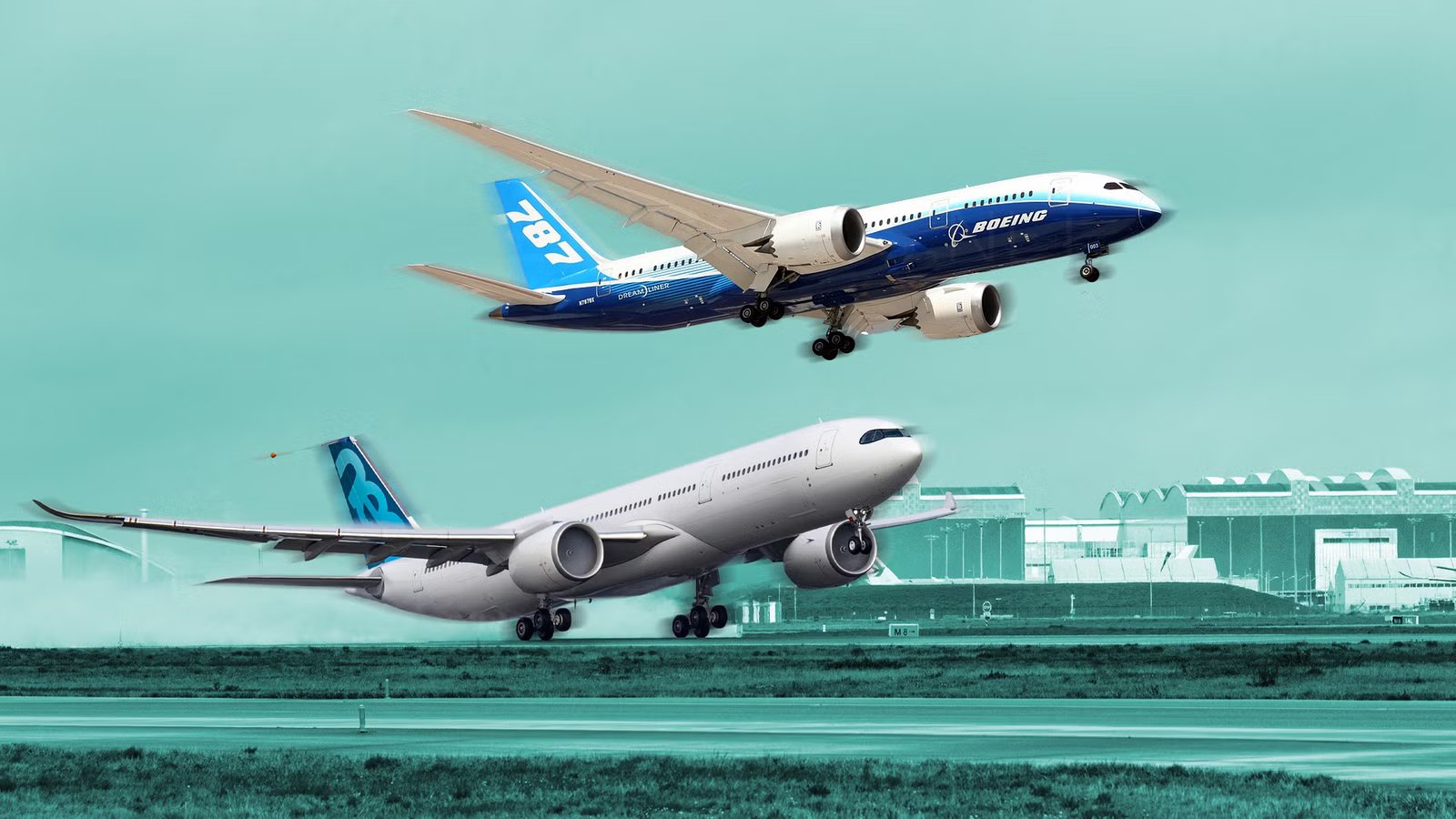
The current commercial aviation landscape is dominated by  Boeing and Airbus. The two companies directly compete for contracts with the world’s largest aircraft operators, and has resulted in an effective duopoly since the 1990s. Today, the Airbus A330neo family and Boeing 787 Dreamliner family compete for market share in the mid-sized widebody category.
For many airlines, the most important factor when deciding which manufacturer to order from is quite simply cost. However, cost is an overarching word that goes beyond the initial price tag. Order size, leasing terms, and operating costs all have financial implications for airlines when deciding whether to order a new aircraft. Today, the 787 and A330neo are two of the most sought-after airliners on the market for their ability to offer a competitive range and price.
A Brief History Of The Two Types

In the early 2000s, Boeing began planning for a completely new airliner that would focus on efficiency and modern manufacturing processes. The Boeing 787 Dreamliner program officially launched in April 2004 with All Nippon Airways as its launch customer. One of the main design targets was offering 20% less fuel burn than the current 767, which would be accomplished in part by building a lighter, more aerodynamic aircraft.
Equipped with state-of-the-art engines and an airframe made of 50% composite materials according to Safe Fly, the Dreamliner proved to be a revolutionary aircraft. The family consists of three variants: the 787-8, 787-9, and 787-10. The key differences are that the 787-10 has the largest passenger capacity at 375, while the more popular 787-9 has the longest range at 8,500 nautical miles. The total development program cost was about $32 billion.
The launch of the 787 led Airbus to rework its current Airbus A330 model. However, after feedback from the market, that plan evolved into the Airbus A350 program, which continues today. Despite the A350 program, airlines still repeatedly expressed interest in a re-engined version of the A330 to compete with the 787 on mid-range routes. In 2014, the A330neo (‘new engine option’) was launched in 2014 at the Farnborough Airshow, equipped with two Rolls-Royce Trent 7000 engines.
These engines improve fuel burn by 14% per seat compared to the older A330s, dubbed the A330ceo (‘current engine option’). The A330-800 and -900 comprise the A330neo family today. The A330-800 has the longer range at 8,100 NM, while the larger -900 variant can carry more passengers with 465, according to Airbus. The total A330neo development program cost was only about $2 billion, as it was a refresh rather than an entirely new design.
Today, both the 787 and A330neo are in active production, but how much does it cost to buy one? A new A330-800 fresh off the line costs about $260 million, and the larger A330-900 costs slightly more at $296 million. The Boeing counterpart will run you $248 million for the 787-8, $293 million for the popular 787-9, and $338 million for the 787-10. It is important to note, however, that operators very rarely pay the full list price when negotiating aircraft purchase orders from these manufacturers.
Orders & Competition

The A330neo is part of Airbus’s answer to the success of the Boeing 787 family. While it is not as popular as its A350 cousins, it has found its place in the market as the rapid-deployment aircraft in the mid-range market. While specific contract figures are not typically disclosed, the market rate for an A330-900 is about $109 million. A major recent order came at the  Dubai Airshow 2025, where
  Etihad Airways announced that it had ordered 15 Airbus A330neos.
The airline expects deliveries to begin in 2027, signaling that the A330neo is a smart option for airlines looking to expand on short timelines. On the other hand, the Boeing 787-9 is the most popular widebody aircraft on the market right now, and the family has experienced strong order flows.
Since its launch, 1,299 Dreamliners have been delivered, and 2,453 have been ordered. This difference highlights an issue: slow delivery times. Post-COVID, Boeing has seen long delays in delivering aircraft and has even cut some production efforts. This has led some airlines to have a wandering eye over towards Airbus and its A330neo and A350 families.
The backlog issue is real for Boeing. At this moment, there are 1,154 examples of 787 aircraft on backlog for Boeing. However, faith in the jet remains strong, as it continues to place sizable orders for the Dreamliner. Boeing will need to ramp up its production and supply chain efforts if it hopes to meet these lofty order totals in a reasonable timeframe. The longer airlines wait for delivery, the more likely they are to purchase from Airbus.
Since the A330neo is essentially the same as the standard A330 with better technology, Flight Plan notes that its backlog is much smaller at 328 examples (524 orders and 196 deliveries). Of course, the A330neo does not experience the same order volume as the 787, so Airbus manufacturing lines are not as stressed. Regardless, the A330neo is a viable solution for airlines looking to solve fleet capacity issues quickly.
Operating Costs

Any aircraft owner can attest that buying an airplane is only part of the financial equation. Evaluating the operating costs associated with owning an airplane is a significant aspect of the purchase process, and one that airlines weigh heavily. Fuel cost is ultimately the largest expense for commercial operators, so fuel efficiency and burn rates are key metrics to look at. The 787 and A330neo both offer lower effective fuel costs for airlines through innovative design choices.
The 787 achieves a higher fuel efficiency thanks to its very light airframe. Meanwhile, the A330neo has lower fuel burn rates per seat due to its advanced engines and wingtip design. Operating costs are often measured on a per-flight-hour basis and are calculated from many components. Beyond fuel, annual and reserve maintenance estimates, depreciation, and crew labor expenses are included in aircraft operating cost calculations.
Aircraft | Average Operating Cost ($/seat/hr) |
|---|---|
787-8 | $30 |
787-9 | $25.86 |
787-10 | $19.54 |
A330-800 | $28.36 |
A330-900 | $22.43 |
For airlines, reducing operating costs is a constant effort. To better compare across different aircraft, these costs are analyzed on a per-seat basis. The table above details a comparison of average operating expenses for the 787 and A330neo families, in dollars per seat per hour.
Major Operators

 Delta Air Lines is the largest A330-900 operator in the world, and is the only American airline to hold an A330neo in its fleet. The largest 787 operator was the original launch customer, All Nippon Airways, with 86 in service. However,
  United Airlines has positioned moved up to the top spot from second with 91, and it plans to eventually operate a total of 221 787s within its fleet. Another US-based airline rounds out the top three, as
  American Airlines is the largest 787-8 operator in the world.
This discrepancy in the number of active A330neos and 787s is primarily due to the head start the Dreamliner had. By the time the A330neo entered service, the market was saturated with 787 orders and deliveries. While the A330neo has been able to capture some meaningful market share in recent years, it is evident that airlines are still betting on Boeing to provide the equipment on the mid-range widebody routes.
The longest 787 flight between  London Heathrow Airport and Perth International Airport holds the fourth spot on the world’s longest passenger flights by distance. However, Qantas’ Project Sunrise, which aims to connect the East Coast of Australia to Europe on a nonstop basis with the A350, will surpass this distance when it begins. In any case, both the A330neo and 787 are relied upon to connect distant corners of the world more efficiently than legacy aircraft such as the A300 and 767.
Redefining Luxury In The Skies

Both Airbus and Boeing offer variants of each aircraft catered to private or corporate travel. Airbus Corporate Jets offers the ACJ330neo in both the -800 and -900 variants, and Boeing Business Jets offers the BBJ 787 in all three models. They are perhaps the most opulent way to travel, with luxurious cabins designed for far fewer guests, enabling nonstop capability between virtually any two points on Earth.
The starting price for a new ACJ330-800 is around $260 million, with the ACJ330-900 starting at $300 million. Similarly, the list price for a BBJ 787-8 is $239 million. While these numbers are staggering, in most cases, they do not represent the full price paid, as operators will make custom modifications to fit their use case. For example, many governments own Airbus Corporate Jets to transport VIPs, so additional security modifications must be made.
Looking Forward

The 787 and A330neo are very comparable aircraft. Both use advanced engines that improve fuel efficiency, helping cut costs. On the market, the different variants of each are in similar price ranges, but specific order details alter unit costs, making an accurate direct comparison difficult in practice. What we do know is that demand is still strong for the 787, and has been growing for the A330neo.
It does not seem likely that the A330neo will catch up to the 787 in terms of order volume, but airlines will continue to place orders with Airbus as long as they can deliver. Delays with Boeing’s 777X program will also further shift focus back to the 787 for the near future. Airlines operate on thin financial margins, and, as such, they are always looking for an aircraft that can serve their mission while staying cost-effective.