dailynewsnblog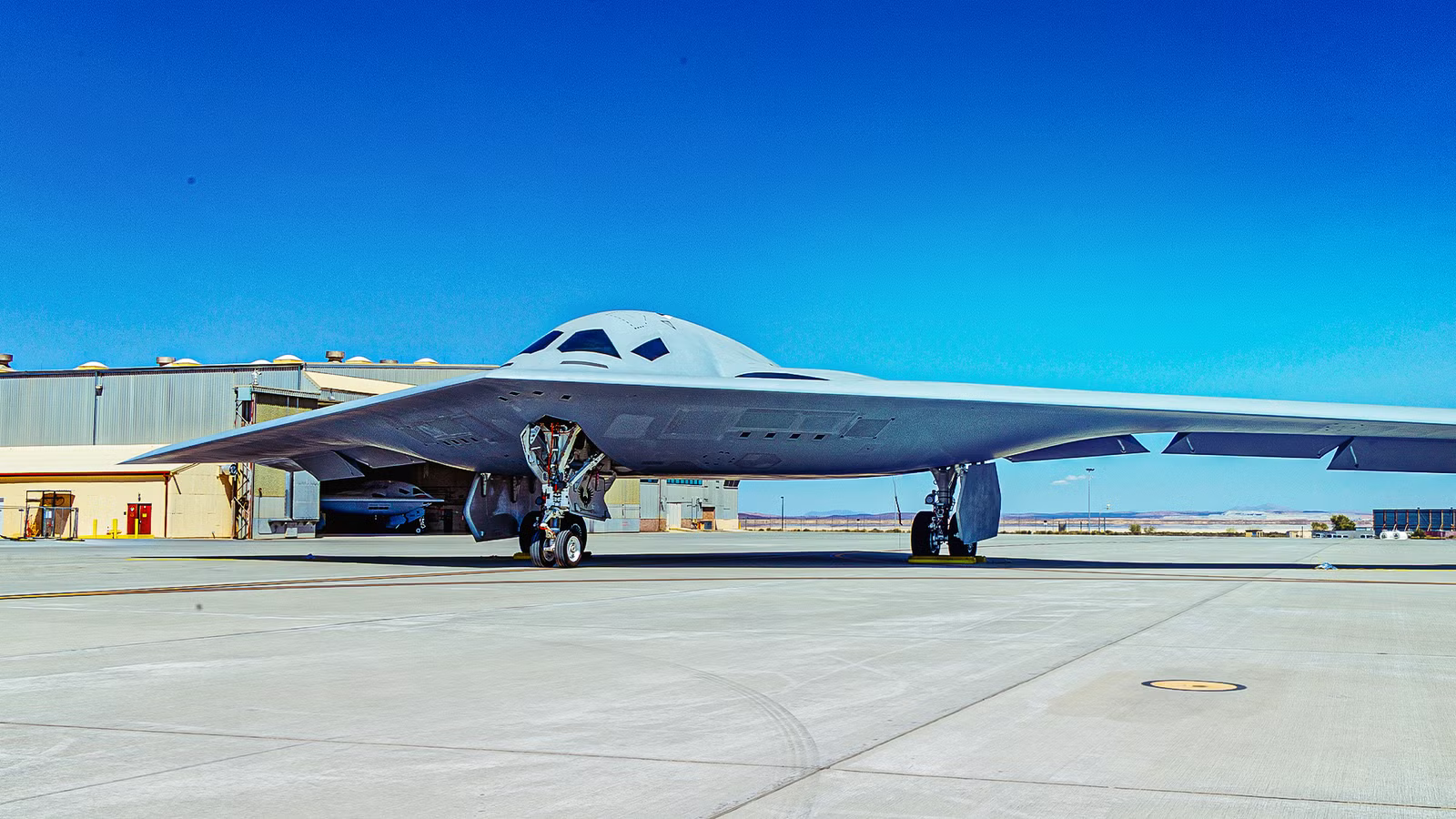
The first example of the world’s first 6th generation stealth bomber is expected to be ‘on the ramp’ at Ellsworth Air Force Base sometime next year. The US Air Force’s B-21 Raider, built by Northrop Grumman, is one of the most resounding successes in recent procurement history for the Department of Defense. Although no official number has been announced for annual production, the Pentagon has already granted a 25% funding increase to expedite initial production.
The aircraft has been so impressive that the initial fleet size of 100 airframes is already expected to increase with proponents from the top brass of the Air Force as well as lawmakers on Capitol Hill pushing for 185 or even 200. Based on the publicly available data and these figures, we can estimate that between nine and ten Raiders will likely be built every year, but that could go up to as high as 12 if the total fleet is greatly expanded.
Northrop Grumman Pumps Up The Numbers At Plant 42

The assembly line dedicated to the B-21 Raider is at Air Force Plant 42 in Palmdale, California. Northrop Grumman plans to keep the entire operation limited to its historic manufacturing complex at this site, which sprawls over nearly a million square feet, even as the total fleet order grows. Northrop and the USAF have indicated that a larger factory is not needed with digital optimization and shifting some manufacturing burdens to Tier 1 suppliers.
Following the confirmation of a 25% capacity increase at Plant 42, Northrop invested $2.5 billion in capital to modernize the site with automation and other upgrades planned for installation between 2027 and 2029. Kathy Warden, Northrop’s chief executive, was quoted by Air and Space Forces magazine giving these remarks during a discussion at the Bernstein Strategic Decisions Conference in May.
“As we move through the completion of the test program and into production, we look forward to the opportunity to build these faster—and that’s the agreement that we have now come to with the Air Force—which also opens up the opportunity for [the Air Force] to potentially buy even more…”
That increased rate allows [the Air Force] to consider how they meet mission requirements, and how many aircraft they would want to build to do that. They are undertaking that analysis now, and certainly our ability to build faster is a positive factor in those evaluations.”
Secretary of Defense Pete Hegseth opened the door in April when he told lawmakers that the Air Force will need a lot more than the planned minimum 100 B-21s. Then in May, Lieutenant General David Tabbert testified to Capitol Hill that the service would prepare its revised Raider fleet numbers by Spring 2028.
Inter-service Support For The B-21 At The Pentagon

US Navy Admiral Richard Correl, commander of US Strategic Command, testified to Colorado in March that the Air Force would need at least 145 B-21s. He went so far as to propose that opening a second production line may actually be a viable means of achieving that goal. So far, Northrop has not indicated that it has explored this potential yet. Has the company already spent very large sums out of pocket on Plant 42, that would require another large funding injection.
Despite the rising investment from the Pentagon, Northrop has spent a considerable amount of its own funds to support the Raider program until federal investment arrives. The company reported a $477 million loss on the first plane after it was delivered in the first quarter of 2025, according to Air and Space Forces magazine. While the B-21 has been an exceptionally smooth development by DOD standards, by leaning on lessons learned from the B-2, it hasn’t been without its hiccups.
The Raider has avoided the notoriety that the B-2 earned when it debuted as the most expensive aircraft ever produced, at about $2 billion per airframe. This time, Northrop has executed an almost flawless program with the B-21. The Spirit is unfairly maligned for that price tag since it only inflated when the fleet size was cut from over 100 to just 20. Warden gave these remarks on the Raider’s progression earlier in May.
“No program is going to be perfect, and so we had that ‘learning,’” Warden said. “It resulted in some rework, and we took that charge. For a program of this size, complexity, and duration, this program is performing exceptionally well. But any program of this size does carry with it risk, especially as you move into production for the first time.
But we are retiring those risks with each passing day. As the aircraft tests well, and we get through build processes, we are feeling very positive about our ability to continue to deliver on our estimates.”
Building The Air Force Of The Future

The Air Force is working on infrastructure to support B-21s at Ellsworth, Whiteman, and Dyess Air Force Base already in anticipation of transition in the near future. The service is aiming for initial combat readiness in 2028 for the first unit at Ellsworth. Ramping up production now will facilitate faster transition across the follow-on bases in 2029 and beyond. As the total fleet size of Raiders may grow, the number of bases dedicated to the type is likely to follow as well.
Northrop’s chief executive, Warden, expressed confidence that the company could continue building the bombers efficiently while lowering risk as it continues to explore different means to meet higher delivery rates in the future. Building aircraft faster means beddown locations must be ready to receive airframes concurrently rather than sequentially.
That is in part already happening with simultaneous overhauls of different scope taking place at each of the three bases already selected. Looking beyond facilities, the formal training unit being stood up at Ellsworth would need to be expanded in order to produce more instructors and graduate more qualified Raider pilots to crew the new stealth bombers as they arrive. All of these efforts would also impact present mission readiness as it would require phasing out of legacy platforms with veteran pilots off the front line to go through the retraining pipeline.
The Two Type Bomber Fleet Of Tomorrow

The Air Force is working through a complex and lengthy ‘divest to invest’ fleet modernization strategy that includes retiring the oldest planes while also recapitalizing some vintage warbirds. The best example is the aggressive push to sunset the Fairchild Republic A-10 Warthog while injecting over $20 billion in upgrades for the Boeing B-52 Stratofortress fleet. The B-21 is one of the next-gen platforms that directly benefits when an old Cold War-era plane is sent to the Boneyard.
Now the A-10 fleet has had its final day extended once again thanks to lawmakers in Washington, but it will inevitably be retired in favor of next-gen aircraft. The old flying tank has been much loved by the troops and aircrew, but Air Force leadership wants to prioritize a new ‘high-low’ fleet mix that leverages legacy airframes with performance that complements next-gen platforms. This is why the A-10 gets the ax, but the B-52 gets a makeover.
At the same time, the B-21 Raider is getting a huge budget boost in order to speed up that fleet recapitalization. As the Stratofortresses go to the depot for overhauls and the Northrop Grumman B-2 Spirits are retired alongside Rockwell B-1 Lancers, a huge capability gap opens up. There is already a readiness level crisis across the Air Force, and at the Air Force Global Strike Command, which is responsible for all three current bomber types.
Consolidating the fleet into just two types will benefit the Air Force in the long term for cost and readiness factors. In the short term, delivering more B-21s to bomber squadrons allows the Air Force to phase out its legacy platforms that are not being renewed and not only keeping readiness up but greatly increasing it. The AFGSC also gets an exponential combat capability spike every time a new B-21 replaces a B-2 or B-1.
Agile Combat Employment And The Raider

Another reason that the Air Force wants the B-21s to arrive as soon as possible is to facilitate the transition to a fully compliant agile combat employment fleet. Currently, the B-2 and the B-1 are far less suited to expeditionary deployments to air bases across the globe than the B-21 will be. In a conflict within the Indo-Pacific, the Air Force can scatter B-21s across smaller allied airfields. This complicates enemy targeting and ensures the fleet cannot be wiped out in a single missile strike at a forward base.
Notably, the B-52 is better suited to ACE operations than its younger successors as well, thanks to the rugged airframe and simple design. It is not a stealthy plane, but it does offer a massive payload capacity for standoff weapons in both its internal weapons bay and external pylons. This makes it an excellent low-cost supporter, adding magazine depth for B-21s flying in contested airspace where the B-52 can’t penetrate.
The B-21 is actually smaller than the B-2, which makes the B-52 backup as a ‘missile truck’ more valuable since it will have a smaller payload. The capacity reduction on the Raider was made consciously for a trade-off in mission capability as it allowed the new sixth-generation bomber to operate freely from virtually any base within the US and allied network around the world. Thus, the USAF is encouraging a rapid spool up in production to replace its restricted B-2 bombers as soon as possible.