dailynewsnblog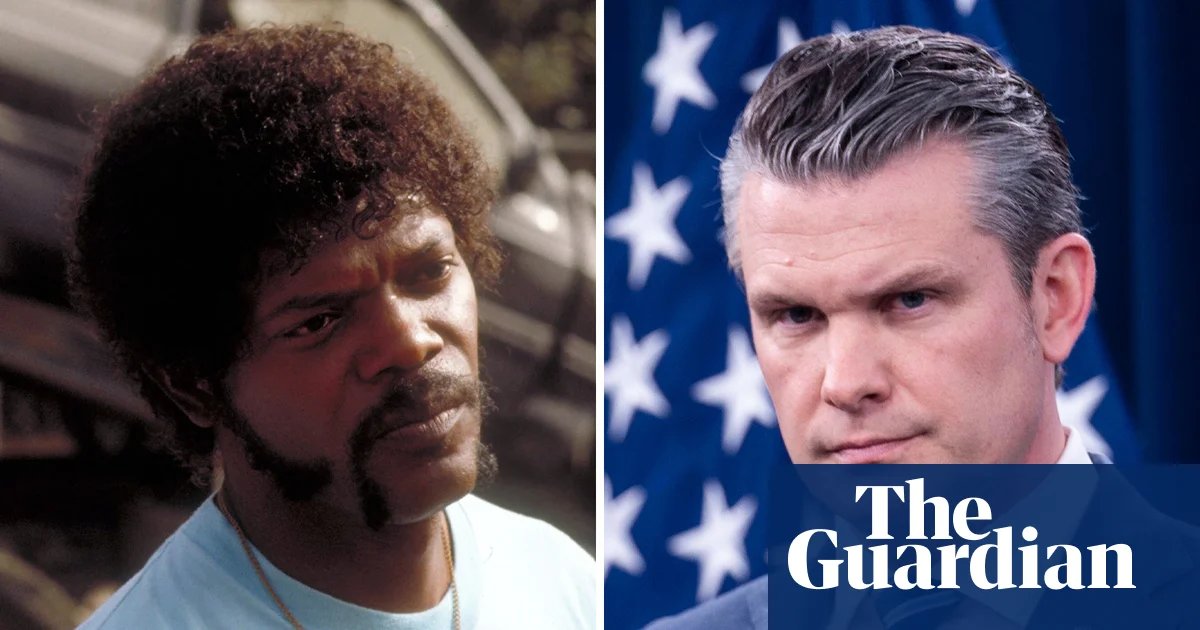
It was perhaps inevitable that a braggadocious Christian nationalist defense secretary elevated from his role as a weekend Fox News television host would pluck a fake Bible verse from a violent Hollywood blockbuster and present it at a Pentagon prayer session to rally the troops for the “holy war” in Iran.
Certainly among a glut of stories swirling around Pete Hegseth this week, including articles of impeachment brought against him by a group of ambitious Democratic lawmakers, the bizarre allegation that the Bible-thumping Hegseth was passing off a fire-and-brimstone script by Quentin Tarantino, an Oscar-winning director, as the word of the Lord was far too compelling to ignore.
On Wednesday, at the latest of his new series of worship services at the Pentagon to bless the Iran war effort, Hegseth stood at a podium and delivered a prayer for search and rescue crews he said was based on a Bible passage in the Old Testament book of Ezekiel.
Yet, as so often in the upside-down world that is Donald Trump’s second term of office, all was not as it seemed. The prayer Hegseth used appeared instead to be a bastardized version of a speech by actor Samuel L Jackson in the movie Pulp Fiction.
According to some accounts of the event, Hegseth acknowledged only the Bible verse on which it was loosely based, Ezekiel 25:17, instead of Jackson’s oratory from the film that it more closely resembled.
Adding to the confusion was how a Hollywood movie snippet pledging “great vengeance” and “furious rebukes” from the heavens morphed into a prayer for the safety of military search and rescue crews that Hegseth was citing.
In its own helpful analysis of the situation, Newsweek presented all three passages of text: Ezekiel 25:17; Jackson’s dialog from Tarantino’s 1994 cult black comedy; and the words spoken by Hegseth on Wednesday, which he stated were from so-called prayer CSAR 2517 (combat search and rescue), was commonplace in military circles, and was read to crews that rescued an air force colonel from an Iranian mountain this month after his fighter jet was shot down.
The shortest passage is the Bible verse: “And I will execute great vengeance upon them with furious rebukes; and they shall know that I am the Lord, when I shall lay my vengeance upon them.”
Both others are longer, more aligned to each other, and expand significantly on the original Bible text.
In Pulp Fiction, just before Jackson’s character, Jules Winnfield, executes a crooked business partner of his mob boss, he declares: “The path of the righteous man is beset on all sides by the iniquities of the selfish and the tyranny of evil men. Blessed is he who, in the name of charity and good will, shepherds the weak through the valley of darkness, for he is truly his brother’s keeper and the finder of lost children.
“And I will strike down upon thee with great vengeance and furious anger those who attempt to poison and destroy my brothers. And you will know my name is the Lord when I lay my vengeance upon you.”
Hegseth said he thought the military prayer he read “is meant to reflect Ezekiel 25:17”, and made no mention of Tarantino’s script, Jackson’s near-identical recital, or the movie role for which he received an Academy Award nomination.
“The path of the downed aviator is beset on all sides by the iniquities of the selfish and the tyranny of evil men,” he said.
“Blessed is he who, in the name of comradery and duty, shepherd the lost through the valley of darkness, for he is truly his brother’s keeper and the finder of lost children.
“And I will strike down upon thee with great vengeance and furious anger those who attempt to capture and destroy my brother. And you will know my call sign is Sandy One, when I lay my vengeance upon thee.”
The defense department did not immediately reply to an inquiry from the Guardian about the origin and content of Hegseth’s retelling.
Kingsley Wilson, a Pentagon spokesperson, did respond to earlier questions about the Democrats’ impeachment effort against Hegseth, telling multiple media outlets: “This is just another charade in an attempt to distract the American people from the major successes we have had here at the Department of War.”
Newsweek noted that the Bible passage is a condemnation of Philistines and the Cherethites, historic enemies of the Israelites, dating to the 5th century BC. Ezekiel, the Old Testament book in which it appears, focuses on a demonstrative prophet of the same name who engages in street theater to attract the attention of crowds to deliver his message.
In a Thursday morning press briefing on the progress of the Iran war, Hegseth, also skilled in performing to the masses from his days as a television host, again invoked the Bible in likening the media to Pharisees, a New Testament-era population often in conflict with Jesus Christ and his teachings.
“As the passage ends, the Pharisees went out and immediately held counsel against him, how to destroy him,” Hegseth said, recalling a sermon he heard last weekend.
“I sat there in church and I thought: ‘Our press are just like these Pharisees. The hardened hearts of our press are calibrated only to impugn.’”
The defense secretary has loudly and repeatedly condemned the press for its reporting of the Iran war, and skepticism of Trump administration pronouncements from the White House and Pentagon that the ongoing six-week war is already won, and that Iran’s leaders were “begging for a deal” to end it, despite denials from Tehran.
Alluding to the media’s perceived “constant negativity”, Hegseth said: “Sometimes it’s hard to figure out what side some of you are actually on.”