dailynewsnblog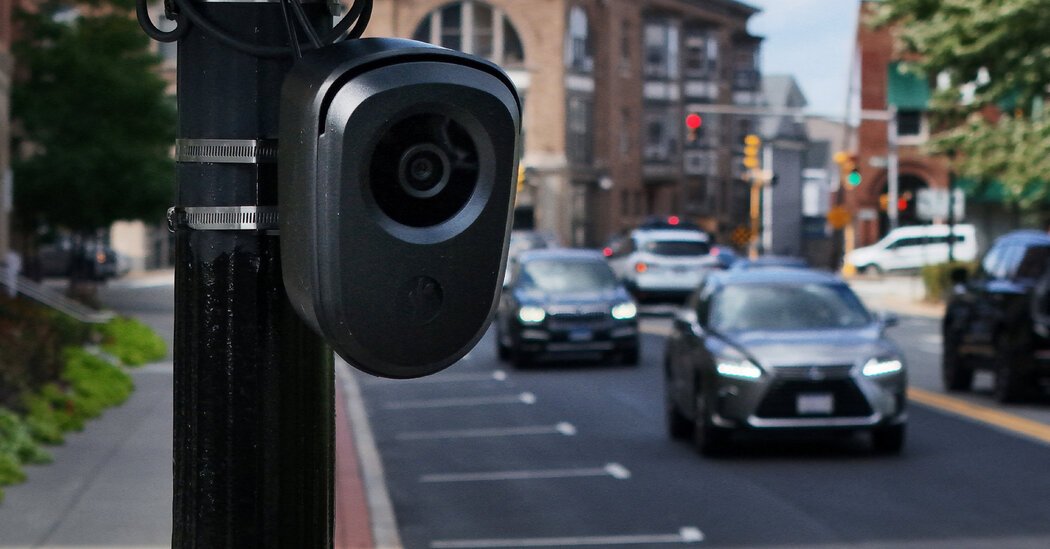
It was approaching 1 a.m. on Aug. 20 when a man emerged from the darkness by the side of a well-traveled road in a northeast suburb of Orlando.
He was wearing a mask and carrying pruning shears, according to the police in Oviedo, Fla., who said they were waiting there and watching as the man batted down something resembling a Flock camera before smashing it from a pole.
The target of the man’s vigilantism turned out to be a plastic reproduction of one of the ubiquitous and intensely debated cameras that read license plates, made by a police officer on a 3-D printer, the authorities said.
This decoy was one of several the police said were intended to “bait” would-be vandals after several of Oviedo’s Flock cameras were stolen in recent weeks, a continuation of a public backlash against the devices nationwide.
Now, the man, Evan Meyer, 24, of Oviedo, is facing three felony charges in a novel case that has drawn scrutiny to the tactics of the police who put up the decoys, and to the city’s use of automated license plate readers or A.L.P.R.s.
While being questioned by the police about the damage, Mr. Meyer said he was uncomfortable that two Flock cameras had been installed near his home, which is about a block from where he smashed the look-alike, according to an arrest report.
“Meyer added that the placement of the cameras make him feel like there is a ‘constant eye’ on him for no reason,” the police wrote in the arrest report.
Mr. Meyer was charged with damaging computer equipment resulting in the endangerment of human life, a first-degree felony in Florida that carries a maximum penalty of 30 years in prison if convicted. He was also charged with causing $1,000 or more of property damage, a third-degree felony; and larceny-theft of property valued between $750 and $5,000, also a third-degree felony.
As of Wednesday, Mr. Meyer, who was released on bond, did not have a lawyer and was waiting for a public defender to be appointed to him. Efforts to reach him were not immediately successful. His arraignment is scheduled for Oct. 13.
No one has been charged in connection with the string of Flock camera thefts in Oviedo; the police said they occurred between July 23 and Aug. 3. A police department spokesman said he could not discuss the missing cameras because that investigation remained open.
On the night of Aug. 19, just over 24 hours before Mr. Meyer’s arrest, officers put up the “clone style” cameras as bait, which the city’s mayor, Megan Sladek, wrote on social media last week came as a surprise and left her “speechless.” A police officer fabricated the plastic reproductions on his 3-D printer at home at no cost to the city, officials said.
In response to emailed questions on Wednesday, Mrs. Sladek defended the tactics of the police in Mr. Meyer’s arrest.
“To meet the legal definition of entrapment, the police have to attempt to trick someone into breaking the law,” Mrs. Sladek said. “In this situation, the person who was observed vandalizing the decoy camera had had zero contact with law enforcement prior to when he made the independent decision to take down the city-owned property.”
Mrs. Sladek added: “If you think about the decoy as a piece of art instead of a controversial A.L.P.R., it’s easier to see how this is not entrapment.”
Thousands of law enforcement agencies across the United States have embraced the use of the license plate readers.
The most prominent supplier is Flock Safety, a private company in Atlanta, which did not respond to a request for comment on Wednesday about the decoy camera vandalism and earlier thefts in Oviedo.
Proponents of the technology have said that it provides critical evidence in missing-person cases and tracks people involved in violent crimes. They credit the tool as helping identify and apprehend Ryan W. Routh, who was sentenced to life in prison for the attempted assassination of Donald J. Trump, then a presidential candidate again, at one of his Florida golf courses in 2024.
But the proliferation of the little black cameras on roadsides has created a fierce backlash. Critics call the devices Orwellian overreach that invites misuse of the information collected by federal agencies for immigration sweeps, and by rogue law enforcement officers for snooping.
That opposition has spawned groups like DeFlock, which seeks to raise awareness about the cameras and map their locations.
At a news conference on Wednesday in Miami for an unrelated announcement, Gov. Ron DeSantis of Florida sounded an alarm over privacy issues surrounding Flock cameras when he was asked about them.
“I think these cameras, the license plate readers — I think it’s out of control,” Mr. DeSantis said.
While he said he supported law enforcement officers’ having investigative tools available to hold criminals accountable, Mr. DeSantis pointed out how Flock cameras have been abused.
“When I see like a police officer using this to track, like, an ex-girlfriend, I’m like, you know, what the hell is going on with this?” Mr. DeSantis said.
He added: “I think people are right to be concerned.”
Cities large and small have debated the use of Flock cameras, with some choosing to turn them off and some even resorting to covering them up with plastic bags.
Oviedo, which is about 18 miles northeast of Orlando, is grappling with similar issues over the future of its cameras.
“I voted NOT to install the Flock cameras in the first place and recent events have not made me more inclined to want to keep them up,” Mayor Sladek said on Wednesday via email.
Three days before the decoy camera was destroyed, the City Council instructed its staff to begin drafting a resolution to end the use of Flock cameras in Oviedo, Mrs. Sladek said. A vote on that resolution is scheduled for Sept. 10.
“Remarkably, the vandal was caught not because of Flock cameras, but because of actual human police officers doing their job the old-school way,” she said.