dailynewsnblog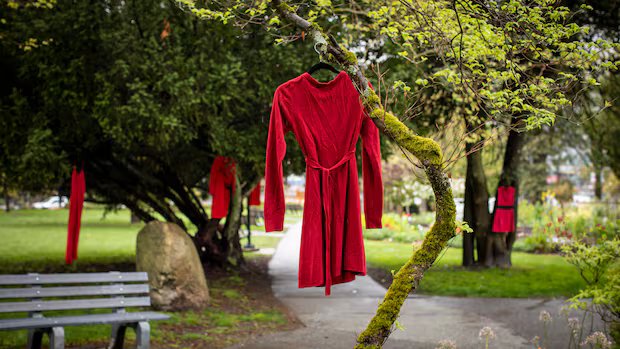
May 5 marks Red Dress Day across Canada, a day to both remember missing and murdered Indigenous women, girls and two-spirit people and to take action to raise awareness and, ultimately, make a change.
A report from Statistics Canada in 2023 found that between 2009 and 2021, Indigenous women and girls were six times more likely than non-Indigenous women and girls to be murdered.
It also found that police were less likely to recommend a first-degree murder charge — about 27 per cent of the time — if the victim was Indigenous, compared to non-Indigenous victims — about 54 per cent of the time.
According to the Assembly of First Nations, Indigenous women make up 4.3 per cent of Canada’s population, yet they account for 16 per cent of female murder victims and 11 per cent of missing women.
But Red River Métis artist Jaime Black-Morsette didn’t need those stats to know what was going on.
“There were families looking for their loved ones, spending their last $20 putting out posters,” she told CBC’s The Early Edition.
“And the tragedies just kept continuing and continuing and it seemed like nobody was paying attention.”
That’s why she was inspired to use her art to make a statement; more than 15 years ago, she hung hundreds of red dresses in public places. This became the REDress Project, also known as the Red Dress Project, which evolved into a national day of awareness.

Do you know why we mark Red Dress Day on May 5? It’s a day to honour missing and murdered Indigenous women, girls and two-spirit people, or MMIWG2S+. CBC Kids News contributor Sophia Smoke breaks down the symbolism behind the red dress.
Black-Morsette spoke with CBC’s Stephen Quinn about the origins of the Red Dress movement and her continued efforts toward justice for missing and murdered Indigenous women, girls and two-spirit people across the country.
This interview has been edited for length and clarity.
The Early Edition9:57REDress Project artist reflects on national day of awareness for MMIWG2S+
Métis artist Jaime Black-Morsette talks about how her art project inspired Red Dress Day, and what work still needs to be done to protect Indigenous women, girls and two-spirit people.
Why did you choose the colour red for the dresses?
Red is a sacred colour. It’s the colour of our heart. It’s our lifeblood and it’s what connects all of us.
I’ve learned things about the colour over time and doing this work as well. Everyone kind of brings their own meaning to the colour.
We had an elder from South America come into the lodge wearing head-to-toe red. And we asked him why and he said it’s the colour of life.
Could you have imagined, Jamie, back then that this installation would inspire what it has right across the country and Red Dress Day recognized right across the country?
Not at all. I think that’s because I was thinking of it as singular. What’s really happened is I shared the project out so that the community and supporters could put up red dresses in solidarity with us. That community support and that power of the people has really been the agency and the driving force of this movement, and the use and the symbol of the red dress has grown so far and wide because we’re doing it together.
You see dresses hanging from apartment windows in the middle of the city. You see dresses hanging on posts on the outskirts of town or in farm communities. I mean, it really is everywhere.
Yeah, absolutely. I really think it speaks to the power of the people to really generate change from the ground up.

How does this land with you as an artist?
I take this very seriously. It’s a very big responsibility to carry this work. It requires a lot of healing and a lot of balance and just really thinking clearly and all the choices that I make.
I try not to get too, you know, too overly egoic about it, but it’s really exciting to see that energy generated by community and to be able to have been a spark that helped that grow.
I think my art in general, it’s almost like when you have a child, you can’t keep it to yourself. You created it, but I think in order for anything to grow organically and transform, you have to share it.
You’ve also just launched a new non-profit.
Yeah. We’ve created a board and you can find us at www.redressproject.com — so it’s redress also, which means to bring justice. We’re just working on that and looking to create programming, arts and cultural programming for Indigenous women, girls and two-spirit people. Eventually, we’re hoping to take donations to keep our non-profit running.

We’re really, really excited to be able to create spaces for healing through art, which I really think the REDress Project is evidence of, of healing through art in ways that we can use our voices and be heard in ways outside of the systems that generally we are forced to work in.
It has been seven years since those 231 calls for justice were published by the National Inquiry into Missing and Murdered Indigenous Women and Girls. Have we seen any of the systemic change that that inquiry has called for?
Last spring there was a newspaper article published that only two of the 231 calls to action have actually been implemented. So there’s very, very slow, if no movement from the structures that we’re existing in. As an artist, I see the power of the people to make the change that’s really what needs to happen and maybe grow from the ground up instead of from the top down.
What does that tell you about how seriously the federal government is taking these calls?
I think the federal government was created to favour certain people. This entire country was founded on the theft of land and the theft of culture from Indigenous people, including women, girls and two-spirit people. That unequal relationship continues today. I don’t have any fantasies that we will be saved by systems that have oppressed us for 200 years.
There has been a push in recent years to introduce a system for Indigenous women and girls that’s similar to something like an Amber Alert. A committee in Manitoba has piloted a Red Dress Alert and they’re calling on the federal government to create a national system to help find missing Indigenous women and girls. How do you feel about that and how do you feel about it being called a Red Dress Alert?
I think that’s wonderful. And I’m really excited to see that real, real practical action connected to the work that I’m doing because it’s very needed and it’s very necessary. I would absolutely support that alert going forward. Unfortunately, there’s been very slow movement on that as well. So I think that as a society, we have the agency to be able to push for these policies to go through and to call for justice and action on these policies.
Jamie, how would you like to see people marking the day today?
You can put up a red dress in your yard. You can make ceremony and connection to this work and what’s going on. You can join us on marches. You can make connections with Indigenous communities in your area and really like support in any way that you can. So that means just kind of, if you’re non-Indigenous, walking into the circle and just asking what needs to be done, what people need help with. We need all the allies we can get. So raising our voices, talking to your politicians about the Red Dress Alert, about the calls to action, what is going on with that and really taking it on yourself to remember that our voices are very powerful.