dailynewsnblog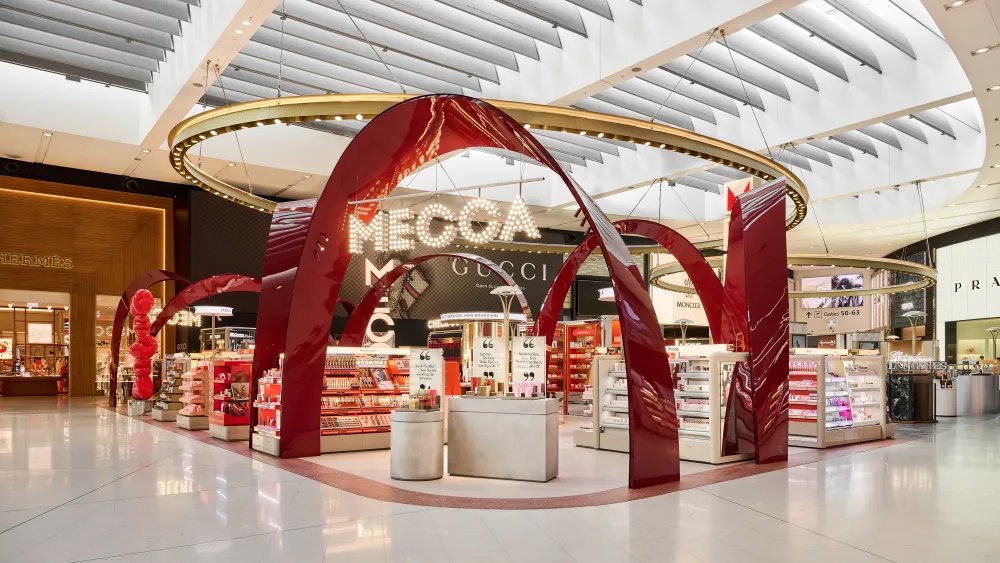
CANNES, France — The travel retail industry is grappling with major conundrums.
Topping the list is that although traveler footfall, which reached an estimated 9.8 billion passengers in 2025, has surpassed levels seen before the pandemic in 2019, individual passenger spend remains down.
“Income from activities such as food, beverage and car parking has continued to grow, but retail revenue per passenger has fallen more than 20 percent since pre-COVID,” said Sarah Branquinho, the new president of TFWA World Exhibition & Conference whose Cannes edition took place from Sept. 27 to Oct. 1, speaking during the show’s opening conference.
She explained this is due to a host of reasons, including changing passenger behaviors, shifting space allocation and digital distraction. Travel retail is no longer a price-value proposition that competes just with the high street, but also with platforms such as Amazon, Rakuten and Tmall around the globe.

The TFWA World Exhibition & Conference in Cannes.
Photo by Anne-Emmanuelle Thion/Courtesy of TFWA
“Our opportunity is not simply to welcome more passengers,” Branquinho said. “It’s to give more of those passengers a compelling reason to shop.”
She believes travel retail stands at a defining moment to reinvent and transform, but that shaping its future is about more than adapting to change — it is about giving direction, creating experiences that are more connected, sustainable and human.
That’s all needed to engage — and convert — younger consumers, who are the burgeoning demographic expected to account for about 50 percent to 60 percent of travelers by 2035. Today, they are less apt to purchase beauty in travel retail than their elders.
“Conversion is not strong,” said Mette Engell, senior vice president of global travel retail at Coty Inc. “Now, 39 percent of travelers are Gen Z and Millennials, and their conversion rate is below the average in the airport. Their main priority is the experience in terms of the purchasing.”
But there is a silver lining.
“They’re changing the rules of travel retail,” said Eva Yu, president of L’Oréal travel retail. “They don’t only want products. They want experience, to be connected, to be surprised.”
The travel retail channel, generating $76 billion overall, is always on the front line of world events. Over the past year alone, it has been buffeted by phenomena such as geopolitical uncertainty — especially in the Middle East — trade tensions, exchange-rate volatility, consumer confidence pressure, and disruption across travel and supply chains.
Still, the channel has always proven to be resilient — a veritable phoenix that keeps rising stronger and ever more creative after world-shattering events such as 9/11, the SARS outbreak and the 2008 world financial crisis.
Opportunities abound. Today, just 1.4 billion of the world’s 8.3 billion people hold a passport. Traveler numbers from emerging countries such as India keep growing. The once deep-pocketed Chinese consumers are traveling again, though more locally and shopping differently.

Carolina Herrera’s La Bomba was showcased in Madrid’s airport.
Courtesy of Puig
Fragrance and cosmetics maintains its lead among travel-retail categories, generating 36.1 percent of the total with sales of $24.5 billion last year, down 3.2 percent versus 2024, Generation Research’s numbers show.
“Travel retail can unlock growth, but only if we continue to reinvent our proposition around price, assortment and experience, while recognizing a broader mix of traveler profiles,” Branquinho said.
“We need to differentiate ourselves more in travel retail,” said Britta Hoffmann, global commercial director of beauty at Gebr. Heinemann, referring to the industry at large. “We need to give together — with our brand partners — a better reason to buy in duty free.”
Whetting Gen Z’s Appetite
Capturing Gen Z’s attention is paramount.
“That’s a challenge, because they are connected to a screen,” said Felipe Grant, Puig’s president of global travel retail. “But ultimately, they are also after experiences, just in a different way.”
To wit, Heinemann in September introduced beauty retailer Mecca in Sydney Airport. This addresses a younger consumer and elevates Heinemann’s beauty offer with a strong local brand partner, which comes with its own selection highly dedicated to beauty subcategories.
“For us it’s an opportunity to bring new brands, new assortment, but also a powerful brand within our brand to talk to consumers who might not have been buying in duty-free because they might think it’s not the right offer, it’s not exclusive enough,” Hoffmann said.
Heinemann just opened a K-beauty brand pop-up in Istanbul Airport and plans to roll that out elsewhere. This can speak to a new traveler and serve as a differentiator, too.
The young generation skews toward products that feel unique, relevant and tailored to them, which they would find only at the airport, and make their experience and journey a great memory.
“They need to consume beauty in a different way,” said Antonin Carreau, global director of beauty at Avolta. “It extends beyond the travel-retail exclusive, which is an important segment, or sets, to include limited editions, prelaunch, location-specific offers or experiences that cannot be found elsewhere.”
Avolta staged a Prada Beauty spring market, which transformed a promotion into an immersive brand experience, in Madrid airport this May, for instance. “The engagement around the brand, the appeal and interest from the consumers has proven to be exceptionally successful,” Carreau said.
Catering to a local sense of taste is another strong strategy. Heinemann recently introduced in Iceland’s Keflavic International Airport a retail concept with local design and a strong footprint of local brands.
“For beauty, more than 30 percent of the assortment is local,” Hoffmann said. “We have all the Icelandic skin care and fragrance brands. It creates a super exciting retail experience for consumers.”
Heinemann takes a similar approach in airports in Copenhagen and Jedda.
To help recruit a younger demographic, Clarins has teamed with Pop Mart to create product packaging featuring an illustrated girl character, named Molly in Paris. Next year, another character, called Twinkle Twinkle, will appear.
Seeking More Converts
One thing is for sure: “Travel is back, and it’s massive,” Yu said, citing how in 2025 there were 4 billion international passengers, higher than pre-COVID-19, and that the level is expected to reach an estimated 5 billion by 2030. “Winning the future is about how well we can satisfy the new pool of travelers happening now.”
That is not just Gen Z. The number of passengers from emerging markets continues rising. By 2029, it is expected there will be 155 million Indian travelers, 38 percent more than today, for example.
While not a new cohort, men comprise another demographic still to be won over in travel retail. Almost half of international travelers are guys, but the percentage of their spend in travel beauty is not on a par versus women’s.
Stats show travel retail stores are being mined for discovery and unforgettable memories, with 86 percent of people wanting exclusive beauty offers in the channel, according to L’Oréal. Twenty-three percent of beauty sales in travel retail is for gifting.
“How can we turn a single transaction into an unforgettable experience?” Yu asked. L’Oréal sets out to change airport waiting time into “wow time,” including curated entertainment destinations.
A Kiehl’s travel retail shop drew inspiration from the traditional New York newsstand. But here, travelers can get skin care tips, a routine tailored to their skin needs and destination, plus copies of “Kiehl’s Times” and souvenir pins. Each element can be localized.
L’Oréal Paris’ corner resembled a red-and-white casino, while SkinCeuticals’ focused on aesthetic tourism, including a board listing top worldwide destinations for various procedures.

SkinCeutical’s travel-retail concept.
Courtesy of L’Oréal
Clarins has created local animations at points-of-sale in different cities.
“As a consumer, you have the ability to keep a memory from Sydney or Singapore or New York by staging and creating a coffret or a set,” said Jonathan Zrihen, president and chief executive officer of Groupe Clarins.
The Clarins brand developed travel retail sets with boxes decorated uniquely for the city the traveler is in, highlighting moments of discovery. There are 23 in all and represent what Zrihen called “personalization at scale.”
The aim, too, is to inject some FOMO into the travel-retail experience.
“We’ve tried the beautiful exercise of a 360 brand experience, Beauty Concierge at Changi Airport,” said Alexandre Callens, Groupe Clarins’ president of global travel retail. It included a recreation of a Parisian palace.
“You haven’t taken the plane yet, but you’re already at your destination,” Zrihen said.
Broader Horizons
Many airports are undergoing major refurbishments. John F. Kennedy International scored a $19 billion investment, Riyadh King Salman International Airport’s is $30 billion, while Jeddah King Abdulaziz International Airport’s is $31 billion.
“Airport authorities realize that it’s a well-used capex to revamp,” Zrihen said. “Traffic is not the issue today for us. The idea is to try to understand how we can capture and be more relevant for most consumers going through the doors, because the reality is that they could find everything by just ordering online and getting it when they come back.”
“They’re creating far better destinations,” said Matthew Growdon, president, Asia-Pacific and travel retail worldwide at the Estée Lauder Cos., of the airport authorities. “The retailers obviously occupy that, and they look to us to then say: ‘OK, we’ve created the environment. Brands, what are you doing?’”
“The airport authority comes and realizes travel retail is not only about maximizing my operating margins from my tenants,” Callens continued. “It’s about building something greater, and we won’t succeed unless we trigger discussions with the brand.”
Meanwhile, brand strategies are evolving. One is to introduce different product price tiers in airports. Lauder, which generally focused on a high-luxury brand such as La Mer in the channel, just started rolling out The Ordinary, with an entry price point, to key travel retail partners in the Western Hemisphere.
“There’s a huge interest from it, because there’s recognition it’s very much a Gen Z brand and that the product offering has to start to match the profile that’s coming into the retail outlets,” Growdon said.
Beauty is expected to begin occupying new outposts — high-profile promotion, or HPP, locations — popping up on a rotating basis in refurbished airports.
“If you want to take that space, you need to be able to do something that’s engaging,” Growdon said.
For the launch of Jo Malone London’s Raspberry Ripple Cologne on the Chinese duty-free island Hainan, for example, there was a photo booth where a portrait could be taken then put on a postcard and sent directly from the outpost.

From Jo Malone London.
Courtesy of the Estée Lauder Cos.
Also to help generate buzz in the channel, Lauder plans to have big celebrity appearances in some airport flagship locations, as it does in domestic retail.
To highlight a sense of place, in Heathrow Terminal 5, the company is about to open the first Jo Malone souvenir store, which stocks London-themed items.
“So that’s another example of how we’re trying to create a different engagement opportunity, taking the gifting theme which this brand is famous for, and dialing it up to another level,” Growdon said.
Coty’s Engell shared excitement about how airports are becoming “lifestyle centers.”
Markus Stauss, vice president global marketing travel retail at Coty, noted bolder steps are being taken. “The retailers are super open to experimenting,” Engell agreed, adding agility is top of mind for them, as well.
For Chloé’s Atelier des Fleurs fragrances, Coty created a pop-up bouquiniste, or bookseller, concept store with Lagardère in the Geneva airport.
“There is a storytelling and that is a heritage that attracts many consumers,” Engell said. “Consumers resonate very well to joyfulness, playfulness. The launch of Marc Jacobs has absolutely been an unprecedented success.”
That was in two airports with Avolta. It attracts Gen Z, while bringing something differentiated to the category, Engell continued.
Heinemann is planning new projects in sync with airport refurbishments. Hoffmann said this is exciting, as “we can once again raise the bar, but also take the current trends, challenges and opportunities into consideration.”
In Copenhagen’s refurbished airport, Heinemann will introduce Becon technology, AI-powered personalized K-beauty tech. “It’s going to move the customer experience from just shelf time,” Hoffmann said.
Exclusivity can be the name of the game. The Boss Bottled Beyond fragrance had an avant-première in travel retail, for example. “The differentiation of two months’ launch for the local market is something that brings a lot of value for both our retailers, but ultimately for the consumers,” Engell said. “They really like that exclusivity for a whole new brand.”
Exclusives — which can include special editions or formats, plus offers for specific holidays — generate about 66 percent of Coty’s travel retail business today.
At TFWA, which drew 8,011 attendees this session, about on a par with 2024’s, Euroitalia had on display the Versace Dylan Blush Pink fragrance it launched exclusively in travel retail for six months. Davide Sgariboldi, general manager at Euroitalia, said that causes excitement.
“For every brand that we have, we will push more and more an exclusivity plan for duty-free,” he said, explaining the strategy also helps elevate product price pressure from the domestic market.
Euroitalia also showcased the relaunched Moschino fragrance brand, with two perfumes, called Pizza and Pasta. As their names suggest, one perfume bottle features an image of pizza and the other of pasta on its front.
“It’s a super-luxury product with an ironical touch,” said Sgariboldi.
Euroitalia is relaunching the Atkinsons fragrance brand in travel retail, too.
Raising the Bar
“Clients are more and more demanding,” said Valentina Colombo, managing director of Bulgari’s perfume business unit, adding that spurs “more experiential spaces, more experiences, more innovation and more differentiation among the maisons, which is a great opportunity.”
“This is how we are going back to our original DNA of a jeweler,” she said. “This is our core, and you can see it in the new retail concept.”
The prevalent color is yellow-gold, and Bulgari has shifted from taking a product-line approach in its in-store organization and imagery to an overarching brand approach. As such, the house’s fragrances are photographed in the same way no matter the price point, with the models wearing jewels.
“The new retail is more welcoming and warm,” Colombo described. “We took inspiration from our hotels.” The retail concept, which has been in test phase, will be rolled out beginning in the fourth quarter.
Technology, including AI, is playing an increasingly important role in better understanding travelers, reducing friction and staying connected with them throughout their journeys.
“But technology should help travel retail feel more human, not less,” Branquinho said. “Our true differentiator remains that personal advice, discovery, sampling, storytelling — the things that turn attention into desire and desire into a sale. Yet, the digital and experiential work hand in hand and you have our single most powerful lever for desirability, emotional connection and conversion.”
Data helps drive insights. Through its loyalty program Club Avolta, which has more than 22 million active members and a loyalty transaction every 2.5 seconds, Avolta collects such information to understand who is traveling, what they value, how preferences might differ from one airport to the next or by routes, traveler segment, nationalities or age, in order to accommodate its proposition.
“It’s not one size fits all,” Carreau said. “Of course, we’re working on the opportunity to create an even more connected beauty journey, linking the inspiration, the convenience and the personalized engagement in-store across every stage of travel. This engagement is critical for us to grow the category performance and recruit.”
In four terminals of Heathrow, Avolta launched the Redefine Your Beauty campaign. “It’s a combination of skin care consultation, express treatments, fragrance discovery, some interactive brand activations and exclusive offers encouraging travelers to explore new products and experiences,” Carreau said. “It’s proven to be extremely successful in terms of commercial performance and recruitment.”
Heinemann uses AI support to improve customers’ overall journeys, as well. Its Heinemann x Me loyalty program uses the technology to give personalized product recommendations upfront.
“The digital engagement in store becomes more important,” Hoffmann said. So the operator uses Lift and Learn digital technology to educate on product and help create a seamless consumer journey.
“But most importantly, it’s also to create experiences, because that’s what consumers are expecting,” Hoffmann said.
Category-wise, the main growth in travel retail comes from niche products and lower-priced products, including travel sizes in most of the regions, according to Philippe Benacin, chairman and CEO of Interparfums SA, and Yaël Blassin, international travel retail director at the group.
“Which means that the retailers grant more space to these two categories, reducing the [allocation to the] core business,” Blassin said. “Luckily, in Interparfums’ portfolio we have brands in each of these three segments, which allows us to adapt ourselves.”

Avolta’s Haute Parfumerie concept in Edinburgh Airport.
Courtesy of Avolta
Fragrance remains an underpenetrated category in a country like China, both in travel retail and the domestic markets, for Puig and other companies.
“Niche fragrances talk to consumers differently,” Grant said. “Its consumers are not shopping it as a product.” Instead, for them it is an experience.
“We see this trend going up,” he explained, adding there is huge potential for fragrances in China as the consumer is changing, including being way more informed.
Puig — which gained 0.9 percentage points of value market share in travel retail worldwide in first-half 2026 — first opened in Hainan in 2021. Grant noted that it’s been a good way to connect, engage and learn about consumers there in order to be relevant to them.
“The Chinese consumer is back to traveling to the levels prior to the pandemic, but they are not shopping or traveling to the same places as they used to,” Grant said.
It’s key to keep a finger on the pulse of everyone.
“We have to understand each nationality, each culture, relevance, habit, sense of place, and develop it toward wherever this consumer is traveling, not necessarily depending on the geographies anymore,” Grant said.
Cross-category retailing can up the experiential quotient for beauty in travel retail stores. Today, that primarily involves a mix with sunglasses. Avolta, for one, has used the strategy with brands such as Chanel and Tom Ford. “It’s proving to get very good reception from consumers,” Carreau said.
Despite the current challenges, executives remain bullish on the channel.
“I am resolutely optimistic about the way forward for travel retail, not just because passenger growth will carry us there, but because the fundamentals are sound and the opportunity is extraordinary,” Branquinho said. “Our task is not simply to protect the travel retail we inherited. It’s to shape a travel-retail proposition that the next generation of travelers will actively choose.”
“It’s not even travel retail anymore — it’s travel experience,” Zrihen said.
“The future is bright,” Engell said.