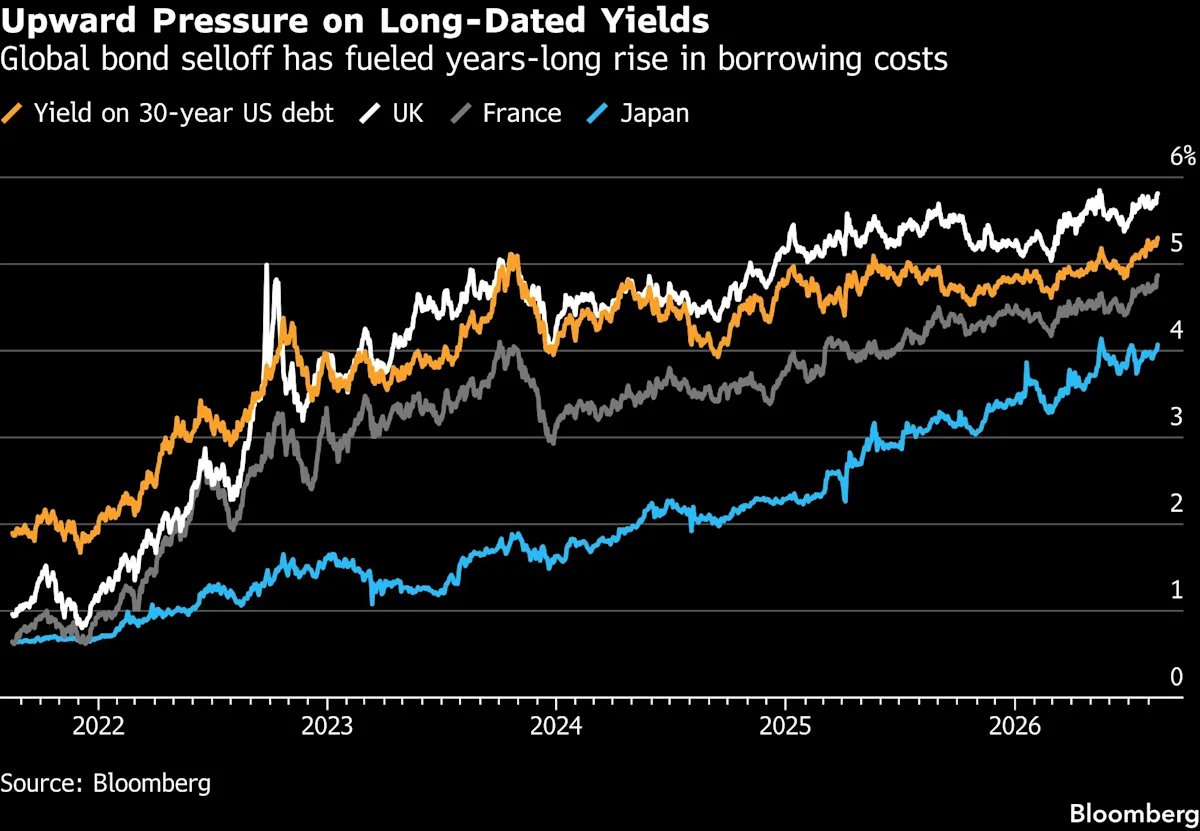
(Bloomberg) — Longer-maturity bonds are at the epicenter of investor angst about everything from inflation to the debt-laden artificial-intelligence boom — and governments are paying the price.
Most Read from Bloomberg
Almost everywhere you look, sovereign borrowing rates are surging. This week, the yield on 30-year US Treasuries rose to the highest since 2007, French borrowing costs hit the loftiest since 2008, and their German peers traded at 2011 levels. In the UK, equivalent gilt yields are approaching 6%, while similar-maturity Japanese ones are close to their all-time high.
While domestic factors have a role in each market, the structural forces driving up yields are global in nature.
There’s the fear an increasingly divided world order will make economies more prone to supply shocks and persistent inflationary pressures. Then there are bondholder worries that governments will fail to rein in spending, stimulating the economy and keeping interest rates higher for longer. Meanwhile, changes in market structure and demographics are resulting in waning demand from once-steady buyers.
It’s a maelstrom for finance ministers, many of whom are shifting their debt-issuance toward shorter tenors where yields are lower. There’s only so much room for maneuver, though, as they adjust to a world where they can no longer lock in financing costs for decades at rock-bottom rates.
“It is hard to know what level of yield would make the outlook for total returns from long duration fixed income better,” said Chris Iggo, chief investment officer at AXA IM Core at BNP Paribas Asset Management. “The only thing which might change that is a sudden weakening in economic data or some kind of external shock. The latter appears more likely than the former.”
Global debt markets have been battered this year by surging energy prices caused by the conflict in the Middle East, which has fueled bets the Federal Reserve and other central banks will tighten monetary policy. But the challenge for fixed-income investors predates that, and recent price action suggests something else is driving long-dated yields higher.
US 30-year yields have climbed almost 40 basis points since the end of June to touch 5.32% on Tuesday, the highest level since mid-2007. That’s a headache for President Donald Trump and Treasury Secretary Scott Bessent ahead of midterm elections, with lofty government financing costs feeding through into corporate and consumer loans.
“November’s elections could bring forth more policy risk and will certainly focus market attention on fiscal matters ahead of the usual budget season,” AXA’s Iggo said. “Ideally, one would not want to be going into an important election period with mortgage rates rising, even if they remain lower than they were in 2023.”
The US Treasury market is just one part of the story. The average yield on a benchmark portfolio of investment-grade government bonds has surged to almost 4.5%, the highest in data compiled by Bloomberg going back to 2015.
One element acting as a headwind for longer-maturity government debt globally is competition from corporate borrowers. A record pace of bond issuance has added substantial duration supply to US fixed-income markets, especially as tech firms looking to finance AI investment seek to borrow at longer maturities.
These US firms are increasingly tapping overseas bond markets, with one example being Alphabet Inc.’s decision to market a debut Australian dollar debt issue of A$5 billion ($3.6 billion).
The supply challenge comes just as the buyer base is shifting. Traditionally, many bond markets were supported by demand for long-dated assets from the likes of pension funds seeking to match such securities against their liabilities. Nowadays, many providers are moving away from defined-benefit systems, while regulations are encouraging funds to invest more in stocks.
More broadly, as government bond issuance ramped up, nations have leaned more on private investors.
Minutes from the Fed’s June policy meeting show officials were briefed on how ownership of Treasuries was shifting from “relatively price-insensitive official-sector holders to more price-sensitive private investors,” which could impact the term premium — or the extra yield investors demand to hold longer-dated debt.
“Official demand is driven largely by policy objectives” while “private investors are more return-sensitive,” said Anshul Pradhan, head of US rates strategy at Barclays Plc. This change in buyers over the last decade is responsible for about 90 basis points of the term premium on 30-year US Treasuries, he said.
In Japan, outright yield levels remain below their peers but their recent increase has been relentless.
The nation’s relatively steep yield curve reflects speculation that the Bank of Japan has been too slow to raise rates to tame inflationary pressures. That’s on top of other concerns including the central bank’s decision to wind down its bond-buying program, and fears over increased government spending and elevated energy costs.
“The prospect of rising imported energy inflation and mounting pressure for the BOJ to tighten provides little incentive to step in and buy JGBs,” said Prashant Newnaha, a senior Asia-Pacific rates strategist at TD Securities in Singapore. “Japan was meant to be the anchor for global rates, and the risk that JGB yields move higher raises the risk that global duration reprices.”
While concern over price pressure has driven much of the bond selloff, long-dated break-even rates — which measure market expectations for future inflation — have remained relatively well anchored in most major markets. Instead, the rise in borrowing costs has been driven by so-called real yields, or the extra compensation investors demand on top of inflation to hold bonds.
This repricing offers a potentially attractive entry-point for fresh cash, according to Kelsey Berro, a portfolio manager at JPMorgan Asset Management.
“Where we have seen more value created and that we like a little bit better would be the long end, particularly in real yields,” she said. “We do believe ultimately correlations would be supportive for the portfolio if you were to see a little bit more of a wobble in risk assets.”
–With assistance from Cameron Fozi, Ye Xie and Masaki Kondo.
Most Read from Bloomberg Businessweek
©2026 Bloomberg L.P.


 dailynewsnblog