dailynewsnblog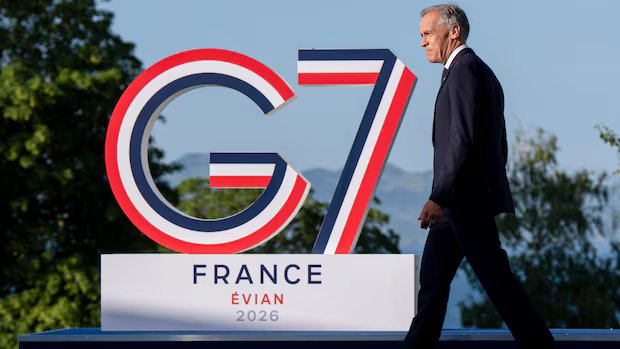

Listen to this article
Estimated 5 minutes
The audio version of this article is generated by AI-based technology. Mispronunciations can occur. We are working with our partners to continually review and improve the results.
Canada is poised to become a key and reliable supplier of energy to the G7 after leaders meeting in France embraced this country’s potential to deliver “significant additional capacity” to global markets to reduce dependence on oil and gas coming through the Strait of Hormuz.
“We commit to accelerate the diversification of energy supply routes in order to reduce global vulnerability to the Strait of Hormuz and to increase our energy stocks,” said a joint statement by G7 leaders in Évian-les-Bains, France, on Wednesday.
“We welcome the potential for Canada to deliver significant additional capacity to global markets in the coming years.”
Prime Minister Mark Carney also announced new partnerships on critical minerals that his office said “will unlock more than $5 billion in capital investment for projects across the Canadian critical minerals value chain.”

Prime Minister Mark Carney was asked about a G7 leaders’ statement that said Canada can contribute significant energy capacity to the world amid uncertainty in the Middle East. Canada’s energy capacity ‘is quite substantial and it’s important to our European partners, it’s important to our Asian partners,’ Carney said.
In his closing news conference, Carney said it’s critical for the global economy to diversify its energy supply routes away from the choke point at the Strait of Hormuz.
“One of the points that I made in the room, in our discussions around Iran and geopolitics was: we have to apply the lessons of recent events,” he said.
Before the war, about 20 per cent of the world’s crude oil was shipped from states in the Persian Gulf, through the Strait of Hormuz and into the Gulf of Oman before fanning out to countries around the globe.
Iranian attacks on ships carrying energy through the Strait of Hormuz essentially closed the access point to the Persian Gulf, halting most shipments of oil and driving up global energy prices.
The road to more energy
Carney said that Canada is already “on the path” to increasing its energy production, with several major liquefied natural gas projects underway.
Combined with increasing the output of the TMX oil pipeline, and the potential of two additional pipelines being built from Western Canada — one going to the U.S. and another to the West Coast — Carney said Canada’s potential to produce energy has been noticed.

CBC’s senior business correspondent Peter Armstrong breaks down why — even when the Strait of Hormuz is open again — getting markets back to pre-war levels is going to be a mammoth task.
“It’s quite substantial and it’s important to our European partners. It’s important to our Asian partners,” Carney said. “It was raised with me on a number of bilaterals as well.”
The prime minister said that beyond energy from Western Canada, there are “other alternatives in the east” to help diversify the G7 energy supply away from the Persian Gulf.
Critical minerals
The G7 leaders issued joint statements on a number of other issues where they found common ground pledging to work together on: growth, the wars in Ukraine and the Middle East, drug trafficking, smuggling, online safety, the Ebola outbreak, cancer research and other areas.
One of those statements focused on how G7 countries can work together on critical mineral production in order to significantly reduce the group’s dependency “on a single supplier outside the G7” by the end of the year.
Building on the Critical Minerals Production Alliance, set up when Canada hosted the G7 in 2025, the leaders said Wednesday that they’d work together to “develop the necessary processing and industrial capacities for diversification of our critical minerals value chains.”
A separate statement from the Prime Minister’s Office (PMO) said that Canada “welcomed 13 new partnerships and initiatives with more than eight countries” at the summit.
That comes off the back of 26 critical mineral partnerships with nine countries that were announced during a G7 energy and environment meeting in Toronto in October.
These new partners, the PMO said, will work within the alliance to “reduce market concentration, and create a reliable buyers’ club that can attract investment and accelerate production for projects.”
These new deals include an agreement with RCT Solutions, a German company that will partner with Canada’s Sio Silica and others on a high-purity silica project and solar manufacturing hub in Manitoba.
Some of the other countries that struck critical mineral deals with Canada at the summit in France include: Japan, Italy, Denmark, the Netherlands, France and Portugal.
“At the G7 leaders’ summit in Évian, we secured new partnerships to build energy projects in Canada, new agreements to make it easier for our businesses to sell abroad and new deals to equip our Canadian Armed Forces with the hardware they need,” Carney said.
Canada not ready, Conservative MP says
Ellis Ross, the MP for the B.C. riding of Skeena-Bulkley Valley, which includes parts of the province’s Pacific coast that is home to a number of LNG facilities, said Canada’s permitting process for new energy projects is convoluted and will frustrate the Liberal government’s attempts to increase oil and gas production significantly.
“They can’t do it,” he said. “They can’t even figure out what their fast-tracking process is going to look like.”
Ross says there are significant questions that remain unanswered when it comes to approving new projects, including how consultation with Indigenous communities will be carried out, and who will be responsible for the issuing of permits.
“What they say on the international stage is different in terms of what they’re struggling with back home here in Canada,” Ross said.